MVMMS Tech Ed

Design Brief-MagLev Trains

Problem

Challenge

Specs

Work list

Research

Grading


The Problem
The Greater Boston area has traffic congestion problems. Many experts believe that the best way to solve them is to design new transportation systems. One approach is to develop "MAGLEV" vehicles which float over a fixed track, supported (levitated) and driven by magnetic fields. This is like flying, with lift provided by magnets instead of wings. So, while barely leaving the ground, a MAGLEV vehicle might be able to go as fast as an airplane. 

In this contest, you will learn about MAGLEV technology and use math, science, and technology principles to optimize the design of a MAGLEV vehicle.

Your problem is to design and build a self-propelled working model of a Maglev train that holds the most "passengers" for the lowest cost. 

Your maglev can be run by an electric motor powered by your 9v battery or the electrified rails along the track. The motor will turn a propeller which will push the train. 

top


The Challenge

A REAL MAGLEV MUST MEET SEVERAL CRITERIA AT ONCE:

  • It should go as fast as possible. The faster you make trips between any two points, the faster you collect fares - that is, make money.

  • It should carry as many passengers as possible. Since each passenger pays a fare, the more passengers you carry per trip, the more money you make.

  •  It should be as cheap as possible. The cheaper the vehicle, the fewer trips will be needed for you to pay back the vehicle's cost and start making a profit. If the vehicle is too expensive, the number of trips you would need to pay it off may even turn out to be greater than the number of trips it can actually make before it wears out. So, you'd never even get your money back, let alone make a profit.

  • Other factors also enter, such as operating and maintenance costs, how long the vehicle actually lasts, the route chosen, the number of people who might want to travel this route, reliability, public confidence and availability of financial support, etc.. However, to keep things simple while illustrating basic engineering principles, in the MAGLEV contest we confine ourselves to speed, number of passengers, and cost.

FOM

  1. The ability of a MAGLEV train to be cost-effective is a key feature.  To be cost-effective you want to carry as many people as possible, as cheaply as possible.  However, adding passengers may slow the vehicle or require a costlier magnetic suspension, etc.  To deal with these design tradeoffs, an engineering Figure Of Merit (FOM) may be used to determine the best design.  The higher the FOM is, the better the design in terms of cost-effectiveness.  
  2. Your team's challenge is to build a model MAGLEV vehicle which has the most cost-effective combination of speed, passenger capacity, and cost as signified by the highest FOM.

Figure of Merit formula

For cost effectiveness, the higher the FOM, the better the design.

To calculate the FOM, the following variables will be used:

  • Passengers: are represented by number of pennies (P) carried by the vehicle
  • Cost: is represented by number of magnets (N) used to levitate the vehicle.
  • Speed: is measured as distance (D) divided by time (T). D is the distance between two points on the standard test track (in feet). T is the measured time (in seconds) the vehicle takes to travel between the two points.

The number of pennies carried (P) and the number of magnets used (N) are up to the designer (6 maximum). All vehicles will be timed over test tracks with D=12 feet. 

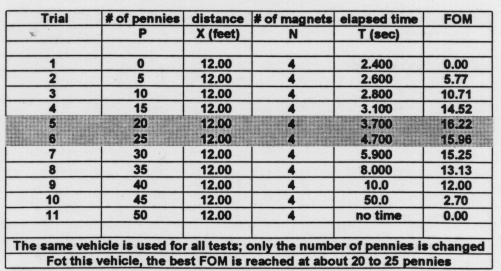
Individual FOMs are then calculated from the number of pennies, magnets, and the elapsed time for each vehicle.

The FOM is used in step 6- testing & modifying on the Design Process Problem Worksheet

top


Specifications

Test Track 
All tracks used in the competition are 16 feet in length, having two parallel lines of 1 inch long by 3/4 inch wide ceramic magnets.  The two lines are spaced 1 inch apart, forming a magnetic track 2 1/2 inches wide. Sides are 1 inch aluminum angles, spaced 2 9/16 inches apart and centered on the magnetic track. 

The side rails of the track can be energized with a 2 amp 12 volt direct current (DC) power supply, this can be used to take the place of a battery to  power a motor.

Trains
Train suspension must be 100% magnetic levitation. Trains must be 16 inches or less in length. There is no height restriction. Magnetic polarity and vehicle width must be compatible with track specifications. Trains must carry pennies in such a way that they can be seen individually or easily removed for counting.

Restrictions

  1. Trains may not use any of the following:
    • Sling Shot Propulsion
    • CO2 Cartridges
    • Compressed Air*
    • Rocket Engines
    • Flammable Fuel 
    • Model Airplane Engines
    • Explosive or Pyrotechnic Devices
    • Open Flame or other forms of combustion

      Note: Use of a balloon shall not be construed as compressed air
  2. The train must operate without being pushed, touched, or otherwise interfered with once in place at the starting position of the track.
  3. Any materials hazardous to human health may not be used.
  4. Any design determined by the judges or contest coordinators to be hazardous or unsafe may not be used.
  5. You may use 1- 9v electric motor with a 3" propeller. The motor may be powered by your 9v battery, or it can be run by the power from the electrified guide rails (2 amp, 12 volt).
  6. Trains must carry pennies in such a way that they can be seen individually or easily removed for counting.
  7. You may use up to 6 magnets supplied by the teacher. A good design should rely on each magnet to lift approx. 15 grams of the total vehicle weight. Each magnet weighs about 9 grams. Motors weigh about 40 grams.

Design/ Building Hints:

1. Guidance is best achieved if the magnets, not the vehicle body, rub against the track rails. The body can be much narrower than the track if the magnets stick out on each side for guidance. 

2. Usually, the higher the vehicle levitates, the better it performs.

3. The load (weight) should be distributed evenly. Vehicles that ride level do very well.

4. Aerodynamics of the vehicle body affects performance very little. However, since you are constructing models of actual maglev vehicles, you should consider aerodynamics when designing your vehicle body.

5. Decorations can and should be added to your vehicle. Most spray paints will dissolve styrofoam but you can use permanent marker, latex paint, or stickers.


top


Work list:
  1. Select a team, brainstorm a name.
  2. Read and understand the Design Brief.
  3. Read and understand the DPPW
  4. Make a team folder in the Stuff folder.  copy (save as) the DPPW on the desktop and place in your folder. fill out the top area and step 1- Problem.
  5. Start your Research- step 2. This involves understanding the theory of Maglev trains.
  6. Step 3- Solutions- Each team will draw 6 thumbnail sketches,  these should include train shape, propulsion, passenger areas, and placement of magnets. Record the ideas you come up with for these design areas in your DPPW.  View some sample cars here, these examples are not maglev trains, they have no passenger areas.
  7. Include these good design parts in your step 4- Best Solution drawing.  Use graph paper and draw an accurate full size drawing.  Include the design areas.  Be neat, your Maglev Prototype should look very similar to your drawing. Pass in your drawing.
  8. Build your Prototype- step 5.  Make sure it conforms to the activity specs.
  9. Once your prototype is built, test it with "passengers".  Start figuring out your FOM.  Fill out step 6- Testing & Modifications, list any changes you made to your final solution.
  10. When satisfied with your design, test out your Maglev train.  Run it at least 5 times down the track, with a different number of passengers aboard. Fill out a test table, and find your FOM. Include your FOM/ Test Table in step 6.


  11.  Lastly, record any changes you would make for the better, or figure out     why your design did not work.  List these in step 8- Re-Design.

   12. skip step 7- communicate.  Take the end of activity Quiz. You may use your "Inspiration" outline for help in answering the questions.

top


Research
  1. Start your Research- step 2.  This involves Understanding the Theory of Maglev trains. Simply go to :

Follow the pages:   

  • Introduction to How Maglev Trains Will Work

  • How Electromagnetic Propulsion Works

  • Maglev Trains In Development

Research these pages to create an "Inspiration" web outline.  This can be used during your end of activity Maglev quiz. Print and pass in your "Research".

The "Inspiration" program is found in Start/ Programs/ Inspiration k-12.  Be sure to save in your stuff folder.

top


Grading


5

3

1

DPPW complete & neat messy, missing 1 or 2 items missing more than 2 items
Maglev train works, tested works, not tested DNW
Research completed, good content lacks good content on subject not completed
Quiz 80% or higher 70-79% below 70%
Cooperation helps the team in all ways helps out and works 70% of time works less than 70 % of time

A 21-25    B 17-20  C 14-16   D 10-13   F 0-9

5 point extras-   Highest FOM  -   Best Design  -  Fastest

top

1


Hosted by www.Geocities.ws

1