Cosmic Encounter
Rules
The
Legend
 Some called
them The Ancient Ones. Others referred to them as Guardians. They called themselves, simply, elders. For eons the elders
had watched the cosmos evolve. They saw matter, popping into existence, unevenly
coalescing into gases and condensing into gravitational anomalies. And,
everywhere, they saw signs of fledgling life.
Some called
them The Ancient Ones. Others referred to them as Guardians. They called themselves, simply, elders. For eons the elders
had watched the cosmos evolve. They saw matter, popping into existence, unevenly
coalescing into gases and condensing into gravitational anomalies. And,
everywhere, they saw signs of fledgling life.
As these alien beings evolved, absorbed in their own
accomplishments. each believed itself unique. The elders, however, studied them all, watching them
develop and extend their control over nearby parts of the cosmos. The elders watched with particular care, knowing that their
own evolution was taking them beyond this universe. They knew that one of these
new forms of intelligent being must be selected to replace them.
The new Guardians must be able to spread their colonies
widely throughout the universe. To do this they must know how to wield power,
but also how ~o use diplomacy. They must conserve resources by attracting
support, but be able to act alone when necessary. To find the alien life form
most capable of this leadership, the elders devised
a plan. They shared knowledge that the Universe contained many alien life forms.
They provided technology so each alien life form could spread out over
interstellar distances and colonize new worlds. Lastly, they made available a
variety of Artifacts featuring effects that could be used by those clever enough
to recognize an opportunity to help themselves in a rapidly deteriorating
situation.
Thus prepared, multitudes of alien life forms were turned
loose to seek their destiny, alone or in combination, among the worlds of the
Cosmos. With each alien firmly convinced that they alone were destined to guide
the future of the Universe, the age of Cosmic Encounter had begun.
Goal
In Cosmic Encounter, you play the leader of a colonization
effort whose ships are traveling throughout the Cosmos to prove their worthiness
for Cosmic leadership. You will use force, cunning, and diplomacy to win success
for your unique form of alien intelligence. This game is best played with three
or four players. The two-player version is very strategic, but omits the
alliances found in the three- and four-player games. The winner(s) will be the first player(s)
to have FIVE COLONIES on any planets outside his or her home system.
Equipment
Planet Systems: There are 4 Planet
Systems. Each is a different color and shows five planets.
The Warp: This is
the saw-toothed center of the gameboard where defeated ships go to wait to be
freed.
Ships: 80 ships, 20 of each color.
Orders: 12 cardboard discs.
Card Deck: 54 cards including 46
Encounter cards (Attack or Negotiate) and 8 Artifact cards.
Alien Cards: 20 cards, each
illustrating an Alien Being and describing its unique power.
Mothership: The large craft that
moves, colonizing ships between planet systems.
Carriers: 4
defender craft, one in each color to match the four different players.
Alien Card Holders: 4 holders for Alien
Cards.
Game
Preparation
Systems: The Warp is placed on the center of the playing space.
Each player selects a Planet System and fits it to the Warp, forming the
gameboard.
Establish Hone Colonies: Take the twenty ships
of your System's color and place 4 of them on each of your planets, forming 5
colonies. These are your home colonies.
Carrier: Place your Carrier next to your planet system.
Orders: Take all the discs of the colors that are in the game. Mix
them together. Randomly turn one over. Note its color (it determines which
player will go first). Remix the pile and place in a stack next to the
gameboard. This is the Orders pile.
Alien Cards: Shuffle the Alien Cards
and place them in the box. Each player blindly draws one. Set aside the remaining
cards. Place your Alien Card in a holder with the picture facing the center of
the game and the description facing you. Read your power to all players.
The Deck: One player shuffles the deck and deals each
player seven cards face down. Players
may look at them but may not show them to other players. The remaining cards
are placed face down to one side, opposite the Orders. As cards are played they
are placed face up in a separate
discard pile.
First Player: The player whose color matched the Order
turned over (in Orders above) goes
first.
At the start of the game, each player has the following:
1 Home Planet System
4 Ships on each home planet
1 Carrier
1 Alien card
7 Cards from card deck
Overview
 Players:
2-4
Players:
2-4
Ages: 12+
Complexity Level: Moderate
You are the leader of a colonization effort You are responsible for your alien
life form's future. The object of the game is to establish colonies in other
players' planetary systems. Players will take turns trying to establish
colonies. The winner(s) will be the first player(s) to have FIVE COLONIES on
any planets outside his or her home system. You do not need to have colonies in
all systems, just colonies on five planets outside your own system. These
colonies may all be in one system or two may be on one player's system and
three in another's, etc.
On Your Turn:
You are the offensive player. You must encounter another
player (the defensive player) on a planet by moving a group of your ships in
the Mothership to that planet. Then you and the other player will play
Encounter cards face down. The combination of ships, Encounter cards, and other
effects will determine the outcome.
 You
may establish a colony on the planet; you may lose ships to the Warp; or some
other outcome may result! Remember: both players can see how many ships each
side has in the encounter, but neither side knows what card the other will play
or what other effects will be brought to bear on the outcome.
You
may establish a colony on the planet; you may lose ships to the Warp; or some
other outcome may result! Remember: both players can see how many ships each
side has in the encounter, but neither side knows what card the other will play
or what other effects will be brought to bear on the outcome.
If you lose your first encounter, your turn ends and play
passes to your left. If you complete a first successful encounter, you may
choose to have a second encounter. Your turn will then end, and play will pass
to your left.
Alliances
You will be able to make alliances with one another during an
encounter, jointly risking your ships to gain or defend a colony.
Alien Powers
You will also have an Alien Power that will give you the
advantage of breaking a specific rule of play, causing your own special brand
of mayhem in the game.
Definition:
What is a Colony?
A colony is defined as one or more ships of the same color on a
planet. Pretty simple. Well, OK, here is a further explanation. If you have one
ship on a planet, you have a colony there. If you have two ships on a planet,
you still have one colony there, but now it is composed of two ships. If you
have three...well, you get the idea.
How to Play
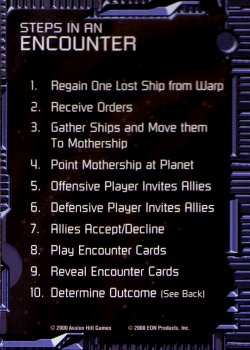 Each
encounter has 10 steps, which happen in order. You may end up performing all or
just some of these steps during an encounter. Also, your alien power may cause
a special kind of havoc with these steps. Artifact cards can also interrupt or
negate some of these steps, but use these steps as your guide.
Each
encounter has 10 steps, which happen in order. You may end up performing all or
just some of these steps during an encounter. Also, your alien power may cause
a special kind of havoc with these steps. Artifact cards can also interrupt or
negate some of these steps, but use these steps as your guide.
1. Regain One Lost Ship: Throughout the game, ships
will go to the Warp when encounters are lost. At the start of an encounter, if
you have any ships in the Warp, you may move one ship from the Warp to one of
your colonies (a home colony or other colony). If you don't have any colonies,
you may move a ship directly from the Warp to the Mothership.
2. Receive Orders: Turn over the top disc in the Orders
pile. The color of the disc indicates the planet system in which you will now
have an encounter. For example, if your color is red and you turn over a green
disc, you must have an encounter somewhere in the green system. The player who
owns the green system is the Defensive Player. If you turn over your own color
you have two options: you can draw again (until you draw another color) or you
can attempt to drive a foreign colony off of your home system, possibly
recolonizing one of your home planets. The player whose colony you point the
Mothership at is the Defensive Player. (see: Driving
A Foreign Colony from your Home System).
3. Gather Ships and Move Them to Mothership: Take 1 to
4 of your ships from any of your colonies, stack them and place them onto the
center row of the Mothership. You may take ships from your home colonies or
from colonies you have established elsewhere. You may take them all from the
same colony or you can take them from different colonies in different systems.
Be careful not to remove all ships from a colony. If you do, you no longer have
a colony on that planet because you no longer have a presence there (see:
Stripping a Planet of Ships).
4. Point Mothership at Planet: Move the Mothership and
point it at one planet in the system that you have orders to colonize. The
player who owns that planet is now the defensive player and will try to defend
the planet. The defending player can neither add nor subtract ships from his or
her planet. Note that, on a home planet, a player may have no ships there, but
still has an obligation to defend the planet.
Definition:
Main Players
During an encounter the offensive player and the defensive player are
the Main Players in the encounter. Allies are not Main Players. This term is
used on cards and Alien Power cards.
5. Offense Invites Allies: You may now invite offensive
allies to help you gain a colony. Announce which color players you wish to have
as allies. These players do not answer yet. As tempting as it is for them to
answer, they should stay quiet. Really. That�s the rule. Those players must
wait for the defensive player�s invitations (if any) before deciding whether or
not they will ally with you.
 6.
Defense Invites Allies: The defensive player may now invite defensive
allies. He or me may invite: any players who have been asked by the offensive
player, those ignored by the offensive player, a combination, or no one.
6.
Defense Invites Allies: The defensive player may now invite defensive
allies. He or me may invite: any players who have been asked by the offensive
player, those ignored by the offensive player, a combination, or no one.
7. Allies Accept/Decline: Starting with the player to
the left of the offensive player and proceeding clockwise, players accept or
decline invitations to ally. You may only ally with one of the main players.
Players allying with the offensive player place one to four ships (taken from
any of their colonies) into the side wings of the Mothership. Players allying
with the defensive player place one to four of their ships into their Carriers
and then move their Carriers in front of the defensive players' planet to help
defend it, as illustrated in the example on page 14. Players may choose not to
airy. Only after a player has allied with a side (if at all) and after he or
she has committed ships does the next player accept or decline an invitation.
8. Play Encounter Cards: After alliances have been
formed, the offensive player and the defensive player each choose an Encounter
card (Attack or Negotiate) from their respective hands and place them face
down.
 9.
Reveal Encounter Cards: Encounter cards are turned face up
simultaneously. Or as close to simultaneously as possible in this imperfect
universe.
9.
Reveal Encounter Cards: Encounter cards are turned face up
simultaneously. Or as close to simultaneously as possible in this imperfect
universe.
When do I get to draw new cards?
Note that you do not get to draw a new card
at the end of an encounter. Or even when you run out of cards. You only draw a
new hand of seven cards when you next need to use an Encounter
card and have none. This is either at the start of your turn or when you become
the defensive player. This is all explained further on. Just remember that you
need to use all seven cards in your hand (most of the time) before you get new
ones. Look for the best situation for using any given card. The key to Close
Encounter is to find ways to make the best use of each card you have. You will
find that cards that seem weak in one situation will be winners in another.
10. Determine Outcome: There are three different
outcomes to an encounter, depending on what type of Encounter card (Attack or
Negotiate) is played by each player. After Encounter cards are revealed, the
encounter is resolved. Then Encounter cards are discarded. Details of encounter
resolution are shown below:
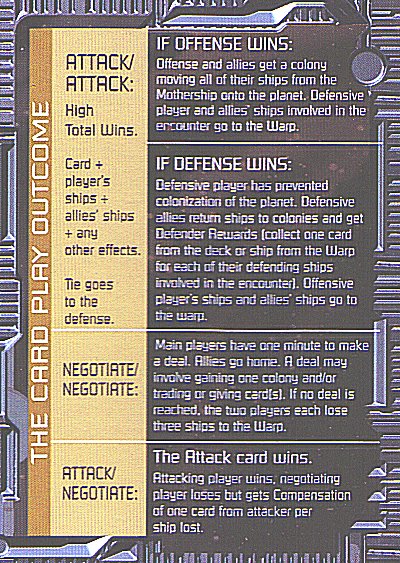 If
Both Players Play Attack Cards: each player adds the number on the card
he or she revealed to the number of ships on his or her side. If you are the
offensive player, you add your card number to the number of your ships on the
Mothership plus any allied ships on the Mothership. If you are the defensive
player, you add your card number to the number of your ships on the planet
involved in the encounter (if there are no ships there it is a O) plus the
number of ships on Carriers protecting the planet. The player with the higher
total wins, with ties going to the defender.
If
Both Players Play Attack Cards: each player adds the number on the card
he or she revealed to the number of ships on his or her side. If you are the
offensive player, you add your card number to the number of your ships on the
Mothership plus any allied ships on the Mothership. If you are the defensive
player, you add your card number to the number of your ships on the planet
involved in the encounter (if there are no ships there it is a O) plus the
number of ships on Carriers protecting the planet. The player with the higher
total wins, with ties going to the defender.
If the offensive player wins:
-
All the ships on the Mothership (both the offensive player's ships plus any
allies' ships) are placed on the planet, thus establishing (Or possibly adding
to) a colony for the offensive player and each offensive ally.
-
The defensive player's ships on the planet plus any defensive allies' ships in
Carriers go to the Warp.
-
Other ships on the planet do not go to the Warp. They were not involved in the
encounter.
-
Carriers do not go to the Warp.
If the defensive player wins:
-
The ships forming the already established colonies on the defensive planet stay
there.
-
All the ships on the Mothership (both the offensive player's plus any allies'
ships) go to the Warp.
-
Defensive allies return their allying ships to any of their colonies (even if
they are different from where they came from) and move their Carriers back to
their home systems. Defensive allies do not
get to land on the planet just defended.
-
Defensive allies also get a special bonus called Defender Rewards.
 For
each ship that you contributed to the defense, you must draw a card from the
deck or take a ship from the warp.
For
each ship that you contributed to the defense, you must draw a card from the
deck or take a ship from the warp.
Move ships from the Warp to any of
your colonies.
You may mix the options,
e.g. drawing two cards and moving two ships from the Warp (provided that you
had committed four ships to the successful defense that turn).
Example:
An Attack Encounter
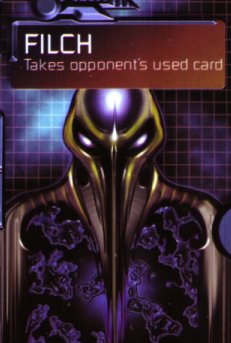
The Zombie is the offensive player and has received orders to attack
the Filch. He placed 4 ships in the Mothership and points it at the Filch's
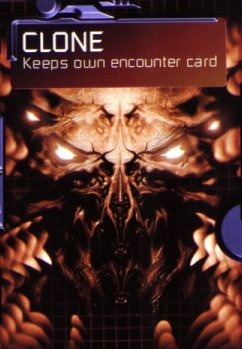
planet that contains 2 defending Filch ships. The Zombie asks both the Empath
and the Sorcerer to be offensive alies. The Filch asks only the Empath to be a
defensive ally. The Empath (to the left of the Zombie) has two offers. He
chooses to ally with the Zombie and places two ships in the Mothership
(bringing the total to 6). The Sorcerer declines to ally. Both the Zombie and
the Filch play Encounter cards face down, then reveal them. The Zombie
plays an Attack card with a value of 8. Added to the ships on his side, he has
a total attack value of 14. The Filch is defending with 2 ships but plays a 20,
bringing his total to 22. The filch wins, keeping the Zombie off the planet.
 If
Both Players Play Negotiate Cards: an attempt is being made to reach a
deal. Attacks have been put aside in favor of talk. All allies on both sides
return their ships to any of their colonies and move their Carriers back to
their home systems. They get nothing. The main players have one minute to make
a deal. At this point, you can negotiate a mutually agreeable deal or play
hardball and try to negotiate a sweet deal (for you) that your opponent can't
refuse.
If
Both Players Play Negotiate Cards: an attempt is being made to reach a
deal. Attacks have been put aside in favor of talk. All allies on both sides
return their ships to any of their colonies and move their Carriers back to
their home systems. They get nothing. The main players have one minute to make
a deal. At this point, you can negotiate a mutually agreeable deal or play
hardball and try to negotiate a sweet deal (for you) that your opponent can't
refuse.
-
Making a Deal: In a deal, you may trade cards and/or allow your opponent
to establish one colony on any one planet where you already have a
colony. In this way you both may gain a new colony and/or new cards. Any of
your ships not in the Warp can be used to establish this colony. Cards must
come from the players' hands, not from the deck. Any ships remaining in the
Mothership afterward return to any of the offensive player's colonies. Allies
are never included in a deal. If no agreement is reached within one
minute, you both lose three of your ships of your choice to the Warp. If
there is no agreement, the offensive player's turn ends.
Example:
A Negotiating Encounter
The Anti-Matter and the Clone are the Main Players in an encounter.
Both play Negotiate cards face down. When they are revealed, the players now
have one minute to reach a deal. The Clone wants a colony (he is behind in
colonies) and agrees to give the Anti-Matter his three lowest cards in return
for a colony (the Anti-Matter like low cards for reasons explained later). The
Anti-Matter agrees to this and the deal is done. The Clone gains a colony and
places 2 ships on it. The Anti-Matter gets three attack cards with values of 4,
6, and 8.
If One Player
Plays a Negotiate Card and the Other
Plays an Attack Card: if you played a Negotiate card, your side loses.
Automatically. Your ships and your allies' ships go to the Warp. However, you
now claim Compensation from your belligerent opponent. You must take at random,
from your opponent's hand, one card for each ship you lost to the Warp (not
counting your allies' they get Warped without Compensation). If your opponent
doesn't have enough cards to provide you full Compensation, you take only the
cards he or she has.
Attack Card Distribution:
|
30
|
20
|
18
|
15
|
14
|
12
|
10
|
08
|
06
|
04
|
|
1
|
2
|
1
|
2
|
2
|
4
|
6
|
8
|
8
|
2
|
Further Details and Other Refinements
 Second
Encounter: If, on your first encounter, you either win an Attack or
successfully Negotiate, and you have at least one Encounter card (Attack or
Negotiate) left in your hand, you may choose to make a second encounter. If you
choose to have a second encounter, start over at Step 1. Regain One Lost Ship
and treat the second encounter the same as the first. After your second
encounter, your turn ends no matter what the outcome. When your turn ends, the
player on your left becomes the offensive player.
Second
Encounter: If, on your first encounter, you either win an Attack or
successfully Negotiate, and you have at least one Encounter card (Attack or
Negotiate) left in your hand, you may choose to make a second encounter. If you
choose to have a second encounter, start over at Step 1. Regain One Lost Ship
and treat the second encounter the same as the first. After your second
encounter, your turn ends no matter what the outcome. When your turn ends, the
player on your left becomes the offensive player.
Playing Encounter Cards: Once both Encounter cards are
played face down, neither can be changed. Artifact cards are never played face
down in an encounter.
Orders: If you turn over your own color disc, you have
a choice. You can turn over the next disc or you can attempt to drive Foreign
Colonies from your Home System and re-establish (or strengthen) a home colony.
If there is only one disc left in the Orders pile, reshuffle it with all the
discards before turning over another disc.
Driving A Foreign Colony from Your
Home System: If you turn over your own color when receiving Orders, you
may try to eliminate a foreign colony in your home system. Perhaps that foreign
colony is threatening to win or you want to protect yourself by maintaining
three colonies in your home system so you can keep your alien power (see page
12). This type of encounter is similar to those described above, except you
point the Mothership at another player's colony in your own planet system.
Choose which player's colony you are attempting to remove from your planet.
That player becomes the defensive player for that encounter. Remember that all
ships of one color on any planet make up only one colony. All other colonies on
the planet are not involved in this encounter.
 Example:
Recolonizing a Home Planet
During the Mind's turn, she draws a blue Orders disc. Since she is the
blue player she now has the chance to attack one of her own planets in an
attempt to remove the Philanthropist from her planet. She takes four ships and
loads them into the Mothership and points it towards the planet where the
Philanthropist has one ship holding a colony. When the encounter is over the
Mind has won. She removes the Philanthropist's ship from her planet and places
her ships on the planet.
Other Colonies on a Defending Planet: Colonies on the
defensive player's planet which are not part of that home system (that is, they
are not the color of the home system) do not count towards the defensive total
and are not affected by the outcome. They are simply bystanders. When a player
is attempting to drive a foreign colony from his or her home system, only one
player's colony can be targeted to be the defensive colony in the encounter,
all others are ignored.
Home Planets without Colonies: If you have no colony on
a home planet that you are defending, you defend the planet normally except
your ship count is zero (0).
 Getting
New Cards: If you are the offensive player and have no Encounter cards
(no Attack or Negotiate cards) at the start of your turn, play (if possible) or
discard any Artifacts, draw seven new cards, and continue your turn.
Getting
New Cards: If you are the offensive player and have no Encounter cards
(no Attack or Negotiate cards) at the start of your turn, play (if possible) or
discard any Artifacts, draw seven new cards, and continue your turn.
If you run out of Encounter cards during your turn as
offensive player and you need to play one, your turn ends immediately. (This
might happen due to an Alien Power or
because of an Artifact card), or due to
paying Compensation after your first encounter. If this happens, return any
ships in the Mothership to your colonies. Allies also return their ships to any
of their colonies.
If you are the defensive player, and must play an
Encounter card, and have none, play (if possible) or discard your Artifacts,
draw seven new cards.
Example:
Drawing New Cards
During the Amoeba's second encounter on his turn, he plays his last
card. His turn is now over and he does not draw any new cards. The next player
does  not
draw the Amoeba's color from the Order pile so the Amoeba still does not draw
any cards. The next player (the Philanthropist) turns over the Order pile and
reveals the Amoeba's color. The Philanthropist attempts to use his power to
give the Amoeba a card (so that she won't get a new hand) but the Amoeba says
"Just a moment. I am now the defensive player and will draw a new hand before
taking your card", and collects her new hand.
not
draw the Amoeba's color from the Order pile so the Amoeba still does not draw
any cards. The next player (the Philanthropist) turns over the Order pile and
reveals the Amoeba's color. The Philanthropist attempts to use his power to
give the Amoeba a card (so that she won't get a new hand) but the Amoeba says
"Just a moment. I am now the defensive player and will draw a new hand before
taking your card", and collects her new hand.
Stripping a Planet of Ships: As
soon as you remove the last of your ships from a planet, whether a home planet
or not, you no longer have a colony on that planet. Any ships involved in the
encounter cannot return to that planet. Ships coming from the Warp cannot
return to that planet. You have no colony there. If you have no ships left on
one of your home planets you must still defend it (with 0 ships). If a
situation arises where you must relocate ships but have no colonies anywhere on
the board, you must put your ships in the Warp.
Shared Wins: It is possible, through alliances and
successful negotiations, to have more than one player gain five colonies at the
same time. In this case, the players share a win.
The Alien Powers
Now that the rules have been explained, here is the part where
you, as a unique alien, get to bend the rules to your own advantage. Your Alien
card explains how you are different from all other aliens in the universe. How
and when you use your power is explained on the Alien card. Some powers must be
used when appropriate, but others are optional. Read the 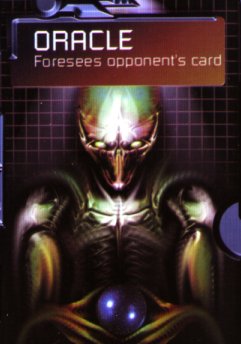 cards
carefully.
cards
carefully.
Losing Your Power: When three or more of your home
colonies are eliminated, you lose your Alien Power. Immediately. Remove your
Power card from its holder and place it face down. You cannot use your power
"one last time" before losing it. Continue to play in the normal manner. If you
draw your own color disc from the Orders pile, you may attempt to re-establish
a colony in your home system. If you regain your Power by having a colony on at
least three of your home planets, you again display your Power card by placing
it in its holder.
Timing Conflicts: In all cases of timing conflicts
(when two players invoke contradictory special effects simultaneously) between
Powers, Artifacts, etc. resolution takes place as follows: the players who are
not the Main Players, in order, to the left of the offense, get to use their
effect first. Then the offensive player plays, and then finally the defensive
player plays. This rule is only in effect if players are unable to determine
who played their Power or card first.
Artifact Cards
Artifacts are devices developed by the elders and distributed
throughout the universe for possible use by enterprising life forms. These
powerful items allow players to even further alter the outcome of encounters
and the game. Artifact cards are clearly marked. They cannot be played as
Encounter cards but are played at other times. Artifact cards are always played
face up, (often with an optional dramatic flourish,. All Artifact cards are
discarded after they have been played. Each Artifact card tells you when and
how you may play it. Artifact cards are played as follows:
 Cosmic
Zap (2): You may play this card whenever a player is about to use his
or her Alien Power. Cosmic Zap cancels the effect of that power for the
remainder of the encounter. Otherwise the encounter continues normally. Aliens
use their Powers at different times and the timing for playing a Cosmic Zap
varies accordingly.
Cosmic
Zap (2): You may play this card whenever a player is about to use his
or her Alien Power. Cosmic Zap cancels the effect of that power for the
remainder of the encounter. Otherwise the encounter continues normally. Aliens
use their Powers at different times and the timing for playing a Cosmic Zap
varies accordingly.
Example: As the Mind attempts to look at your cards. You Zap
it and prevent it from
seeing that you have the 30 Attack
and two Negotiate cards.
Force Field (1): You may play this card after allies'
ships have been committed to an encounter, but before the Encounter cards are
revealed. Force Field prevents a player or players of your choosing from
allying in that encounter. Any of those allies' ships committed to the
encounter are returned to any of their colonies. Player or players affected by
the Force Field may not rejoin the encounter on either side. This card has no
value in a two-player game but is kept in play.
Example: As the Macron you have allied with the Mutant and
supplied a ship to help defend the Mutant's planet. Zombie (the offensive
player) plays Force Field, sending your ship back to a Macron colony. The
Encounter cards are then revealed.
 Mobius
Tubes (2): You may play this card only when you are about to begin an
encounter as the offensive player, before the top Order is turned over. All
players with at least one colony gain back all ships from the Warp. They may
add these ships to any of their colonies, home or otherwise.
Mobius
Tubes (2): You may play this card only when you are about to begin an
encounter as the offensive player, before the top Order is turned over. All
players with at least one colony gain back all ships from the Warp. They may
add these ships to any of their colonies, home or otherwise.
Example: As the Vulch. you have lost several encounters and
have 10 ships in the Warp, more than anyone else. Your colonies have only 2
ships each and your turn is starting. Worried about weakening your colonies
even more if you take ships from them into the Mothership, before you turn over
the Orders disc, you play your Mobius Tubes card, freeing all of the Vulch
ships (plus everyone else's ships) from the Warp. Now you are better able to
protect your colonies and also commit four ships to your encounter.
The Plague (1): You may play this card at any time. You
name the player against whom it is being played. The victim places three ships
from colonies to the Warp, and selects an Attack card, a Negotiate card, and an
Artifact card to discard. The victim who does not have enough cards or ships to
comply with the Plague loses only the cards or ships he or she does have.
Example: As the Philanthropist you are going for a fifth
colony [and the win] against the Parasite, who only holds two cards. At the
stat of the encounter, you play The Plague on the Parasite and the Parasite
loses three ships, its last Attack card, and its last Negotiate card. The
Parasite has no Artifact cards so it doesn't lose any. As the Philanthropist,
you then use your special power to give the Parasite an Attack card that has an
attack value of 4. Now you know exactly which Encounter card the Parasite will
play - a lowly 4.
 Stellar
Gas (1): You may play this card when any player is about to claim
Compensation (see page 8 and 9). The player against whom it is played loses the
right to claim Compensation (collect cards) during that encounter.
Stellar
Gas (1): You may play this card when any player is about to claim
Compensation (see page 8 and 9). The player against whom it is played loses the
right to claim Compensation (collect cards) during that encounter.
Example: As the Mind you have looked at your opponent�s hand
and seen some good cards. You deliberately played a Negotiate card, losing four
ships to the Warp (your opponent played an Attack card). You now have the
chance to claim Compensation and take four cards from your opponent's hand. A
third player, however saves your opponent by playing Stellar Gas and preventing
Compensation from taking place.
Emotion Control (1): You may play this card during an
encounter, just after Encounter cards are revealed. Emotion Control turns any
Attack cards played in an encounter into Negotiate cards. The main players now
attempt to make a deal, just as if two Negotiate cards had been played.
Example: As the Mutant you are having an encounter with the
Zombie and feel confident you will win. But when the Encounter cards are
revealed (both are Attacks], you have lost. You then play your Emotion Control
card, turning both Attack cards into Negotiate cards. Now your allies and the
Zombie�s allies return their ships to their colonies and you and the Zombie
have one minute to make a deal.
Example: A Comprehensive Encounter
 The
Pacifist, the Macron. The Vulch, and Chronos are playing a game. It is the
Pacifist's turn. He draws an Order and it is Chronos� color. The Pacifist loads
3 ships into the Mothership and points it at a planet where Chronos only has
one ship. He then asks the Vulch for help. The Vulch doesn�t answer yet as
Chronos has a chance to recruit allies as well. Chronos doesn�t ask the Vulch
but, instead, asks the Macron for help. The Macron is to the left of the
Pacifist (the offensive player), so he answers first. He agrees to help Chronos
and places one ship in his carrier and places it next to the planet. The Vulch
declines to ally with the Pacifist and chooses to sit out. The Pacifist now has
3 ships on offense. Chronos has a total of 5 ships defending - her one plus the
one ship Macron is lending (which counts as 4).
The
Pacifist, the Macron. The Vulch, and Chronos are playing a game. It is the
Pacifist's turn. He draws an Order and it is Chronos� color. The Pacifist loads
3 ships into the Mothership and points it at a planet where Chronos only has
one ship. He then asks the Vulch for help. The Vulch doesn�t answer yet as
Chronos has a chance to recruit allies as well. Chronos doesn�t ask the Vulch
but, instead, asks the Macron for help. The Macron is to the left of the
Pacifist (the offensive player), so he answers first. He agrees to help Chronos
and places one ship in his carrier and places it next to the planet. The Vulch
declines to ally with the Pacifist and chooses to sit out. The Pacifist now has
3 ships on offense. Chronos has a total of 5 ships defending - her one plus the
one ship Macron is lending (which counts as 4).
Both Main Players [the Pacifist and
Chronos play Encounter- cards face down and reveal them. The Pacifist has
played a Negotiate Card and Chronos has played an Attack card with a value of
10. Normally Chronos would win, but the Pacifist's power states that if he
reveals a Negotiate cad and his opponent reveals an Attack card, then he wins.
At this point. Chronos, sensing a loss, calls out �Time Travel� which activates
her Power. At this point, the Pacifist would be forced to play a new Encounter
card. However, before Chronos can enact her Power, the Pacifist plays an
Artifact  cad
-- Cosmic Zap. Cosmic Zap cancels one player's Power for the remainder of an
encounter. So, no Time Travel, no new cards and the Pacifist wins. Chronos� one
ship and Macron�s one ship go to the Warp. The Pacifist places the 3 ships in
the Mothership onto Chronos� planet, forming a colony. The Cosmic Zap Artifact
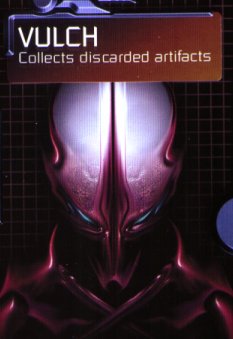
card goes into the discard deck where the Vulch (whose power is to collect
discarded Artifact cards) snags it and puts it in his hand.
cad
-- Cosmic Zap. Cosmic Zap cancels one player's Power for the remainder of an
encounter. So, no Time Travel, no new cards and the Pacifist wins. Chronos� one
ship and Macron�s one ship go to the Warp. The Pacifist places the 3 ships in
the Mothership onto Chronos� planet, forming a colony. The Cosmic Zap Artifact
card goes into the discard deck where the Vulch (whose power is to collect
discarded Artifact cards) snags it and puts it in his hand.
The encounter is over.
Strategy Hints
COLONIES
Gathering Ships: When gathering ships for an offensive
encounter or in an alliance, it is wise to take them from several colonies in
order not to leave any one colony weakly defended. As the game progresses, you
will often gather ships from colonies which you have established outside your
planet system - making sure that at least one ship is left behind on each to
hold the colony.
 Defending
Home Planets: You should try to keep your home planets well defended,
because if you are forced off too many home planets you will lose your Alien
Power. Usually, one or two ships are enough to hold a foreign colony and extra
ships are used to secure the homefront.
Defending
Home Planets: You should try to keep your home planets well defended,
because if you are forced off too many home planets you will lose your Alien
Power. Usually, one or two ships are enough to hold a foreign colony and extra
ships are used to secure the homefront.
Encountering a Planet Defended with no Colony: The
planet where the defensive player has no colonies will often be your best
target. In this case, the defensive player's total will be O + allies' ships +
Attack card. Or, if he or she plays a Negotiate card there will be no
Compensation.
More than Four Ships in a Colony: While it is
permissible to have more than four ships in a colony during play, it is usually
best to keep your colonies evenly defended.
NEGOTIATE CARDS
Claiming Compensation: You may sometimes want to play a
Negotiate card in the hope that your opponent will play an Attack card and you
will therefore be able to take cards from your opponent's hand as Compensation.
This is a good move against an especially strong attacking Power such as the
Virus, because that player would then lose some cards and be less powerful. But
your opponent may have a good hand and, suspecting that you will use this
strategy, counter by also playing a Negotiate card hoping to force a deal
situation. Then again, taking too many cards from a player just means he or she
is that much closer to drawing a whole new hand.
 Making
a Deal: When both players play Negotiate cards in an encounter, they
have one minute to try to reach a deal. One easy bargain is granting a colony
for a colony. (Remember that you can allow your opponent only onto a planet
where you already have a colony, even if it is outside your home system) Also,
key cards may be traded with one another because some cards appeal to certain
aliens more than others. As the game progresses, however, an easy deal may be
harder to achieve, because some players are ahead of others. In some cases you
may wish to wait out the one minute and force your opponent to lose three ships
to the Warp (while sacrificing three of your own). By this maneuver you can
also end your opponent's turn when it is that player's first encounter. At the
end of the game, a deal can lead to a double win as each player simultaneously
gains a fifth colony.
Making
a Deal: When both players play Negotiate cards in an encounter, they
have one minute to try to reach a deal. One easy bargain is granting a colony
for a colony. (Remember that you can allow your opponent only onto a planet
where you already have a colony, even if it is outside your home system) Also,
key cards may be traded with one another because some cards appeal to certain
aliens more than others. As the game progresses, however, an easy deal may be
harder to achieve, because some players are ahead of others. In some cases you
may wish to wait out the one minute and force your opponent to lose three ships
to the Warp (while sacrificing three of your own). By this maneuver you can
also end your opponent's turn when it is that player's first encounter. At the
end of the game, a deal can lead to a double win as each player simultaneously
gains a fifth colony.
ALLIANCES
Choosing Offensive Allies: As the offensive player you
should ask for allies only if you think extra help is necessary for victory.
Otherwise you will be needlessly helping other players establish colonies. It
is wise to check how many colonies a potential ally already has before
extending an invitation. Of course, sometimes a show of force convinces the
defending player to play a Negotiate card and you can play one too, trade
colonies with just the defending player, leaving your "allies" out in the cold.
 Choosing
Defensive Allies: As the defensive player you should weigh your allies
potential gain. A defensive victory will provide them with Defender Rewards
(extra cards and or retrieved ships) which may later be used against you.
Choosing
Defensive Allies: As the defensive player you should weigh your allies
potential gain. A defensive victory will provide them with Defender Rewards
(extra cards and or retrieved ships) which may later be used against you.
Deciding Whether or Not to Join an Alliance: When you
are invited to ally you should weigh the following: Do you want to help that
player win this encounter, and if so what are the chances for success? Is the
player who invited you to ally really trying to win or simply decoying in the
hopes of taking some allies along to the Warp! Will other players already in
the alliance gain undue advantage through a victory! When asked by the defense,
consider whether or not you really want several additional cards in your hand
at this time. Would you be better off letting your hand run out in order to get
seven new cards? If so, do you have enough ships in the Warp to retrieve in
lieu of taking cards! Do you want ships instead and is it worth the risk of
losing more to the Warp?
THE DECK
Playing Your Hand: It is not always wise to play your best
cards at first. Because you must discard each card you play, you may soon be
left with a very weak hand and have to play it out to severe disadvantage. Of
course, if you save your best cards, you run the risk of another player taking
them (as Compensation, etc.). Remember that most Attack cards have a value
between 4 and 10.
Two Player Game
In a two-player game the Orders are not used, except to
determine the first player. Encounters are made, as you wish, on your
opponent's planets or on your own system where your opponent has a colony.
There are no alliances. Also, you lose the use of your Alien Power when you no
longer have FOUR home colonies.
Campaign Play
Cosmic Encounter can be played as a unique individual game
with absolute success. It's always different and it's always fun. That�s how it
is designed. However, it can also be played as a campaign, where players play a
series of games and keep a running score. Gameplay is identical to individual
games with the following exceptions:
-
At the end of a game, scoring is as follows.
A player who wins individually (no
shared win) gets 8 points.
Players in a shared win each get 4
points.
Players with four foreign colonies
(the close-to-a-win-players) each get 1 point.
-
New aliens are drawn for each game.
-
The player with the lowest score starts the next game. In the case of a tie,
the player with the lowest score closest to the left of the last winner starts.
The tournament campaign is over when one player has 15
points. If, at the end of a game, more than one player has 15 points, the one
with a higher score wins. If it is a tie, the player with the most cards left
in his hand wins. If it is still a tie, then the player who was born closest to
the start of the year wins. If it is still a tie then the universe has demanded
a shared win and there is nothing we can do about it.