Jerry Goldsmith - Planet of the Apes

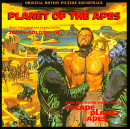
PLANET OF THE APES
A movie directed by Tim Burton
(2001)

It is the year 2029. Astronaut Leo Davidson boards a pod cruiser on a Space Station for a "routine" reconnaissance mission. But an aburupt detour through a space time wormhole lands him on a strange planet where talking apes rule over the human race. With the help of a sympathetic chimpanzee activist named Ari and a small band of human rebels, Leo leads the effort to evade the advancing Gorilla Army led by General Thade and his most trusted warrior Attar. Now the race is on to reach a sacred temple within the planet's Forbidden Zone to discover the shocking secrets of mankind's past - and the key to it's future...
 Franklin Schaffner's Planet Of The Apes
(1968), composed/conducted by Jerry Goldsmith. If the movie isn't to your
liking (though in some quarters this allegory of apes, starring Charlton
Heston, is regarded as a sci-fi classic) then this is no reason not to be
gripped by a stunning score. One of the film industry's most prolific and
critically acclaimed composers, Goldsmith (born Los Angeles, 1929) must
have written for every genre by now, yet Planet Of The Apes remains
his most unorthodox, formally inventive score to date.
Franklin Schaffner's Planet Of The Apes
(1968), composed/conducted by Jerry Goldsmith. If the movie isn't to your
liking (though in some quarters this allegory of apes, starring Charlton
Heston, is regarded as a sci-fi classic) then this is no reason not to be
gripped by a stunning score. One of the film industry's most prolific and
critically acclaimed composers, Goldsmith (born Los Angeles, 1929) must
have written for every genre by now, yet Planet Of The Apes remains
his most unorthodox, formally inventive score to date.
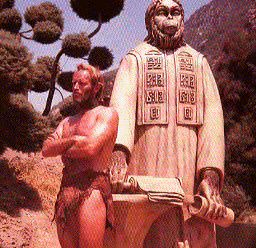
Planet of the Apes is by no means an average film. Although we may be familiar with it now, it contains images which are frankly quite shocking on an initial viewing: clothed apes walking upright and talking, intelligent masters treating the inferior humans as we would treat animals or slaves, the world strangely turned on its head, and that final image in the last minutes of the film.
The soundtrack
Against this background, you don't want an everyday soundtrack, but one that is equally striking to complement the movie. Jerry Goldsmith did not disappoint in this department, but crafted a score reminiscent of modernist trends in classical music, and wholly original in the world of film. The impressionistic effect is that this music has reverted to some primitive basic form, even more primeval than Stravinsky's Rite of Spring.
The Main Title track immediately sets the tone of the whole score with low piano notes and short woodwind fragments over a percussive punctuation that avoids any resemblance to a regular beat. Then the Crash Landing track, after some initial loud noises, moves the music into a more tentative mode as the astronauts wonder where they have landed and start to explore.
Responding to the film's peculiar characterisation, bleak futuristic setting and pacy action sequences, the score persists in defiant dissonance to the point where occasional tonality is almost shocking. The key to its success is a capacity to evoke a distinctive soundworld by an adventurous use of orchestral colour and texture, emanating from unusual instrumental ingredients such as metal sheets and mixing bowls, wood blocks and small percussives (some echoplexed), ram's horn and Brazilian cuica, plus carefully deployed harp, xylophone and snare drum. The results are sometimes reminiscent of Varèse (e.g. Hyperprism). Eschewing elaborate themes, Goldsmith uses motivic fragments like the serial phrase played by ethereal flute or high strings, the running piano figures, and the parched cry of the ram's horn. A major film score of great character and originality, marred only by less than crystal clear recording quality. Indispensable.
Rather than give a complete breakdown of all the tracks, this review aims to provide a flavour of what to expect. Much of the music seems to be raw and formless, although closer inspection does detect repeating motifs and sounds. Those sounds are in part made by a conventional orchestra, but using the instruments in unusual ways, whether it is the string section using the wood side of the bow, or the flutes using a "flutter-tongue" technique, some bending or sliding of notes, or wind instruments being blown through without the benefit of the mouthpiece. Some of the percussion sounds are unidentifiable, but the upturned metal bowls are there as mentioned in the review of Jerry Goldsmith's 70th birthday concert. You can also hear what might be ape noises in Track 10, and strange hunting horn calls in track 7.