Wedding March 'A Midsummer
Night's Dream', Op. 61
The triumphal Wedding March, from the incidental music
to Shakesphere's A Midsummer Night's Dream, is one of the most famous pieces
of music ever written. It begins with a fanfare and then plunges majestically
into the splendid processional music to which many a bride has walked happily
to the alter.
A lighter, less stately march then takes over, as if Shakesphere's fairies,
too, were tripping down the aisle. The processional music is repeated twice
more, interspersed with a gentler, more lyrical passage.
The final repeat is heard in the distance and gradually fades away to merge
imperceptibly into the shimmering fairy music represented by the woodwind.
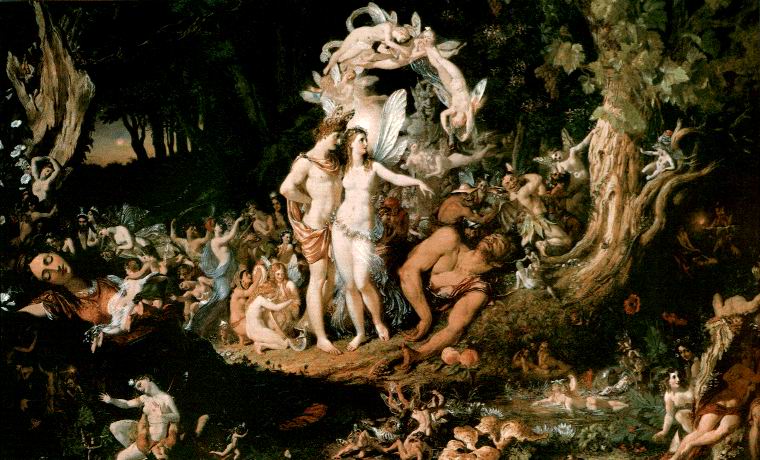 Mendelssohn
composed his overture for Shakesphere's play in 1926, when he was only 17. It
was not until October 1843, however, that he added several items of incidental
music to accompanya production of the play at Potsdam, near Berlin. All 11 numbers
met with overwhelming success. Indeed, it is a mark of Mendelssohn's genius
that, despite a gap of 17 years, the style of the later incidental pieces blends
in perfectly with that of the overture.
Mendelssohn
composed his overture for Shakesphere's play in 1926, when he was only 17. It
was not until October 1843, however, that he added several items of incidental
music to accompanya production of the play at Potsdam, near Berlin. All 11 numbers
met with overwhelming success. Indeed, it is a mark of Mendelssohn's genius
that, despite a gap of 17 years, the style of the later incidental pieces blends
in perfectly with that of the overture.
The "Wedding March' is played after the end of Act IV and celebrates the
simultaneous marriage of three couples.
Song Without
Words - from Book 5, Op. 62
'Song Without Words' was a term introduced by Mendelssohn
to describe a piano solo which incorporats a song-like melody with accompaniment
in the bass (left hand).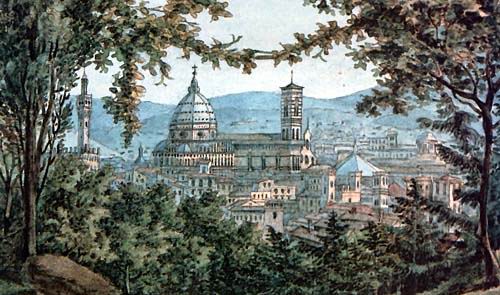
Mendelssohn wrote 48 of these compositions during his lifetime. They are miniature,
intimate pieces intended to be played on musical evenings in the drawing room
or salon.
Mendelssohn deliberately wrote these song melodies without words because he
felt that words would get in the way of the emotions he was trying to convey.
This
short piece, composed in 1842-4, is a sombre and dignified funeral march. Perfectly
rounded and restrained, it conveys a sense of gentle melancholy and, like almost
all these songs, is unassuming and graceful.
|
Above Right: It was Johann Goethe, the
German philosopher and poet, who encouraged Mendelssohn to visit Italy.
This view of Florence was painted by Mendelssohn.
|
[Back|Home|Contact]