Frederic CHOPIN
1810 - 1849
|
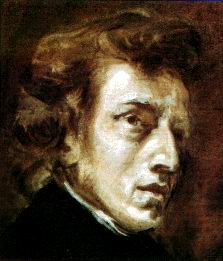
Above: The combination of Chopin's romantic
good looks and musical genius guaranteed his popularity wherever he
went
|

|
Above: The combination of Chopin's romantic
good looks and musical genius guaranteed his popularity wherever he
went
|
Musical Period: Romantic
Birth Place: Warsaw, Poland
Major and Famous Works:
|
a) Piano and Orchestra b) Piano Sonatas c) Chamber Music d) Songs |
e) Piano Pieces
|
Frederic Chopin showed his musical talent at a very early age. He was born in Poland on 1 March 1810, the son of an immigrant French teacher. All his family was artistic, so Chopin's ability to compose music on the piano at the age of six, came as no suprise. He started piano lessons when he was seven, and showed such promise that he was invited to play at private parties for eminent Warsaw families. He gave his first piano concert when he was eight.
First Love
Chopin was not a robust child, and his father sent him to the countryside every
summer so that the fresh air could strengthen him. He loved the music of the
local people, and thus many of his early compositions show the influence of
these country melodies.
Chopin's father enrolled him at the newly formed Warsaw Conservatoire when he was 16 and that was where he found a tutor who recognised his unique genius and sent him to Vienna to broaden his musical horizons.
In September 1829, back in Warsaw, he fell in love with Constantia Gladkowska, a young singing student. During the course of this romance, Chopin took inspiration for his music from the human singing voice, transferring its purity and melody into many of his piano works.
Chopin was kind and courteous, with a ready sense of humour and was thus popular in Warsaw. He was also extremely handsome, with the pale look of the consumptive. With his dazzling piano skills, he fulfilled everyone's idea of the frail genius marked for death.
The intensity of his personality often brought frustrations. On his visit to Vienna in 1830, he was irritated by the superficial nature of the public's musical taste. The worse thing was that Viennese preferences had changed and he was far less in demand than on his previous visit. He only played two public performances in eight months. This was not necessarily disastrous for the sensitive Chopin. He preferred intimate gatherings, playing in people's homes, or teaching pupils on a one-to-one basis.
Emotional Insecurity
The dramatic uprising of the Polish people against their Russian rulers in 1830
changed the course of Chopin's life. He was on tour in Europe and, as he was
unable to go home, he decided to head for Paris. There he met the wealthy Rothschild
banking family who introduced him to their aristocratic friends, and he gave
concert recitals in their houses. His elegant manners and sensitivity made him
extremely popular and his living was assured.
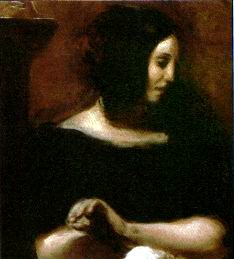
However, he was very insecure emotionally. During a visit to Germany in 1835 to see some old friends from Poland, he fell in love with their 16-year-old daughter, Maria Wodzinski. Her mother forbade their marriage on the grounds of the 25-year-old Chopin's obvious ill-health. He returned to Paris broken-hearted, where he received a proposition from one of the French capital's most notorious women. The author George Sand, whose real name was Aurore Dudevant, was reputed to have many affairs and did not care about the opinions of polite society. Chopin did, and at first declined her offer to be his mistress.
She persisted and they became lovers in 1838. That winter, he travelled with her and her son to Majorca where the milder climate would be kinder to his failing health. It was a strange arrangement and the suject of much local talk.
When Chopin suffered a severe bout of tuberculosis, George Sand took him back to France where skilled doctors saved his life. But, he was never able to enjoy good health. Although he was 5ft 8ins tall, he weighed a pitiful seven stone. his lover did her best for him, taking him to the country in summer, just as his father had done in Poland. There, Chopin devoted what energy he had to composition. During the rest of the year in Paris, he made his living giving piano lessons.
The idyll was not to last. George Sand's adolescent children became increasingly resentful of Chopin, and gradually their relationship became strained. It ended with a farewell letter to Chopin in July 1847. He fell into depression from which he never really recovered.
Chopin tried one more relationship with former pupil Jane Stirling. She took him on a tour to England in April 1848, but the punishing schedule of concerts in London wrecked his health. He went back to Paris in November, very near to death.
He spent most of 1849 in the Paris suburb of Chaillot where he died on 17 October, aged only 39. His last request was for Mozart's Requiem to be played at his funeral, in Paris on 30 October.
His short life was marred by ill-health, disappointment in love and artistic frustration. Yet, his sensitivity and creative genius shine through his music. His rare gift for composing melodies full of heartfelt emotion, and his ability to coax from the piano an almost magical range of moods, places him among the immortals of music.