Musical Period: Baroque
Birth Place: Eisenach, Thuringia (recently known as East Germany)
Major and Famous Works:
|
a) Organ Pieces b) Keyboard Pieces c) Chamber music d) Choral preludes |
e) Orchestral Works f) Religious Choral Works (including motets, cantatas, Passion,
Oratorios & mass) |
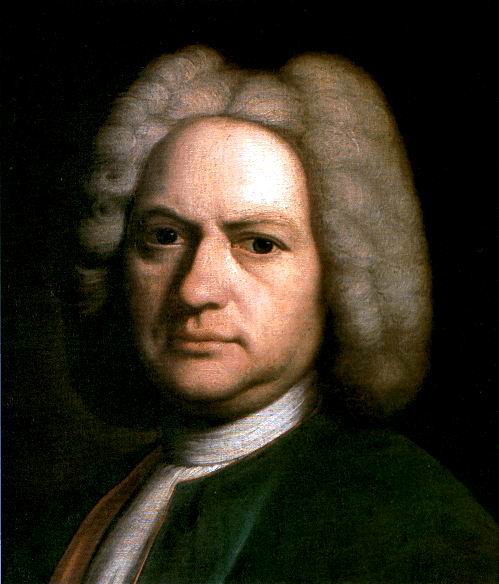
Johann Sebastian Bach (J.S. Bach), a German composer
was born in Eisenach, Thuringia, deep in the heart of Germany (recently known
as East Germany) in
1685. He was the youngest of eight children and his musical line can be traced
back to his great-great-grandfather, Veit Bach, a miller who played the lute.
His
father also played the fiddle and the organ.
By 1695, Bach was an orphan as his mother died when he was nine, and his father, the year after. His eldest brother, Johann Christoph (an organist) took him in and he was given a wide and varied musical education. His lessons ranged from musical theory to the art of organ construction.
At the age of 15 in 1700, Bach was a choirboy at the Convent of St Micheal in Lüneburg. He spent as much time as he could while he was there listening to the greatest organists of the age (George Böhm, a resident in Lüneburg and the great Adam Reinken in Hamburg. It was this experience that confirmed Bach's great love for the organ.
Bach's voice broke in 1702, and as a result, his career as a chorister ended. He landed the post of organist and choirmaster at a new church in Arnstadt, after a brief spell working as a musician for a nobleman.
Being a very modest man, Bach politely declined to provide any details of his life when, in later years, was approached by a publisher who wanted to include him in a series of biographies.
Though he was modest, he could also be very acerbic and gets annoyed very easily. Therefore, throughout his career, he had had frequent clashes with his various employers, especially in Arnstadt. The church authorities there accused Bach of neglecting his duties, of over-embellishing the hymns, and even alleged that he sneaked out of church sermons to have a drink at a nearby hostelry. The crunch came when he was absent without leave over the Christmas and New Year period of 1705-1706.
Bach then moved to Mühlhausen, a town in the Alsace region the following year, to take up the post of organist of the Blasiuskirche. One of the most important events of this period of Bach's life was his marraige to his cousin, Maria Barbarah Bach in October 1707.
However, after only a year at Mühlhausen, Bach resigned from his post in 1708 and thereafter, became a court organist to the Duke of Saxe-Weimar, Wilhelm Ernst, who was a great lover of the arts. During this time, he produced some of his finest fugues and cantatas. He was appointed as the Concert Master to the Duke, which was one of the most prestigious musical posts available in 1714, as a reward.
In the year 1717, Bach was invited to take part in a harpsichord competition
against Louis Marchand, who was organist to King Louis XV of France. However,
Bach arrived to find that his rival had already fled the city. Bach was euphoric
at what he considered to be a victory, but within a few months, this euphoria
was dispelled.This was because his application to become the Duke's Kapellmeister
- Head of Music - was rejected. Bach was later sucessful in his next application
for the post of Kapellmeister to prince Leopold of Anhalt-Cöthen. When
he tendered his resignation to his employer, the Duke was so affronted that
he promptly had
Bach imprisoned for 16 days. Bach was only 'allowed to resign' upon his release.
A new challenge
Prince Leopold was a keen musician himself, and in the
years that Bach spent in the service were said to be among his most productive
and his compositions included the celebrated Brandenburg Concertos. The sudden
death of his wife in 1720, while Bach was travelling with the Prince, was the
only unhappy event that happened in these years. However, in December 1721,
Bach happily married Anna Magdalena Wilcken, the 20 year old daughter of the
local court trumpeter.
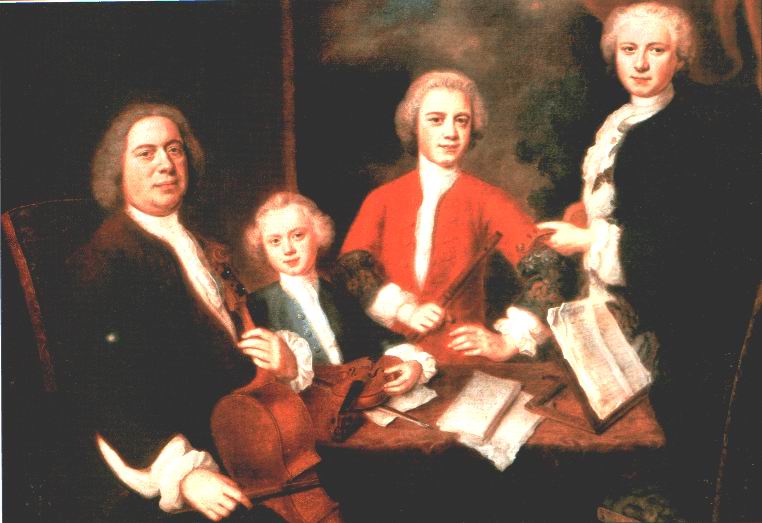
Anna Magdalena produced no fewer than thirteen children and the marriage was a happy one. It was for her that he completed the simple and charming keyboard pieces played by many novice musicians today. His second marriage also coincided with the highest point in his professional career. He was appointed as Cantor of St. Thomas's Church in Leipzig and director of the Collegium Musicum in 1723 and 1730 respectively.
In 1741, Bach retired from public duties and his level of contentment in Leipzig can be gauged by the music he produced. He composed all the great religious masterpieces, such as the St John and St. Matthew Passions, the Christmas and Easter Oratarios and the majestic Mass in B Minor during this period, as well as nearly three hundred cantatas.
The last ten years of Bach's life was blighted by the onset of blindness. However, he found great solace during this time in his numerous and gifted family - four of his sons went on to become renowned composers in their own right.
On 28 July, 1750, Bach died.
Tragically, his music languished in obscurity for nearly 80 years after. A few composers, including Mozart and Beethoven respected and admired him, but it was Mendelssohn who began a Bach-revivalist crusade in 1829. And it was only then, that the humble organist from Thuringia, often described as the most accomplished musician who ever lived, and one of the most prolific composers, began to be fully appreciated by music lovers around the world.
|
|