- Canard
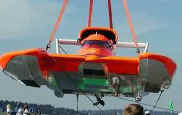
- The airfoil running across the front of the boat between the
two sponsons.
It includes moveable flaps on it's trailing edge, which are
controllable by
the driver. These flaps affect the flow of air both above and
below the
boat's hull, which in turn affects the boat's lift and control
characteristics.
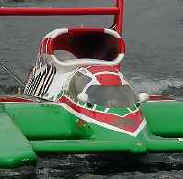
- Cockpit
- Utilizing the canopy from an F-16 fighter jet, the cockpit of
an Unlimited Hydro
includes a five-point harness and oxygen supply for the driver.
Support for the
side of the driver's head is also helpful as he may experience
forces as high as
6 g's while cornering. At the bottom of the cockpit capsule is
an escape hatch
in case of emergency.
- Air Intake Scoop
- Directs large amounts of air to the turbine engine behind it.
When running on
saltwater courses, the scoop is generally extended beyond the
front of the
cockpit canopy to prevent damage to the engine's turbine blades
caused
by ingestion of the salty spray.
- Engine Cowling
- Covers and protects the engine and aids in aerodynamics.
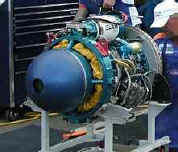
- Engine
- Turbine powered hydroplanes use a Lycoming T-55 gas turbine engine.
These engines saw extensive use in the U.S. Army's CH-47
"Chinook" helicopters. Used in Unlimiteds, they
produce between 2,500 and 3,000 hp.
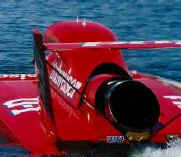
- Exhaust Funnel
- Basically just a really big exhaust pipe.
- Vertical Stabilizers
- Non-moveable, vertical structures at the rear of the boat used
to support the
horizontal stabilizer and to help with directional stability.
- Horizontal Stabilizer
- Also known as the "Wing", this airfoil helps
stabilize the boat's attitude while planing.
- Deck
- The upper surface of the hull on either side of the cockpit
and engine compartment.
- Sponsons
- Pontoon-like elements located at the forward section of the
hull. While on plane, the bottoms of the sponsons are the only
part of the hull actually in contact with the water. In rough
water and while cornering, a hydroplane will frequently rock
from side to side, only one sponson being in contact with the
water at any given moment. This is known as "sponson
walking" and if not brought under control, can lead to
disaster.
- Air Tunnel
- Formed by the inside edges of the sponsons and the underside
of the deck,
air is forced into the tunnel by the boat's forward motion
creating a "cushion" and lifting the boat out of the
water. While riding this cushion, the boat is said to be
"on plane."
- Propeller
- Very expensive and meticulously machined to extremely high
tolerances, the "prop" is the only means by
which the power of the engine is translated into forward motion.
Consisting of no more than three blades and measuring a maximum
of 16 inches across, they can push a boat weighing over 6,000
lbs
to speeds in excess of 200 mph.
- Rudder
- A long, sturdy, moveable blade located on the aft section of
the boat, off to one side of the propeller. The rudder provides
directional control of the hydroplane.
- Skid Fin
- Last but not least, one of the most critical components of a
hydroplane, the skid fin is fixed to the left side of the boat's
hull just behind the sponson. This blade digs into the water and
prevents the boat from sliding across the surface of the water
as it makes a high-speed turn. Without it, cornering at race
speeds would be impossible.
|
 |