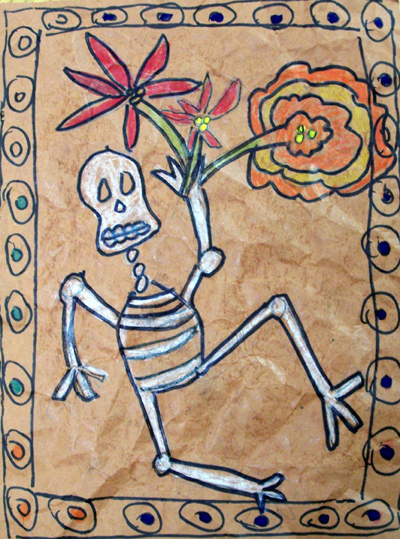
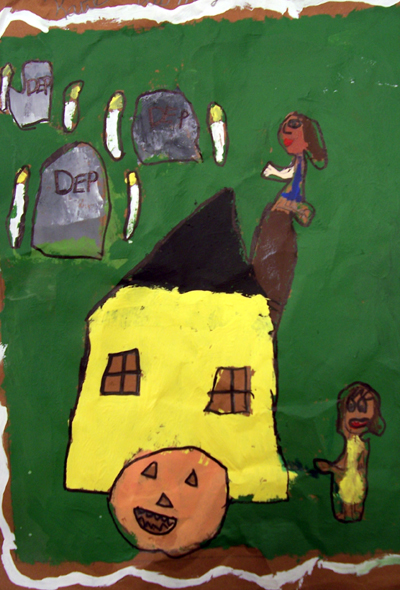
| Grade 4 students studied how the bark of the "mora o higo" (berry or fig) trees are prepared to make special paper called "papel amate". The indians of Puebla Mexico use "colores brillantes" to create scenes of their daily lives and celebrations. Some of the characteristics of these beautiful art pieces are: 1. a specific border pattern 2. bright colors, espcially white 3. shapes are out of proportion, flat and layered 4. space is filled with details 5. black is used to outline everything In class, we used our imaginations to create "papel amate" and then our knowledge of the special characteristics of this folk art to create a scene of our own. We spent some time thinking about how the celebration of el Dia de los Muertos compares to a North American holiday such as Christmas, Easter, Halloween or the 4th of July. Using the traditons of amate folk art, we were able to successfully illustrate our learning. We hope you enjoy these beautiful works of art along with some student's reflections. They continue to surprise and delight me and teach me new ways to look at familiar things! Gracias cuarto grado! For more information on the art of "papel amate" check these web sites: The Paper Art of Mexico Dos Mujeres Mexican Folk Art La Fuente Imports |
| Amate Bark Painting Folk Art of Latin America Grade 4 Project 2005 |
 |
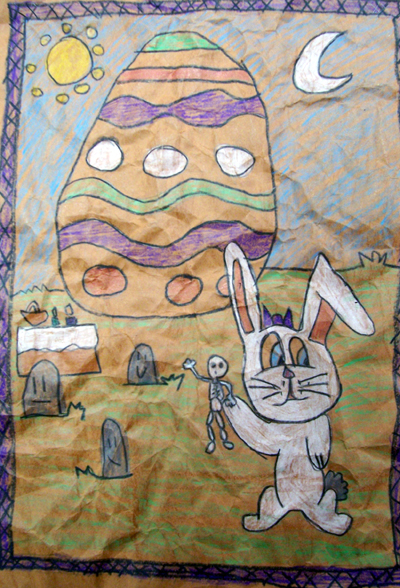
| El Dia de los Muertos is the same as Easter because they both have decorations and many people celebrate both. Dia de los Muertos is also different than Easter. Dia de los Muertos has "calacas" and Easter has "bunnies". Dia de los Muertos has "cempazuchitl" (marigold) and Easter has whitl lilies. Dia de los Muertos is at a cemetary and Easter is at a church. I show this in my "amate art" by drawing a bunny holding a "calaca". There is a cemetary, an Easter egg, an altar and a basket. Some things I know about "amate art" are that the Nahua hecho a mano the art and color it with "colores brillantes". They flatten the bark of the "arbol de morea" and use it to make the "papel amate". por Alli |
 |
| Mas arte? Clic! |
 |
 |
 |