 |
 |
| Plant Pathology |
| Fly specks on the window or the Cannon Fungus stricks again: |
| Taken from an article by, L.F. Grand, NC Coopertive Extension Service. |
| The problem..... |
| In recent years there have been an increasing number of complaints about small (less than 1/10 inch), dark brown to black, "fly speck-like" objects that stick tenaciously to house siding, windows, cars and a variety of other surfaces. |
| Removal of these sticky objects has proven quite difficult, especially from light-colored cars where attempts to remove the spots have resulted in marring of the paint finish. Speculation on the identity and source of these structures has implicated insects, fungi and even tar splashed from the road resurfacing activities. |
| The Source.......... |
| The culprit is a fungus- aptly described as the cannon fungus, Sphaeroblus stellatus. The fruiting bodies of this fungus are 1-3 mm (0.04-0.12 inches) broad, roundish in shape and off-white to buff or orange-buff color. At maturity the fruiting bodies splits in a star-like pattern exposing a dark brown, roundish "cannon" or "egg" (termed a peridole) that is 1-2 mm (0.04-0.08 inches) broad and contains the spores of the fungus. This structure is forcibly ejected or shot from the fruiting body, hence the name "cannon" fungus. This fungus is also called the "sphere thrower" and the "artillery fungus". The "egg" which may be ejected up to 14 FEET from the fruiting body has an oily or stickly surface that enables it to ahere to most surfaces it encounters. Once stuck to a surface the "egg" dries to a disk shape and adheres tenaciously. Removal of the "egg" often leaves an oily stain or discoloration on the surface. Fruiting body development is correlated with high moisture and temperatures in the 70's and low 80'sF (10-20C). A change in temperature to 90F will stimulate ejection of the "egg" from the fruiting body. The fungus also is phototropic and the "egg" is shot toward a light source. |
| The Habitat...... |
| Sphaerobolus stellatus grows primarily on decaying woody substrates (especially wood chip), twigs, corn cobs, and dung. The fungus can also be found on rotten wood in greenhouses and on wood chip mulch and some bark mulch in potted indoor plants. The apparent increase in occurrence of this fungus is attributed to the increased use of wood chip mulch in landscapes. Under the proper environmental factors large numbers of fruiting bodies can develop over a substantial area of wood chip mulch in a landscape. Conditions of high moisture and temperatures in the 70-80 F range that favor fruiting body development (growth) occur in the spring and fall. |
| The Control...... |
| Avoid using wood chips as mulch when this problem occurs; pine or hardwood bark mulch does not seem to harbor the fungus as much and can be used as an alternative. Spores are know to survive up to 11 YEARS so covering mulch which contains fruiting bodies with fresh wood chips may only solve the problem temporarily. NO FUNGICIDES ARE RECOMMENDED nor labeled for this use. |
| Side note: |
| A Connestee resident has this fungal problem, The resident retrieved mulch from one of the Connestee Mulch sites. This is not to say that the road right- a- way clipping should not be used, just mearly a pre-cautionary note. Another resident observeding the firing of the cannon fungus stated it was aptly named. This Fungus alert was reported at the September (04) meeting of the Connestee Mt. Gardeners. The resident had pulled the above information sheet from the NC Coopertive Extention Service site and gave the sheet to us for use. |
| More information on this and other gardening items visit the sites listed below. |
| NC quick ref. |
| NC soil |
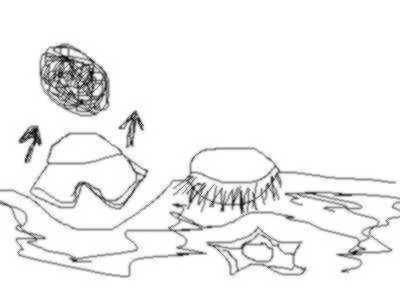 |
| The rendering below shows the egg being fired from the fruited body. |
| The fruited body |
| The open fruited body |

|