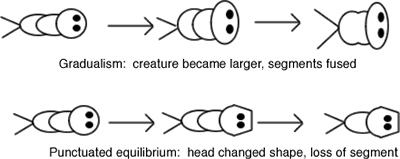
| Examining the Fossil Record Objectives: analyze characteristics of fossils compare placement of fossils and determine relative ages develop a model evolutionary tree based on the morphology and age of fossils Background Fossils are traces of organisms that lived in the past. When fossils are found, they are analyzed to determine the age of the fossil. The absolute age of the fossil can be determined though radiometric dating and determining the layer of rock in which the fossil was found. Older layers are found deeper within the earth than newer layers. The age and morphologies (appearances) of fossils can be used to place fossils in sequences that often show patterns of changes that have occurred over time. This relationship can be depicted in an evolutionary tree, also known as a phylogenetic tree. There are two major hypotheses on how evolution takes place: gradualism and punctuated equlibrium. Gradualism suggest that organisms evolve through a process of slow and constant change. For instance, an organism that shows a fossil record of gradually increased size in small steps, or an organism that shows a gradual loss of a structure. Punctuated equilibrium suggests that species evolve very rapidly and then stay the same for a large period of time. This rapid change is attributed to a mutation in a few essential genes. The sudden appearance of new structures could be explained by punctuated equilibrium. |
 |
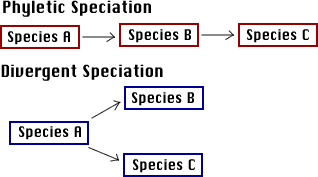
| Speciation The fossil record cannot accurately determine when one species becomes another species. However, two hypotheses regarding speciation also exist. Phyletic speciation suggests that abrupt mutations in a few regulatory genes occur after a species has existed for a long period of time. This mutation results in the entire species shifting to a new species. Phyletic speciation would also relate to the Punctuated Equlibrium hypothesis regarding evolution. Divergent speciation suggest that a gradual accumulation of small genetic changes results in subpopulation of a species, that eventually accumulate so many changes that the subpopulations become different species. This hypothesis would coincide with the gradualism model of evolution. Most evolutionary biologists accept that a combination of the two models has affected the evolution of species over time. |
 |
| Procedure: 1. The diagram you are creating requires a large space. To create your workspace, tape together 8 sheets of standard sized pape. use a ruler to draw the following chart on your workspace |
 |
| Time Period ( 2 1/2 inches wide) |
| Began (years ago) ( 2 1/2 inches wide) |
| Fossils (8 inches wide) |
| Wyomington (oldest) 995,000 Ohioian 745, 000 Nevadian 545,000 Texian 445,000 Oregonian 395,000 Coloradian 320,000 Montanian 170,000 Californian 80,000 Idahoan (the present) 30,000 |
| (Each row here must be 5 inches tall) |
|
|
|