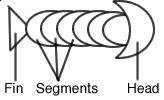
| 2. The group of "fossils" you will work with are ficticious animals. Each fossil on your sheet is marked with a time period. Cut out each fossil and make sure you include the time period marked below it. 3. Arrange the fossils by age. On your data chart, place each fossil next to the period from which the fossil came from. The term "upper" means more recent and should be placed lower in the low. The term "lower" means an earlier time period, fossils from a "lower" time period should be place toward the older time periods. In each fossil column, you may have 3 specimens, one from the main time period, one from the upper and one from the lower. Not all fossils are represented, illustrating the incompleteness of any fossil record. 4. While keeping the fossils in the proper age order, arrange them by morphology (appearance). To help you understand the morphology of the specimen, view the diagram. Arrange the fossils using the following steps. a. Center the oldest fossil at the top of the fossil column (toward the oldest layer) b. Throught the chart, those fossils that appear to be the same (or close to the same) as the fossils preceding them should be placed in a vertical line c. During a certain period, the fossils will split into two branches. In other words, one fossil from that period will show one type of change, and another fossil will show a different change. When this happens, place the fossils side by side in the appropriate time period. From this point on you will have two lineages. 5. Once all the fossils have been placed correctly according to time and morphology, tape or glue the fossils in place. Analysis 1. Give a brief description of the evolutionary changes that occured in the organism. 2. During which time period did the fossils differentiate into two branches. 3. Explain how the chart illustrates both punctuated equlibrium and gradualism. Use specific fossils from the chart to support your answer. 4. Making the assumption that each fossil represents a separate species. Explain how the chart illustrates divergent and phyletic speciation.Use specific fossils from the chart to support your answer. 5. Define the following terms: morphology fossil phylogenetic tree |
 |
| FOSSILS |
| GET these templates from http://www.biologycorner.com/worksheets/fossilrecord.html |