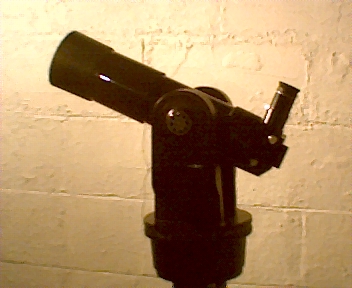
The Meade ETX-60AT-BB is a 60mm f/5.8 achromatic refractor. What sets this telescope apart from similar ones is the mount and the AutoStar controlled drive system. AutoStar is a nice system for amateurs and beginners. It is based on the Motorola 68HC11 microcontroller, and has 512K of flash memory, dual 9 speed servos with encoders, and serial control ports. The included object database has a large selection of objects and events. In addition, there is a set of tools for aligning and maintaining the unit, as well as storage for user objects, sites, etc. Some of the thoughtful extras include a camera port with flip up mirror, flip up 2x barlow, 45° erecting prism for the rear port, software, and connectivity to a PC.
The included 1.25" eyepieces are 25mm, 12mm, and 4mm. Usually, telescopes include only two eyepieces, and often they are terrible. The eyepieces included with the ETX-60 are of decent enough quality, although the 4mm is not my favorite. This is more about my eye relief than it is about the eyepiece. I expect that I will use it for lunar and planetary observation. (Although the short focal length is really not suitable for high magnification of planetary detail.) The small aperture is somewhat helped by the short focal length for deep-sky objects, however. The limiting magnitude is about 11, so many larger deep-sky objects can be viewed with it.
Also included is a DVD with instructional videos and software. My first impression of the software is that it is probably very good for connecting to the telescope, but the star map graphics are not done well in my opinion. For starters, the display is a spherical projection with the earth at the center. The mouse controls are two-dimensional. This gives only x-y control. There is included in Windows a control model called an arc-ball, which gives rotation, and scaling about any of the three axes available. Also, there is no provision for projecting the view from the user's POV, like most star map programs. It is not all bad, however. The program calculates Ephemerides for solar system objects, which is very nice to have. There are many nice features to this program, and the star maps are useable, just not very user-friendly, in my opinion.
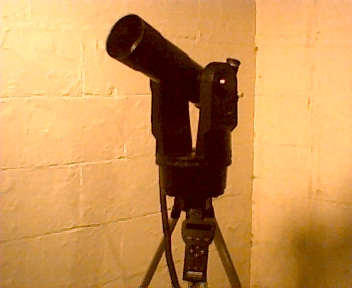
I picked up the telescope on 31 July, in the middle of a nasty heatwave. After practicing the alignment procedure in sweltering 98° weather just prior to sundown, I was able to look at the first quarter moon against the hazy blue sky. It was still very impressive! Dusk finally arrived, and I tried the Easy Align method. I did not have a compass, but I knew approximately where North was. Unfortunately, I live in town, with many obstructions and I could not help the alignment by centering the alignment stars for the unit. No matter, the moon was still in view, and after having the telescope slew to it I had a RA correction to apply to the Alt/Az zero position. I did this about 6 times before I was satisfied with the results. Once I did that, I tried the Two Star alignment with two visible stars, Arcturus and Vega. (This alignment is the same as Easy Align, except that you can pick the stars yourself.) My errors were so large before that manually centering the star took alot of time at the rate the unit was set at. Later, I learned that you can still change the slew rate during the alignment. That helped enormously. Also, it appears that stars near the zenith are not the best choices for alignment stars when you are off in the zero position.
Next, I wanted to view Jupiter, but it was too late. Jupiter was already behind the trees. Every other planet was below the horizon, and all I had was Hercules, Lyra and Cygnus, so I selected the Guided Tour. The first object on the list was M13, a globular cluster of some size and proximity. The telescope went there as requested, and M13 was in the field of view, despite a poor alignment. I had not calibrated the motors, even though I had read many owner's comments, and troubles that had involved this procedure. The rest of the tour was hit and miss. The horrible viewing conditions did not deter me, and I lost a night's sleep with my new telescope. Two very interesting things happened, however. Early in the tour, while I was in Hercules, a bright meteor streaked across the field of view. A little later, a satellite crossed the field of view. Both were very exciting to me. That is just the kind of thing that happens when you have the 25mm eyepiece inserted.(14X) The 25mm eyepiece is a little too wide-field for this telescope. That is a seat of the pants observation. The 17.5mm that came with another scope of mine works the best in this instrument. The images are still very crisp, and lunar detail is strikingly beautiful, despite the image size. The 12mm is also a nice eyepiece for this telescope. My results with the 4mm have been mixed over the last three nights. I have only used it on Jupiter and the moon. The short eye relief is hard on my 43 year old eyes. The truth is that a lot of my discomfort can be attributed to the generally horrible viewing conditions that I have been experiencing.
I spent the next few hours going through the tour and trying to see as much as I could. I was able to see M31 and M32 very well despite the soupy atmosphere. I was very tired the next day at work, but I was looking forward to seeing Jupiter and its moons later that night. Unfortunately, the sky overcast just as sunset approached, so I decided to familiarize myself with the AutoStar system a little more. First, I ran the Calibrate Motors utility. Next, I went into the Events category, and looked up lunar and solar eclipse data for the remainder of this year, and next year, reviewed the major meteor showers, and also the equinox and solstice data. The AutoStar is simply amazing. The 68HC11 is one of the the most hacked microcontrollers ever, and this design is well done. Somewhere around this county I have a Philips 8051 derivative Java web server, and I am considering purchasing a BasicStamp web server, too. (I still lack that static IP with domain hosting capability, however.) More on this later, elsewhere.