I.P.F. TECHNICAL RULES
Part 3.
COSTUME AND PERSONAL EQUIPMENT
1. Costume
The lifting costume shall consist of a one-piece full length lifting suit
of one-ply stretch material without any patches, padding or division into
panels by means of seams not necessary in the manufacture of the costume.
Any seams, false or otherwise, that in the opinion of the referees is
incorporated into the costume purely as a form of reinforcement or bracing,
shall invalidate the costume from being used in the competition. The costume
must be form fitting without any looseness when worn by the lifter. The straps
must be worn over the shoulders at all times while lifting in competition.
Only costumes officially registered and approved by the IPF Technical Committee
shall be permitted for use in powerlifting competitions. The lifting suit
shall also be subject to the following requirements:
(a)It may be of any colour or colours.
(b)The lifting suit may bear the badge, emblem, logo and/or inscription of
the lifter's nation, national association, or sponsor. That which is offensive
or liable to bring the sport into disrepute is not allowed.(Refer to item
8 (h) for sponsor's logos)
(c)Seams and hems must not exceed 3 cm in width and 0.5 cm in thickness.
Only non-supportive weightlifting/wrestling type suits may have seams and
hems exceeding 3cm in width. The non-supportive weightlifting/wrestling type
suits may also have a double thickness of the same material size 12 cm x
24 cm in the area of the crotch.
(d)Seams may be protected or strengthened by narrow gauge webbing or stretch
material not exceeding 2 cm in width and 0.5 cm in thickness.
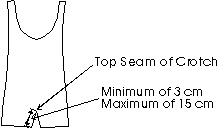
(e)It must have legs and the length of the leg must not exceed 15 cm from
the middle of the crotch. Measurementis to be taken on a line from the top
seam of the crotch down the inside of the leg. (See Diagram below)
(f)Any alterations to the costume which exceed the established widths, lengths
or thicknesses previously stated shall make the suit illegal for competition.
2. Undershirt
An undershirt (commonly known as a "T-shirt") of any colour or colours must
be worn under the lifting suit during the performance of the squat and bench
press but is optional for men in the deadlift. Women must wear an undershirt
as described above while competing on all lifts. The undershirt is subject
to the following provisions:
(a)Is not ribbed.
(b)Does not consist of any rubberized or similar stretchmaterial.
(c)Does not have any pockets, buttons, zippers or a reinforced collar. (See
diagram below)
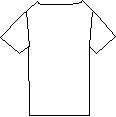
(d)Does not have reinforced seams.
(e)Is not constructed so as to place seams in a position which, in the opinion
of the IPF, might tend to assist the lifter in powerlifting competition.
(f)Is made either exclusively of cotton or polyester, or a mixture of cotton
and polyester. Denim is not acceptable.
(g)It shall not have sleeves which terminate either below the elbow or at
the upper deltoid. Lifters may not push the sleeves of such an undershirt
up to the deltoid when competing in IPF competitions.
(h)Fits loosely enough on the lifter's body to ensure that it does not afford
the lifter any physical support.
(i)Is plain or the official T-shirt of the contest in which the lifter is
competing or only bears the badge and/or inscription of the lifter's nation,
national or regional federation or sponsor. That which is offensive or likely
to bring the sport into disrepute is not allowed.The sponsor's logo must
also conform with item 8 (h).
3. Bench Shirt
Special bench shirts as approved by the technical committee and noted in
the list of appoved equipment and clothing issued periodically by the Committee
may be worn for the bench press. These and similar shirts are not permitted
to be worn for the execution of other lifts under any circumstances. Only
an undershirt as defined in the rules may be worn during the squat and
deadlift.
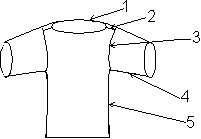
Conditions (a),(b),(c),(f),and (g) as defined for "Undershirt" above, item
2, also apply to the bench shirt. In addition, seams may only be placed in
the positions indicated in the diagram below.
4. Undershorts
A standard commercial "athletic supporter" or standard commercial undershorts
of any mixture of cotton, nylon or polyester (but not swimming trunks or
any other garmentconsisting of rubberized or similar stretch material except
in the waistband) may be worn under the lifting suit provided that:
(a)Any support to the body of the lifter which may be provided by the "athletic
supporter" or undershorts is limited to the lifter's lower abdominal wall.
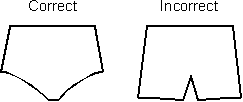
(b)The garment does not have legs and does not extend down over the lifter's
thighs. (See diagram below)
(c)Women may wear protective briefs or panties provided thatthey are not
deemed to be supportive in any way.They may also wear a bra provided that
the bra cup does not maintain its shape when placed upright upon a flat surface.
Tampons, sanitary napkins or similar articles when used for hygiene protection
are also permitted.
5. Socks
Socks may be worn.
(a)They may be of any colour or colours.
(b)They shall not be of such length on the leg that they come into contact
with any knee wrapping or knee cap supporter when in use.
(c)Full length leg stockings, tights or hose are strictly forbidden.
6. Belt
Competitors may wear a belt. If worn it shall be on the outside of the lifting
suit.
Materials and Construction
(a)The main body shall be made of leather or vinyl in one or more laminations
which may be glued and/or stitched together.
(b)It shall not have additional padding, bracing or supports of any material
either on the surface or concealed within the laminations of the belt.
(c)A standard metal buckle and studs are the only non-leather components
permitted. The buckle shall be attached at one end of the belt by means of
studs and/or stitching.
(d)The belt may have a buckle with one or two prongs or "quick release" type.
(e)A leather or vinyl tongue loop shall be attached close to the buckle by
means of studs and/or stitching.
(f)The name of the lifter, the lifter's nation, state or club may appear
on the outside of the belt.
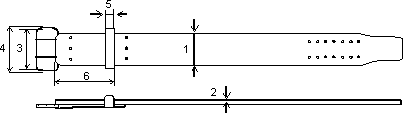
Dimensions
1.Width of belt maximum 10 cm.
2.Thickness of belt maximum 13 cm along the main length.
3.Inside width of buckle maximum 11 cm.
4.Outside width of buckle maximum 13 cm.
5.Tongue loop maximum width 5 cm.
6.Distance between end of belt and far end of tongue loop maximum 15 cm.
6. Shoes or Boots
Lifting shoes or boots shall be worn.
(a) Shoes shall be taken to include boots, sport shoes, trainers gymnastic
slippers or any foot covering that has a patterned moulding or foot type
outline that provides an inner sole.
(b) Shoes with metal spikes or cleats are not permitted.
7. Wraps
(a) Only wraps or bandages of a one ply commercially woven elastic that is
covered with polyester, cotton or acombination of both materials; or medical
crepe are permitted.Bandages of rubber or rubberized substitutes are strictly
forbidden.
(b) Wraps or plasters may be used as follows:
Wrists
1.Wraps not exceeding 1 m in length and 8 cm in width may be worn. Alternatively,
wrist bands not exceeding 10 cm in width may be worn. A combination of the
two is not permitted.
2.If wrist bands are wrap around style, with or without stitching to form
a sleeve, they may have velcro patches not exceeding 30 cm in total length
and 8 cm wide for securing them as well as a thumb loop. The total length
of the wrist band shall not exceed 50 cm. The velcro patches must be incorporated
within the 50 cm total length. The thumb loop shall not be over the thumb
during the actual lift.
3.A wrist wrap shall not extend beyond 10 cm above and 2 cm below the centre
of the wrist joint and shall not exceed a total covered width of 12 cm.
Knees
4.Wraps not exceeding 2 m in length and 8 cm in widthmay be used.A knee wrap
shall not extend beyond 15 cm above and 15 cm below the centre of the knee
joint and shall not exceed a total covered width of 30 cm. Alternatively,
an elasticated knee cap supporter not exceeding 20 cm in length may be worn.
A combination of the two is strictly forbidden.
5.Wraps shall not be in contact with the socks or lifting suit.
6.Wraps shall not be used elsewhere on the body.
Plasters
7.Two layers of plasters, bandages or bandaids may be worn on the thumbs.
These items may not be worn anywhere else on the body without official permission
of the Jury or Chief Referee. Plasters, bandages or bandaids may not be used
as aids to the lifter inholding the bar.
8.Contingent upon prior approval by the Jury, the official doctor, paramedic
or paramedical personnel on duty, may apply bandages to bodily injuries in
a fashion that would not grant the lifter an undue advantage.
9.At all competitions where a Jury may not be present and no medical personnel
are on duty, the Chief Referee shall have jurisdiction over the use of spot
plasters.
8. Inspection of Costume and Personal Equipment
(a) In large competitions when the allotted weigh in time is likely to be
insufficient to allow for the inspection of costume and personal equipment,
the Jury, at its discretion, may fix a separate time for the inspection and
drawing of lots. In normal circumstances this shall take place one hour before
the official weigh in, but may be varied as required by the Jury.
(b) A minimum of two referees or technical officers shall be appointed to
fulfil this duty. All items shall be examined and approved before being
officially stamped or marked.
(c) Bandages over permitted length shall be rejected, but may be cut to correct
length and resubmitted within the specified inspection time.It is the lifter's
responsibility to cut bandages.The examining referee is not permitted to
perform this service.
(d) Any item considered unclean or torn shall be rejected.
(e) The referees shall record each item on the official inspection sheet.The
inspection sheet shall be handed to the President of the Jury at the end
of the inspection period.
(f) If after the inspection, a lifter appears on the platform wearing or
using any illegal item or article not recorded on the inspection sheet, the
lifter shall immediately be disqualified from the competition.
(g) All items mentioned previously under Costume and Personal Equipment shall
be inspected prior to the competition together with any other items such
as headbands, mouthpieces, ribbons, etc.that the lifter may wish to wear
on the platform. Hats are strictly forbidden and may not be worn on the platform
during lifting. Items such as watches, costume jewelry, eyewear and feminine
hygiene articles need not be inspected.
(h) Nations or lifters wishing to take advantage of the rules regarding sponsor's
logos being worn on articles of costume and personal equipment, must apply
for permission to the General Secretary. The application must be made at
least three months prior to the published date of the first competition,
and must be accompanied by a fee of GB50 or such sum to be determined by
the preceding Congress. Upon permission being granted, the logo may be suitably
displayed in a position agreed between the IPF and the nation or lifter.
It may be worn for the remainder of that calendar year and the following
calender year. The fee shall only cover one sponsor and one nation. Additional
fees of GB50 each shall be required for other sponsors wishing to add their
logo to the costume or equipment. The IPF reserve the right to refuse permission
if it considers that a logo falls below the required standard of good taste
or contravenes any prior commitment under taken by the IPF with any other
contractor such as television or championship promoter. The IPF Executive
Committee reserves the right to limit the size of the logo. Nations or lifters
may display national emblems or badges without payment of a fee. Similarly
manufacturer's logos displayed upon IPF approved items of equipment for which
a sanction has been paid will not require additional fees.
(i) The IPF is to maintain a register of approved logos. Sponsors fees for
logos shall be divided 50% to the IPF and 50% to the regional federation
of the lifter. If the lifters regional federation does not operate a separate
bank account, then 50% of the fee will be paid to the filfters national
federation. Lifters wishing to wear sponsors logos must present a current
permit or receipt to the referee examining equipment.
(j) Any lifter successful in a world record attempt must immediately present
himself to the three referees for inspection. If the lifter is found to be
wearing illegal wraps or clothing, the lift shall be declared invalid and
the lifter shall be disqualified from the competition.
9. General
(a) The use of oil, grease or other lubricants on the body, costume or personal
equipment is strictly forbidden.
(b) The use of any form of adhesive on the underside of shoes or boots is
strictly forbidden.
(c) Baby powder, pool hall chalk, liquid chalk, resin, talc or magnesium
carbonate are the only substances that may be added to the body and attire.
(d) No foreign substances may be applied to the equipment or wraps.