I.P.F. TECHNICAL RULES
Part 4.
POWERLIFTS AND RULES OF PERFORMANCE
Squat
1. The lifter shall assume an upright position with the top ofthe bar not
more than 3 cm below the top of the anterior deltoids. The bar shall be held
horizontally across the shoulders with the hands and fingers gripping the
bar and the feet flat on the platform with the knees locked.
2. After removing the bar from the racks, the lifter must move backwards
to establish his position. The lifter shall wait in this position for the
Chief Referee's signal. The signal shall be given as soon as the lifter is
motionless and the bar properly positioned. The Chief Referee's signal shall
consist of a downward movement of the arm and the audible command "squat".
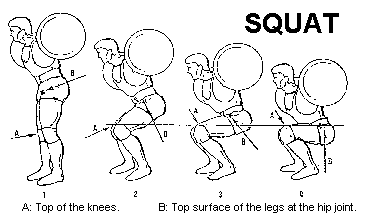
3. Upon receiving the Chief Referee's signal, the lifter must bend the knees
and lower the body until the top surface of the legs at the hip joint is
lower than the top of the knees. See diagram 2, 3, & 4)
Diagram 4 shows a lifter just below parallel. Point "B", the top surface
of the leg at the hip jiont below point "A", the top of the knee. A good
lift.
4. The lifter must recover at will without double bouncing or any downward
movement to an upright position with the knees locked. When the lifter is
motionless, the Chief Referee will give the signal to replace the bar.
5. The signal to replace the bar will consist of a backward motion of the
hand and the audible command "rack". The lifter must then make a bona fide
attempt to return the bar to the racks.
6. The lifter shall face the front of the platform.
7. The lifter shall not hold the collars, sleeves or discs at any time during
the performance of the lift. However, the edge of the hands gripping the
bar may be in contact with the inner surface of the collars.
8. Not more than five and not less than two spotter/loaders shall be on the
platform at any time.
9. The lifter may enlist the help of the spotter/loaders in removing the
bar from the racks; however, once the bar has cleared the racks, the
spotter/loaders shall not assist the lifter further with regard to proper
positioning, foot placement, bar positioning, etc.
10.The lifter may, at the Chief Referee's discretion, be given an additional
attempt at the same weight if failure in an attempt was due to an error by
one or more of the spotter/loaders.
Causes for Disqualification of a Squat
1. Failure to observe the Chief Referee's signals at the commencement or
completion of a lift.
2. Double bouncing or more than one recovery attempt at the bottom of the
lift.
3. Failure to assume an upright position with the knees locked at the
commencement and completion of the lift.
4. Any shifting of the feet laterally, backwards or forwards, during the
performance of the lift.
5. Failure to bend the knees and lower the body until the top surface of
the legs at the hip joint are lower than the top of the knees.
6. Changing the position of the bar across the shoulders after the commencement
of the lift.
7. Contact with the bar by the spotter/loaders between the referee's
signals.
8. Contact of elbows or upper arms with the legs.
9. Failure to make a bona fide attempt to return the bar to the racks.
10. Any dropping or dumping of the bar after completion of the lift.
11. Failure to comply with any of the requirements contained in the general
description of the lift which precedes this list of disqualifications.
Bench Press
1. The head of the bench must be placed on the platform facing the Chief
Referee.
2. The lifter must lie on his back with head, shoulders and buttocks in contact
with the flat bench surface. His hands must grip the bar with a "thumbs around"
grip, thus locking the bar safely in the palms of the hands. His shoes must
be flat on the floor. This position shall be maintained throughout the
attempt.
3. If the lifter's costume and the bench surface are not of a sufficient
colour contrast to enable the referees to detect possible raising movement
at the points of contact, then the bench surface may be covered
accordingly.
4. To achieve firm footing the lifter may use flat surfaced plates or blocks
not exceeding 30 cm in total height, to build up the surface of the platform.
Whichever method is chosen, the entire foot must be flat on the surface.
If blocks are used, they shall not exceed 45 cm x 45 cm.
5. Not more than four and not less than two spotter/loaders shall be in
attendance.The lifter may enlist the help of the spotter/loaders in removing
the bar from the racks.The lift off, if assisted by the spotter/loaders,
must be to arms length.
6. The spacing of the hands shall not exceed 81 cm measured between the
forefingers. The use of a reverse grip is forbidden.
7. After removing the bar from the racks or receiving it from the
spotter/loaders, the lifter shall wait with elbows locked for the Chief Referee's
signal. The signal shall be given as soon as the lifter is motionless and
the bar properly positioned.
8. The signal shall consist of a downward movement of the arm together with
the audible command "start".
9. After receiving the signal, the lifter must lower the bar to the chest,
hold it motionless on the chest with a definite and visible pause and then
press upwards with an even extension of the arms to arms length. When held
motionless in this position the audible command "rack" is given.
Causes for Disqualification of a Bench Press
1. Failure to observe the Chief Referee's signals at the commencement or
completion of the lift.
2. Any change in the elected lifting position during the lift proper, i.e.
any raising movement of the head, shoulders, buttocks or feet from their
original points of contact with the bench or the floor, or lateral movement
of the hands on the bar.
3. Heaving or bouncing or sinking the bar after it has been motionless on
the chest.
4. Any uneven extension of the arms during the lift.
5. Any downward movement of the bar in the course of being pressed out.
6. Failure to press the bar to full extension of the arms at the completion
of the lift.
7. Contact with the bar by spotter/loaders between the Chief Referee's
signals.
8. Any contact of the lifter's feet with the bench or its supports.
9. Deliberate contact between the bar and the bar rest supports during the
lift in order to make the press easier.
10. Failure to comply with any of the requirements contained in the general
description of the lift which precedes this list of disqualifications.
Dead Lift
1. The bar must be laid horizontally in front of the lifter's feet, gripped
with an optional grip in both hands, and lifted without any downward movement
until the lifter is standing erect.
2. The lifter shall face the front of the platform.
3. On completion of the lift, the knees shall be locked in a straight position
and the shoulders back.
4. The Chief Referee's signal shall consist of a downward movement of the
hand and the audible command "down". The signal will not be given until the
bar is held motionless and the lifter is in the apparent finished position.
5. Any raising of the bar or any deliberate attempt to do so will count as
an attempt.
Causes for Disqualification of a Dead Lift
1. Any downward movement of the bar before it reaches the final position.
2. Failure to stand erect with the shoulders back.
3. Failure to lock the knees straight at the completion of the lift.
4. Supporting the bar on the thighs during the performance of the lift.
5. Stepping backward or forward although lateral movement of the sole or
rocking feet between ball and heel is permitted.
6. Lowering the bar before receiving the Chief Referee's signal.
7. Allowing the bar to return to the platform without maintaining control
with both hands.
8. Failure to comply with any of the requirements contained in the general
description of the lift which precedes this list of disqualifications.
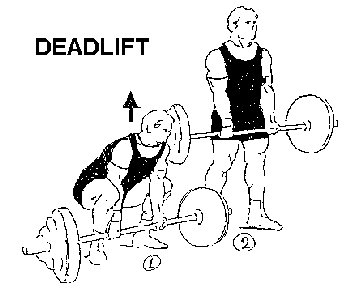
The correct finish position in the deadlift is shown at 2 above. The lifter
must be standing erect with the shoulders back and the knees locked.