









MATICA SLOVENSKA ABROAD
Matica Slovenska Abroad (MSA) is a non-profit organization that has been chartered as an independent fraternal, non-political, cultural organization representing all Slovaks living abroad.
The aim of the MSA, which is incorporated in Canada, provides moral support and instigates a strong national identity among Slovaks emigrating abroad either for their material needs and work or for political harasment of the previous communist government. These two groups left their birthplace, Slovakia, but they still love their roots under the High Tatras located in the heart of Europe.
Matica Slovenska Abroad was established by Mr. Jozef Ciger Hronsky in Buenos Aires, Argentina in August 1959. He left Slovakia after a harsh persecution by communists after WWII. The motto of the MSA clearly defines her goals For God, For Independant State and Country, which was an extended slogan of Mons. Andrej Hlinka, father of the Slovak Nation For God and for the Country.
FACTS ABOUT SLOVAKIA
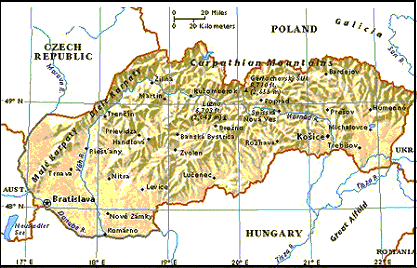
The Slovak Republic is located in the heart of Europe, standing at the north-west end of the Carpathian Mountains and forming a clear barrier between the plains of Poland to the north and Hungary to the south. The Slovak Republic also shares borders with the Czech Republic in the north-west, Austria in the south-west and Ukraine in the east. At present there are 5.5 million Slovaks living in the Slovak Republic and almost the same population resides abroad.
The spectacular High Tatra alpine range runs along the Slovakian north-eastern border, shared with Poland. Gerlach peak (2655 meters) is the highest of the mighty Tatra peaks. Forests, mainly spruce, oak and birch, cover the Country despite centuries of deforestation. Wildlife including bears, wolves, lynxes, otters and mink live in the High Tatras. The national parks outside the Tatra also include most of the aforementioned animals. Deer, pheasants, partridges, ducks, wild geese, storks, eagles and vultures are also seen throughout the countryside.
The continental climate over the most of the Slovak Republic is comprised of warm summers, cold snowy winters and generally dry conditions. July is the hottest month.
WHAT TO VISIT ?
May, June and September are prime tourist months. Most Slovaks and visitors from Hungary, Austria and Germany travel especially to the Tatra Mountain resort areas. Thermal spas, castles, museums, and other tourist attractions, including excellent theaters are available for at least 10 months.
Since 1989, Slovakia has been a bargain for travelers more so than the neighboring Austria, Poland, Hungary or Czech Republic. Food, admissions, transportation and accommodation are relatively cheap. For example, a budget meal is $3 to $7 dollars (Canadian) and a budget bed is $ 20 to $25 dollars. A mid-range hotel is less than $55 dollars per night including breakfast.
WHO ARE SLOVAKS?
Historical Overview
Along with the Poles and Czechs, Slovaks belong to the group of the Western Slavic people. Slovaks were the first of the Slavs to become Christianized. In 828 AD the first Christian church was built in Nitra. Beside their centuries of existence, the Slovaks distinguished themselves from their neighbors by two social and cultural criteria, namely language and character. These fundamental differences shaped the political identity of Slovaks, and stimulated their legitimate aspiration to independence.
The arrival of Cyril and Methodius, two Byzantine missionaries' (863 A.D), had an enormous cultural, national and political meaning. Their arrival to Nitra provided our ancestors with the establishment of written and spoken old-Slavic language. After 905 AD, historians used to look at Slovak's political and constitutional history as entirely absorbed by the Kingdom of Hungary, this however is a simplification. The Magyars did not subdue all Slovak regions at the same time. The Slovaks continued in their traditional way of speaking and thinking. In short, the village and the church and Matica Slovenska literally saved the national consciousness of the Slovak speaking population.
After the disintegration of the Austria-Hungary monarchy in 1918, the Slovaks and Czechs agreed on the original conception of Czecho-Slovak State. The Cleveland Agreement signed on October 25th, 1915 between the Slovak League of America and the Czech National Federation provided the grounds for a Confederation. Another important step in this direction was the Pittsburgh Pact, signed on May 30th, 1918 by both the Slovak League of America and the Czech National Federation with the Czech Catholic Alliance. This document adopted the project of a Czecho-Slovak Federal State. From the very beginning, there was a visible Czech opposition to the idea of the Confederation. The Czechs preference was for a centralized State. Slovaks were disappointed with this marriage and their struggle for independence continued until 1939. On March 14th, 1939 the Slovak Diet enacted law stating that the Slovak Land constitutes itself a sovereign and independent State of Slovakia. The capital of the Republic was Bratislava. It was a golden age for the Slovak nation. Slovaks enjoyed the highest standard of living in history. Unfortunately, after World War 2, Slovakia ceased to exist. The President of the first Slovak Republic, a Roman-catholic priest ThDr. Joseph Tiso was executed and for many Slovaks, he is a martyr who died for the Slovak nation.
The Country was thrown into an unwanted Czechoslovakia union again. Communists from 1948 governed the second Czechoslovakia until December 28th, 1989. The second Slovak Republic was established January 1st, 1993.
The Preamble of the Slovak Republic Constitution starts as:
We, the Slovak People bearing in mind the political and cultural heritage of our predecessors, the experience gained through centuries of struggle for our national existence, and statehood, mindful of the spiritual bequest of Cyril and Methodius and the historical legacy of Great Moravia, recognizing the natural right of nations to self-determination., together with members of national minorities and ethnic groups living in the Slovak Republic; in the interest of continuous peaceful cooperation with other democratic countries; endeavoring to implement democratic forms of government, guarantee a life of freedom, and promote spiritual, cultural and economic prosperity.
This excerpt from the Constitution documents that Slovaks have encompassed their history and can see their destiny in unification with other democratic Countries in Europe.
E-mail: [email protected]
