|
Ph.D.
Thesis: A Multi-Objective Inverse Method for Obtaining Constitutive
Material Parameters of Textile Composites Using Two Hyperelastic Models
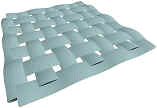 Numerical simulation
of forming processes has been an important means for material selection,
tool design, and process optimization. A critical component of simulation,
however, is an accurate material constitutive model, describing the
response of the material under possible modes of deformation. The accuracy,
in turn, is linked to the tests and techniques applied for identification
of constitutive models: the more elaborate the identification, the more
reliable the material parameters. Numerical simulation
of forming processes has been an important means for material selection,
tool design, and process optimization. A critical component of simulation,
however, is an accurate material constitutive model, describing the
response of the material under possible modes of deformation. The accuracy,
in turn, is linked to the tests and techniques applied for identification
of constitutive models: the more elaborate the identification, the more
reliable the material parameters.
For
textile composites, uncontrollable factors such as contact friction,
misalignment, slip, variations in local fiber volume, and tow compaction
are sources that generate considerable scatter in the response of fabrics.
Accordingly, characterization methods occasionally suffer from non-repeatability
of test data even under similar testing conditions. Furthermore, it is
typical that different deformation modes result in different sets of
material parameters. If the variance of material response within
replication of tests and deformation modes is neglected, then the
identification of model parameters can be far from the true material
behavior.
In
order to confront the above shortcomings, this work is an attempt to
elaborate on the characterization of textile composites using a new inverse
method by means of a signal-to-noise weighting scheme, and two constitutive
models by means of a phenomenological invariant-based approach. A full
identification of the developed constitutive models for a typical woven
fabric is applied using the introduced inverse method and a set of data
from standard testing methods, with close attention to the behavior of the
composite constituents in a macro level. Particularly, the effects of
complex fiber-resin interactions and fiber misalignment are introduced. A
novel modified picture frame test is also studied and used for validating
the models.
From
the results of this work, it is expected that the use of a number of test
methods simultaneously and the inclusion of all the data generated from
them may not only be useful, but can also be critical for better
characterization of this class of materials.
M.Sc.
Thesis: On Optimization of Mechanical Components using Numerical and
Statistical Methods
|
In
this work, multiple criteria decision-making (MCDM) models are applied
for the optimization of mechanical components. The proposed models are
particularly used when objectives and constraints of a problem are not
presented explicitly (e.g., material selection), and only some
informational data (e.g., from computer or physical experiments)
represent the system behaviour.
|

|
B.Sc.
Thesis: Design of 5-Speed Manual Gearbox (for national car ‘ARROW’)
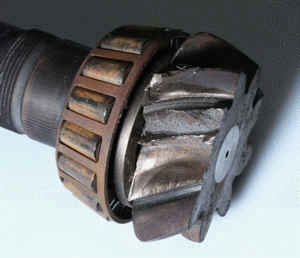 In this work,
appropriate speed ratios according to given engine performance of the
national car "ARROW" are first selected. Following, the component
design of a 5-speed manual gearbox is conducted using a user-defined design
code. In every stage of the stress analysis, a subroutine has been embedded
so that the final version of the code can be applied to any compatible
gearbox. The work has been awarded the best thesis of the year by the
Iranian Society of Mechanical Engineers (ISME). In this work,
appropriate speed ratios according to given engine performance of the
national car "ARROW" are first selected. Following, the component
design of a 5-speed manual gearbox is conducted using a user-defined design
code. In every stage of the stress analysis, a subroutine has been embedded
so that the final version of the code can be applied to any compatible
gearbox. The work has been awarded the best thesis of the year by the
Iranian Society of Mechanical Engineers (ISME).
|