|
| |
|
|
|






|
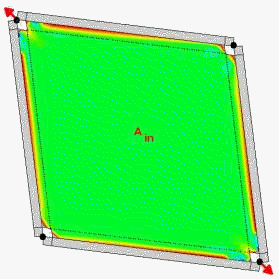
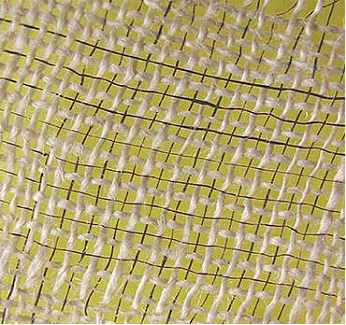
Current Research 1- A New Dynamic Signal-to-Noise Identification Method for Characterization of Fiber Reinforced Textile Composites During a previous work, a new framework for the inverse identification of material models was developed that is applicable to a variety of engineering problems. The developed multi-objective inverse method was used for the identification of two material models for a typical textile composite under basic deformation modes in quasi-static loading conditions. There is therefore the need for further extension and application of the method to different types of composites under more complex deformation modes, particularly rate/temperature dependent applications. Accordingly, as the main objective of the current research, it is proposed to elaborate on the characterization of composite materials for these applications. To this end, a new dynamic signal-to-noise identification scheme is under development.
Upon the
completion of this research, it is expected that the understanding
and modeling of non-repeatability in material response, which is a
problem that has recently gained significant attention in textile
composite literature, will be enhanced. Particularly, it will improve
the reliability of rate and temperature dependant constitutive model
parameters used in simulation and optimization of forming processes.
2- Application of a new adaptive one-factor-at-a-time design of experiments algorithm in the layout optimization of composite laminates using FEM (collaborative project with the robust design group@MIT)
Sample Research Project Collaboration (2005)
Modeling
and Optimization of Nail Reinforcement in Femur Bones
"Multiple-Criteria
Optimization of a Cold Heading Process using Finite Element Analysis
and a Taguchi Approach", Master Thesis by Christine El-Lahham,
Department of Mechanical Engineering, McGill University, Montreal,
Canada, 2004
Sample Industrial Projects "Constitutive Models for the Study of Woven Fabrics Under Basic Deformation Modes", Conducted by Abbas S. Milani and James A. Nemes, Industrial Material Institute, National Research Council (NRC), Boucherville, Canada, 2002 "Design of Override Gear for National Car "ARROW", Conducted by Abbas S. Milani, Reza T. Faal and M. Meigunpoori, IUST in collaboration with Mega-Motor Inc., Tehran, Iran, 1998
Sample Packages used Abaqus, SolidWOrks, Catia, Autocad, Matlab, Mathematica, LabView, Visual Basic, Fortran, C++, MOWR (multi-objective weighted regression, developed during Ph.D.), Gearbox Design (developed during B.Sc. & M.Sc.)
|
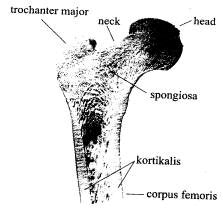 The
femur or thigh bone is the longest (in length), largest (in volume)
and strongest (in mechanical ability to resist deformation) bone of
the human body. Osteoporosis in the femur is diagnosed when its
strength (often in the neck region) is weakened or it is fractured.
The fracture is frequently seen in elderly people, particularly women.
The
femur or thigh bone is the longest (in length), largest (in volume)
and strongest (in mechanical ability to resist deformation) bone of
the human body. Osteoporosis in the femur is diagnosed when its
strength (often in the neck region) is weakened or it is fractured.
The fracture is frequently seen in elderly people, particularly women.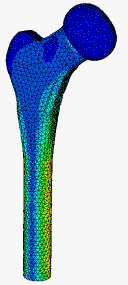
This page last modified on Macrh 24, 2005