
 A Black-chinned Story

Mark's Hummingbirds
Mark's Hummingbirds
A Black-chinned Story
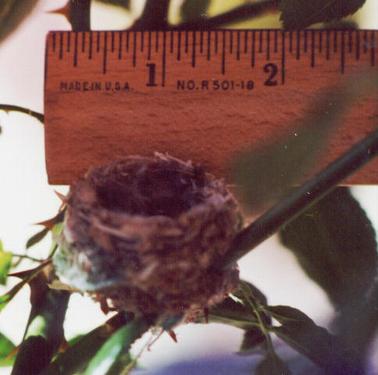
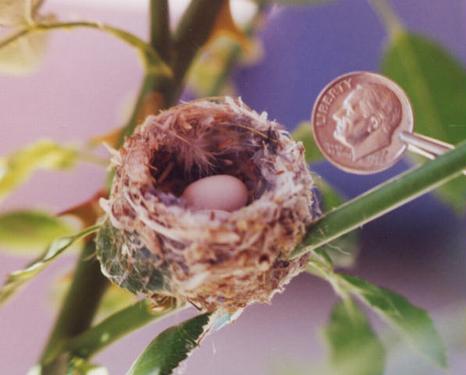
That day she did not incubate the egg at all. That night as it became very dark I was afraid something had happened to her because she was not at the nest once it had become very dark outside. I don't know if she finally spent the night there but my impression was that she had not. At dawn's light the next day there she was, still building, adjusting (you know, redecorating) and coming and going. On my morning inspection there was still only one egg. Later that day around noon I checked again and there it was, egg number two.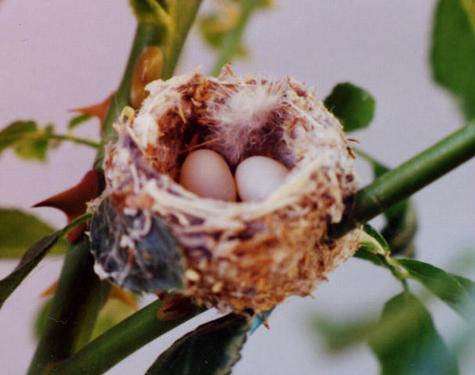
That night she was on the nest before dusk where she remained for the next 15 days except for short 5 to 10 minute absences to forage for food and get more nest material. At this point I figured she had a vested interest in her nest and would not abandon it so easily. I eventually moved my video camera outside onto a tripod angling down at a macro range of about 18 inches. I would let it run for 2 hours at a time and then glean any parts onto VHS tape that I liked. When Mom returned she examined my camera closely and once she determined that it posed no particular threat, she plopped down to continue her incubation duties.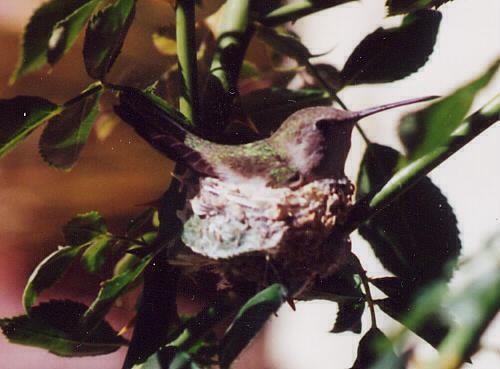 It got to the point that I could go out and set up or take down the camera with her sitting on the nest. She would watch me closely but would not leave. Remember this camera was only about 12-18 inches from her.
Hatching
On the morning of the 15th day the first egg hatched. It looked like a small black bug, so tiny. You could see a teeny little yellow beak that looked nothing at all like a hummingbird. She began feeding immediately. What now seemed like a huge bill on Mom going deep into that tiny baby looked almost frightening at first. That baby was a true sword swallower. I remember thinking, "I hope she knows what she is doing". Apparently she did. The next day, early, I checked for the second hatchling but with no luck. Then at noon I checked again and there was our second little baby. For the next 21 days she fed them on average 3 times an hour each.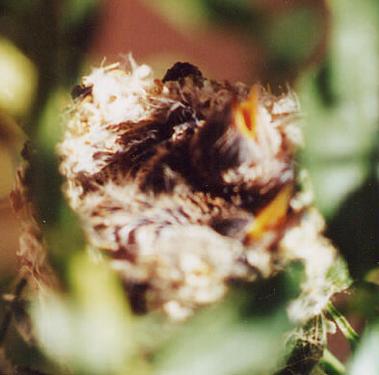
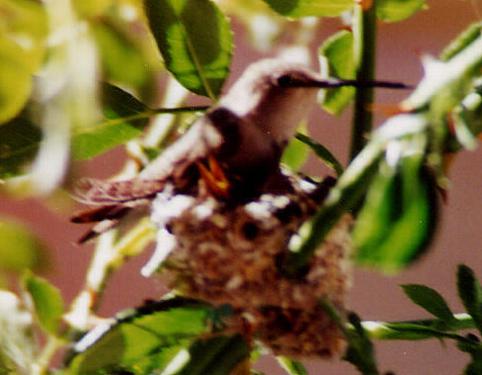
Maybe a little more during the first half and a little less at the end, but averaging 6 feedings an hour (3 apiece). We humans can be thankful we don't have to feed our young that often. On the other hand, these small babies instinctively would not make a mess in their nest and would do whatever was necessary to hike their little rear ends up over the edge of their nest to go to the bathroom.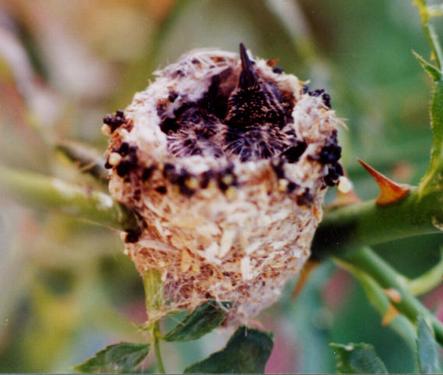
While most went completely over the rim of the nest it still ended up with little hummer poops around the outside rim of the nest. Still, you have to be impressed! OK, OK, here's one where the hummer has a big work-saving advantage over us humans. I abandoned my business scheme to market disposable hummingbird diapers after seeing that.
As the days progressed the babies began to look more like little birds. They had little fluffy feathers by about the 9th day. They opened their eyes around this time also, but not for long. When not eating they spent most of their time sleeping.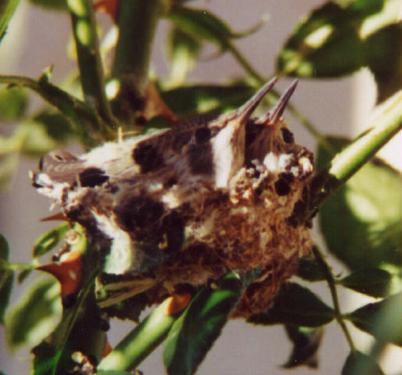 By the end of the end of the second week you could see them stretch and make out the shape and beginning feathers of their wings. Around this time I witnessed the first flapping. They seemed to take turns flapping furiously to exercise their wings. Of course, they would wait until Mom wasn't sitting on them to do that. When I would go out to photograph or change the video camera, if Mom wasn't around, she would be there within a few seconds. I got the impression that she kept an extremely close eye on things. The little babies would stare at me when I was near them with an expression reminiscent of a toddler's confused look when they don't understand something.
Housekeeping and a Little Help From Her Friends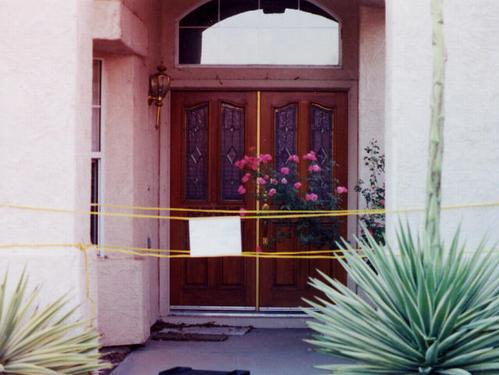
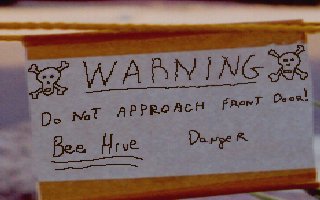
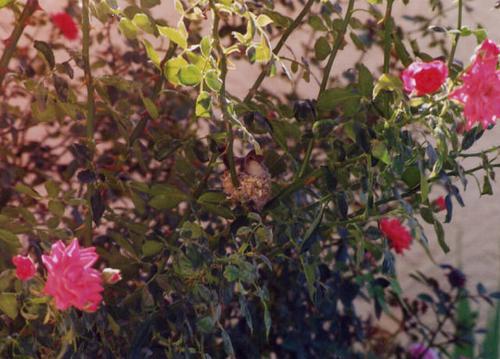
As soon as the nest was discovered I roped off the front porch with a yellow rope barrier since it was hanging right in the walkway. Any delivery person or solicitor could have accidentally become snagged on that rose bush branch and sent the eggs/babies flying. Then of course, I would have had to kill them. So not being interested in doing hard time I included a sign which said "Danger Bee Hive....Stay Away". For good measure I put a few skulls & crossbones on it (after all I don't think it would have helped if I had said "Keep Away--Hummingbird Nest").............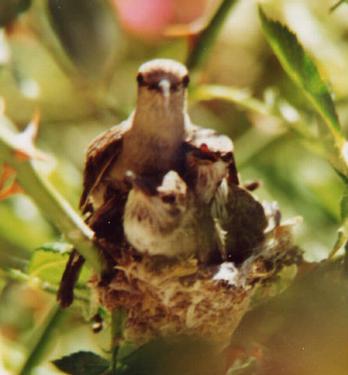 Throughout the nestling's time in the nest, Mom would continually bring more bits of twigs and spider webs to perform home repairs. Before the kids would leave the nest it was badly stretched and almost flat on top. The Arizona sun was only on the nest about two hours of each day during which time Mom was almost always there trying to shade her children by spreading her wings over them and standing in the way of the sun.
One day as the Arizona winds started to whip up in May I became afraid of her losing her babies to the wind when she was not around. When she was around she would hold them tight by sitting on them and I'm sure holding on with her feet. I have video of her feeding the babies while perched on the edge of the nest when a sudden gust of wind blows the branch several inches. She immediately hopped on top of the babies to hold them securely while continuing to feed them sort of over her shoulder. So being a semi-handyman I set to work. Taking a 3 foot garden stake, a patio umbrella stand, and some nylon cord I went out to see her. She allowed me to sit under her nest while moving the stand and pole in place. I wedged it into a Y in a branch and lashed it securely with cord. I was amazed to see her just watching me closely because she was perched on the nest only about 12" above me. She never left. I went back inside and looked out the window. Within a few seconds she took off and hovered inspecting my handiwork from all angles. Seemingly it met her approval and she returned to the nest. After this the strong winds only jiggled the nest some. I have wondered if she knew I was in my own way trying to help. The only other thing I did was to spray a small barrier at the very bottom of the bush and my pole with a pesticide to block any ants avenue of attack. I had seen that fire ants will devour nestlings of many birds during the night in the southern US so I became concerned since we do have those miserable little creatures here also.
Black-chinned Story Page 1 | Page 2 | Page 3 |