 |
|
|
|
|
|
|
|
|
|
|
|
|
|
|
|
|
|
|
|
|
|
|
|
|
|
|
|
|
|
|
|
|
|
Our Writing Program |
|
 |
|
|
|
|
|
|
|
|
|
|
|
|
|
We love to write in our classroom as it is another way to express our ideas and thoughts. Learning to write is just as exciting as learning to talk. Children go through numerous stages as they develop the skills needed to be good writers. As parents and teachers we need to encourage and praise their efforts through these stages and remember not to expect perfection.
Our classroom goal is for children to enjoy writing and to begin to understand how to become a better writer. Neatness is important and should be strived for daily. Just as children learn to speak gradually, they learn to write gradually. Celebrate their growth!
Our writing program consists of numerous kinds of writing:
Interactive Writing: Interactive writing is when the class works as a group to create a story. The teacher does a lot of modelling and students have some control of the pen. A lot of teaching occurs during an interactive writing session and it is later used as a reference for individual writing.
Experiential Writing: Experiential writing is when children write short stories of personal experiences. These stories are often written in notebooks and are editted for corrections but are not recopied. A student may chose one or two of their favorite stories to further develop and publish throughout the year. The ideas for these stories come from their sheet called " My topics" which was completed at home.
Journal Writing: Journal writing is when children write short stories to retell a sequence of events. It is excellent for teaching students how to make order in a story.
Class Books: Our class books are made up of personal stories on the same subject. To create our class books, children go through the complete writing process. We begin by making a story map or web. Using the ideas from the web, students compose a rough draft which they later edit with their peers. Following the peer editting, I edit with the children. They then make corrections and once they have my approval they are able to develop their good copy (final draft). I then bind all the stories into one "class book" and everyone has a chance to take it home.
Letter Writing: In letter writing, children are taught proper rules while composing letters to Santa, their family and various authors. Sometimes the letters are delivered other times they are not. |
|
|
|
|
|
|
|
Our Spelling Program |
|
|
|
|
|
|
|
|
|
|
|
|
|
Our spelling program is a major part of our writing program. Grade one students work through 32 units of ten words and grade twos have 32 units of 15 words. The units consist of various spelling patterns and high frequency words that have been determined appropriate for their grade level. The letterland program is also used to provide students with unique rules and tricks to help them remember spelling patterns. These letterland clusters are posted around the room with samples of words that follow the rule below. At the back of the classroom we have a word wall where commonly used words are located for children to use properly in their work. All words found on the word walls are expected to be used properly. A notation of "ww" will be placed by any word wall words misspelled in their writing. All spelling words are also expected to be spelled correctly once taught. A notation of "sp" will be placed by any spelling word that is misspelled in their writing. Students are also expected to make use of their word books, where they have placed numerous words that they commonly use in their writing. I will not spell words for the students! If they have made an honest attempt at unknown words, I consider that good enough. |
|
|
|
Grade 1 Spelling Lists |
|
|
 |
|
|
|
|
|
|
Grade 2 Spelling Lists |
|
|
|
|
|
|
|
|
|
Letterland |
|
|
|
|
|
|
|
|
|
Students Become Authors |
|
|
|
|
|
|
|
|
|
 |
|
|
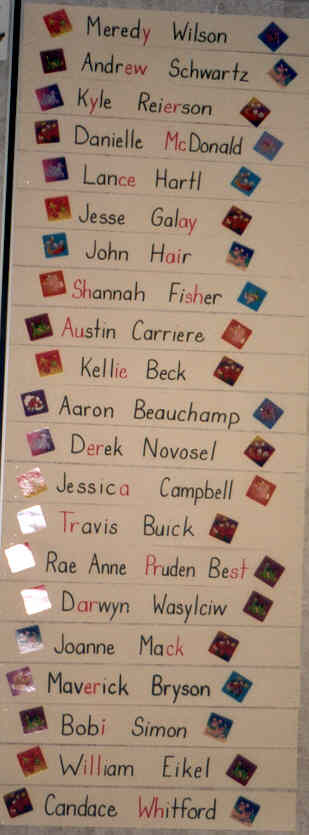
The name word wall lists all the students first and last names for easy reference. It also has common spelling patterns that I have found in their names highlighted in red. I can refer students to the name wall for help. For example: Candy is just like Meredy (if they are stuggling with y says e). |
|
|
|
|
|
|
 |
|