How sustainable are our choices?
People depend on nature for the supply of food, energy and fibre, the absorption
of waste products and other life-support services. If we are to continue
to have good living conditions, we must ensure that nature's productivity
isn't used more quickly than it can be renewed, and that waste isn't discharged
more quickly than nature can absorb it. To find out whether nature provides
enough resources to secure good living conditions, the Task Force on Healthy
and Sustainable Communities at the University of British Columbia has developed
an ecological accounting tool: the ecological
footprint
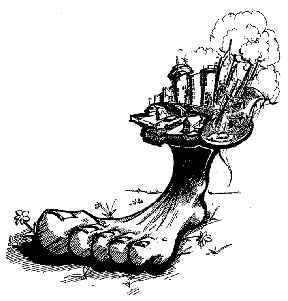
Our ecological footprint
The ecological footprint is an accounting tool
for ecological resources. Categories of human consumption are
translated into areas of productive land required to provide resources
and assimilate waste products. The ecological footprint is a measure of
how sustainable our life-styles are.
The ecological footprint of the average Canadian
adds up to 4.8 hectares. This is the total amount of land required
for food, housing, transport, consumer goods and services. Energy is a
large component of the footprint: some 2.9 hectares are necessary for the
long term provision of a biological substitute for fossil fuels. The second
largest component at 1.1 hectare is agriculture for food supply and consumer
goods. Forestry takes up 0.6 hectare to supply the fibre for housing and
consumer goods. Finally, the built environment takes up 0.2 hectares for
housing and transport.
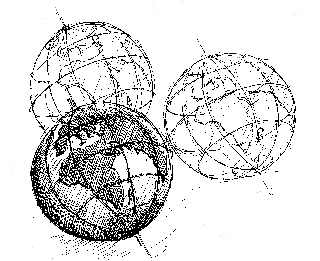
Can everybody on earth live like
the average North-American today?
No. In fact, if everyone on earth lived like the average North American,
it would require at least three earths to provide all the material and
energy she or he currently uses. Preliminary estimates show that the ecological
footprint of today's consumption in food, forestry products and fossil
fuels alone might already exceed global carrying capacity by roughly 30%.
About 3/4 of the current consumption goes to the 1.1 billion people who
live in affluence, while 1/4 of the consumption remains for the other 4.6
billion people. This demonstrates the ethical implications of the sustainability
dilemma and questions economic expansionism as a remedy for poverty.
Ecological footprint for the Lower Fraser Basin
The ecological footprint can be used to establish the amount of ecological
resources required to support a comunity or region. The Lower Fraser Basin,
for example, contains approximately 2 million people, but the area is far
smaller than that needed to supply the resources for this population. At
the average footprint of 4.8 hectares, the Lower Fraser Basin needs an
area 20 times larger than what is actually available for food, forestry
and energy. This deficit is "appropriated" from other regions by the import
of resources into the basin. With the growing population this appropriation
will only increase.
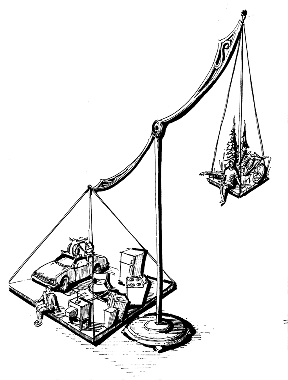
Different life-styles, contrasting footprints
Individual life-style choices have a strong influence on the ecological
footprint. These choices include housing, transport, food, energy and water
consumption, and other non-consumptive goods. For example, compare how
much ecologically productive land is necessary to commute by bicycle, bus
or car. Most of the car's land is required to absorb CO2. Most the biker's
land is required to provide the extra food for quenching the biker's hunger.
 Click here to Estimate
your own footprint on the earth! (This
site is American however, and calculations come out in acres instead of
hectares!)
Click here to Estimate
your own footprint on the earth! (This
site is American however, and calculations come out in acres instead of
hectares!)
Click here to learn
about Canada's
Ecozones and to see a map.