
| Introduction
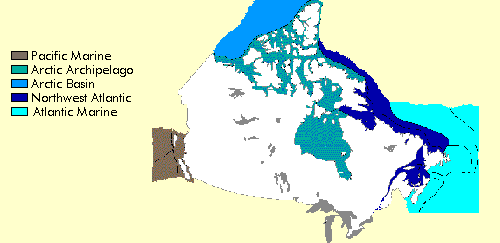
Canada is among the largest nations on the globe. Within the country’s borders, there are significant parts of three major oceans, large tracts of the arctic environments, huge expanses of varied forest types, extensive areas of plains and mountains, major wetlands, many kinds of wildlife, all sizes and densities of fresh-water lakes and many other varied phenomena. The natural diversity throughout the country’s landscapes and seascapes is seemingly endless. With such variety, Canada is far too complex to be described as a single ecosystem. Canada has 20 major ecozones.
They include 15 terrestrial units and 5 marine units. Each of these ecozones
covers vast areas of Canada. There are distinctive mosaics of characteristics
within each zone. The boundary or change from one ecozone to the next is
often gradual. Each of these ecozones offers different opportunities and
constraints for particular uses such as forestry, agriculture, recreation,
conservation, urbanization, fishing, and so on. An understanding of the
characteristics of an ecozone helps us to understand that life on Earth
depends on a balance among many factors. The maps of the 15 terrestrial
ecozones and 5 marine ecozones are colour coded and include the proper
names of the ecozones found in Canada.
|
|
| Classifying
Ecozones
The use of 'ecozones' has been a convenient way to simplify the ecosystem complexity that exists in Canada. Ecozones are used to describe large ecosystems. They are simply distinctive areas of the earth’s surface throughout which similar characteristics prevail; these characteristics often inter-linked and endure over long periods of time. The Prairie ecozone is
an example. It occupies a large expanse of the landscape in south-central
Canada. Throughout the area, the soils, landforms, vegetation, wildlife,
human activities, water bodies and climatic characteristics are often unique
and together form a rather distinctive package. For example, the grassland
soils, the great plains, the native grassland area, and the pronghorn habitat
are a few to note. The Prairie Ecozone's mosaic of characteristics are,
however, markedly different from other large order ecozones such as the
arctic or the boreal.
|
|
| Defining
Ecozones
Ecosystems can be defined as areas where organisms and their physical environment endure as a system. Organisms include plants, insects, animals, people and many other forms of living things. The physical environment involves things such as rocks, soils, climate and water. The organisms and the physical environment are the basic ingredients upon which the structure, function and processes of ecosystems are established. Ecosystems are nature’s basic
units -- the earth's life support systems. Organisms cannot have life without
a suitable physical environment; and a physical environment is equally
lifeless without organisms.
|
|
| Relationships
and Composition
Each ecozone is created and sustained by the interplay of numerous biological and physical characteristics and not by any single one. People intuitively capture the special character of an ecozone such as the prairie ecosystem by their use of many simple phrases. Consider all the attributes and qualities that are implied by phrases such as the prairie grasslands, the great central plains, the bread basket of Canada, the cereal grain and ranching heartland, the native habitat of the buffalo, the nation’s farmscape, the prairie climate, the grassland soil zone and the prairie potholes. Beyond expressing something about the overall character of the region, these phrases also speak of the underlying relationships and connections that people inherently know are peculiar to this ecosystem. The prairies are productive agro-ecosystems for cereal grain production. Why is this so? Many factors contribute -- the deep and nutrient-rich soils, the extensive tracts of farmland, the adaptability of plants in the grass family, and the warm, dry climate. |
|
| Sustaining
Ecozones
Understanding ecozones in the broader context is vital today. The planning and management of large areas are increasingly difficult tasks. Most ecozones within Canada are subject to many competing resource use pressures, to local and distant sources of stresses, and to varying lobby groups to either conserve or develop resources. The sustainability of the eastern Boreal Forest ecozone is as an illustration. The success is dependent upon balancing interests ranging from harvesting timber, protecting natural areas and biodiversity, maintaining recreational values, protecting fish and wildlife habitat, conserving water quality, to supporting hydroelectric and mining developments. Which types of activities should be encouraged? How much of the area should be allocated to what use? What will be the local impacts of these activities? How the acid rain pollutants transported from the northeastern states be further aggravated by regional land uses? Answering these questions is a tasking effort. Land planning and resource management need to be supported by comprehensive information and knowledge about large ecosystems and their components sub-systems. |