 |
|
|
|
|
|
|
|
|
|
|
|
|
|
|
|
|
|
|
|
|
|
|
|
|
|
|
|
|
|
|
|
|
|
|
|
|
|
|
|
|
|
|
|
|
|
|
|
|
|
|
|
|
|
|
|
|
|
|
|
|
|
|
|
|
|
|
|
|
|
|
|
|
|
|
|
|
|
|
|
|
|
|
|
|
|
|
In 1914 Australia had only been settled by Europeans for 126 years, it had been 63 years since the Gold Rushes and 101 years since the crossing of the Blue Mountains, and despite Federation in 1901, most Australians still felt close ties with Britain. The population of Australia at the time was 4 � million and increasing, with 40,000 mostly British migrants arriving each year. A popular misconception is that Australia was still a small barren colonial outpost of the British, this was not the case. In 1914 Australians lived in a country that had one of the highest wages of the world, Australians had already become a nation of outdoor recreation lovers and the public school education system was amongst one of the best in the world. Dams and weirs along the Murray Darling Rivers was just one of the many Government funded programs in the pipelines, Canberra, the recently chosen new nation capital was still to be built, Australia had built up a wool industry and sheep export. Australia was looking into a bright future. |
|
|
A NATION'S PRIDE |
|
|
|
|
|
Gallipoli,
25th April - 20 December, 1915 |
|
|
|
|
|
 |
|
|
|
|
|
"BROTHERHOOD WAS NEVER LIKE IT; FRIENDSHIP WAS NOT THE WORD
BUT DEEP IN THAT BODY OF MARCHING MEN
THE SOUL OF A NATION STIRRED"
Banjo Patterson |
|
|
|
|
|
|
Australians, even though they were at the other end of the world were kept up to date with the situation in Europe and so it came as no surprise to the Australian government and people when Britian declared war on Germany on August 4th, 1914 at 11pm. Prior to this declaration of war the British Government had sent to Australia, as with all country within it's Empire, a telegram shoring up Australian support. Australia although in the middle of an election campaign promised to aid Britian. Australia had reason to worry about the developments in Europe, like most European countries of the time, Germany had built up an empire. Part of this empire was in North New Guinea, but even though New Guinea was seen as a possible future training base for the Germans, it did not really pose any great threats in 1914 to Australia, because of the small amount of military presence based at New Guinea. Australian believed that if a threat from Germany existed, it came from Europe. |
|
|
|
|
The impact that the ANZACS had on Australia's identity is immeasurable. Before Gallipoli, Australia and Australian's saw themselves and where they lived as an extension of Great Britain. The campaign in Gallipoli changed that forever, as a nation we grew up a little. Before Gallipoli we were fighting for Britian, after Gallipoli we were fighting for Australia. Still we line the streets of Australia on the 25th April each year to commerate the ANZACS.
It is the one Theatre of War that almost all Australian's would know a little about, it may have very well been the first time in Australia's history that we became patriotic. And the legend grows, each year more and more people make the pilgrimage to Gallipoli just to never forget those that fell.
It's funny how such a little bit of Turkey can still to this day mean so much to Australia. |
|
|
|
|
|
|
Soon eager young men were elisting for the adventure of a lifetime. Bands such as the Wagga Wagga "Kangaroos" went from town to town picking up recruits as they went along. It was to the Light Horse that the Australians rushed, as they did not have a fondness for walking. The infantry was not as desireable, the uniforms the Light Horse wore were smarter than those of the infantry, which were seen as baggy and workmanlike, causing some onlookers to note "They'll never make soldiers of this lot". So great was the rush to join the mounted arm that many fine horsemen went straight into the infantry. |
|
|
|
|
|
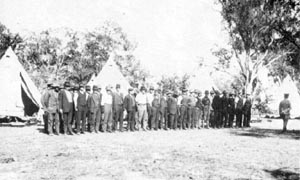
By 1914 more than 20,000 men had joined the AIF(which had been formed in 1902)and had left Australian shores for training in Egypt, not too far from Cairo. Here they were joined by the New Zealanders and together they formed the ANZACS. Soon the bright lights and delights of Cairo was causing problems amongst the Australian troops, desertion and absence from training was growing. The Australian forces decided to adopt the same punishment that was already enforced amongst the New Zealanders, any trouble makers would be sent back to Australia. |
|
|
|
|
|
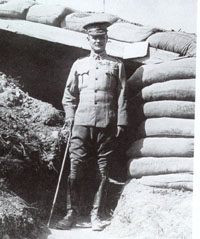
The commander of the ANZACS was Lieutenant-General-Sir William Birdwood, a british cavalry officer who soon was accepted by the ANZACs as one of their own with his braveness. Birdwood was also an understanding leader of his men. After the war he was to receive many honours and to the ANZAC's he became known as "Birdie". |
|
|
|
|
|
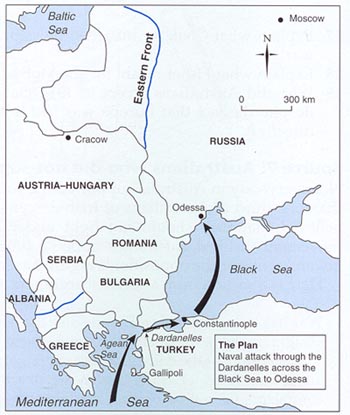
20th February, 1915 the Australians based in Egypt were excited to hear the news that British and French Fleets were bombarding the the forts of the Turks at the Dardenelles. The British Government believed, with the war in France and Flanders reaching deadlock that if they could defeat Turkey and gain access through the Dardenelles they could gain access to Russia |
|
|
|
|
 |
|
|
|
|
|
|
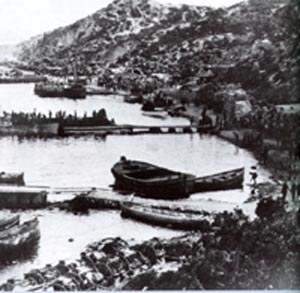
The day of the landing, 25th April, 1915, the Anzacs were landed about 2 kilometres from where they should have been, partly due to strong currents. At "Anzac Cove", as it is known today, the ANZACS faced steep cliffs. and the Turks were also waiting for them. Actually the boats landed on a part of the coast which Birdwood and Australian officers had scanned from a warship a few days before and considered ";impossible" for an attempt at landing in the dark. |
|
|
|
|
 |
|
|
|
|
|
|
The British Forces decided to launch a number of combined attacks on the Turkish strongholds, these included Suvla Bay, Cape Helles and at Anzac Cove to seize the strategic heights of Sari Bair and Chunuk Bair, the task was to attack the Turks at Lone Pine and occupy them whilst the British landed at Suvla Bay. At 5.30pm on August 6th 1915 the Australians left their trenches and attached the Turkish positions. |
|
|
|
|
 |
|
|
|
|
|
|
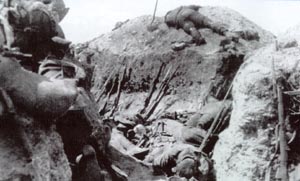
To get to the trenches the Australians had to cover land that was potholled with craters that had been blown by mines earlier in the day to offer the troops some protection, they also had to cross barbed wire, and to the surprise of the troops when they reached the trenches they were not open as expected but instead roofed with thick pine logs packed down with earth. The Turkish and Australians fought, some with bare hands, but by 6pm Lone Pine had been taken. |
|
|
|
|
|
Although Lone Pine was been captured the whole strategy was seen as a failure. The decision to pull out of Anzac Cove was given on December 7th, 1915. The withdrawal is seen as the most organised part of the campaign. It was decided to fool the Turks into believing that it was all just normal preparation for winter. To help with the deception empty boxes were bought ashore to look as if they were building up their supplies.They also kept up the pretence of a normal front line trench, but behind it thousands of troops and vehicles were slowly over the entire night being withdrawn and all the withdrawing troops wore pads on their feet. By midnight on Sunday 19th, 1915 only 1500 Anzacs were left, by 4am they were all on boats sailing away from from Gallipoli. When the decision to withdraw was first made the casualty rate was expected to be about 50%, but thanks to the plan drawn up by Australian Lieutenant-Colonel Brudenell and British Colonel Aspinall only 2 people were killed on the night of the withdrawal. |
|
|
|
|
";The Australian's rose to the occasion. Not waiting for the orders, or for the boats to reach the beach, they sprang into the sea, and forming a sort of rough line, rushed at the enemy's trenches. Their magazines were not charged, so they just went in with cold steel ....The Australian's found themselves facing an almost perpendicular cliff of loose sandstone |
|
|
|
|
|
covered with thick shubbery. Somewhere, about half-way up the enemy had a second trench, strongly held, from which they poured a terrible fire on the troops below and the boats pulling back to the destroyers for the second landing party. They stopped for a few minutes got rid of their packs and proceeded to scale the cliffs without responding to the enemy's fire. They lost some men, but they did not worry. There was been no finer feat in this war than this sudden landing in the dark and storming the heights, above all holding on whilst re-inforcements were landing"(1) |
|
|
|
|
|
|
8709 Australians were killed , 19,000 had been wounded, 2701 New Zealanders too lost their lives. The Australians and New Zealanders who returned from Gallipoli to Egypt were a different force from the adventurers that had left 8 months before. They were a military force with strong traditions. Not for anything would they change their loose, faded tunics or battered hats for the smarter uniforms that other armies wore. |
|
|
|
|
|
I will not go into the other Theatres of War that the Australians fought in, instead I have decided to show some images. There are some great sites on the internet that deal just with Australias involvement in both the 1st and 2nd World Wars. |
|
|
|
|
|
IMAGES FROM WORLD WAR 1 |
|
|
|
|
 |
|
|
|
|
|
|
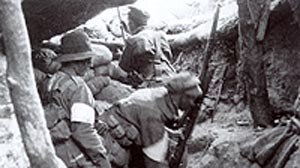
COMING ASHORE |
|
|
|
|
|
LONE PINE |
|
|
|
|
|
STEEL HELMETS |
|
|
|
|
|
GAS MASKS |
|
|
|
|
|
CAMEL CORPS |
|
|
|
|
|
TRENCH FEET |
|
|
|
|
";Noting the the Turkish bombs had long fuses, the Australians constantly caught them and threw them back before they burst. The Turks then learnt to shorten the fuses and many boys' hands were blown off, and others were blinded or killed. Hundreds of times bombs falling into the trenches were smothered with half-flled sandbags; but others burst, killing and wounding the groups behind the barricades, and the stream of wounded was continous. At intervals when Turks were clearly massing behind the barriers the Australians would clear them, exposing themselves above the parapet in the process, and with rifles or a machine-gun sweeping down the enemy. |
|
|
|
SIMPSON AND HIS DONKEY |
|
|
|
|
|
POZIERES |
|
|
|
|
|
HMAS AUSTRALIA |
|
|
|
|
|
ARTIFICAL LIMBS |
|
|
|
|
|
YPRES |
|
|
|
|
|
GLENCORSE WOOD |
|
|
|
|
|
AUSTRALIAN FLYING CORPS |
|
|
|
|
|
CAUGHT IN THE ACT |
|
|
|
|
|
PALESTINE |
|
|
|
|
|
RELAXATION IN EGYPT |
|
|
|
|
|
The Turks dynamited a barricade but the Australians twice extinguished it. The Turks twice penetrated far into the trenches they had lost; the Australians turned them and chased them back. Jam-tin bombs, though pouring from the factory to the beach were still in insufficient supply. But on both sides the dead clogged many of the trenches. When on August 10th fighting ceased in the pine, six Australian battalions had lost, in all 80 officers, 2197 men and the Turks (according to their most active commander there)5000";. (2) |
|
|
|
BEERSHEBA |
|
|
|
|
|
WESTERN FRONT |
|
|
|
|
|
TOM ROBINSON |
|
|
|
|
|
 |
|
|
|
 |
|
|
|
|
|
(1) Ellis Ashmead-Bartlett, Daily Telegraphy (London) April 1915. |
|
|
|
(2) CEW Bean, Anzac to Amiens |
|