| History |
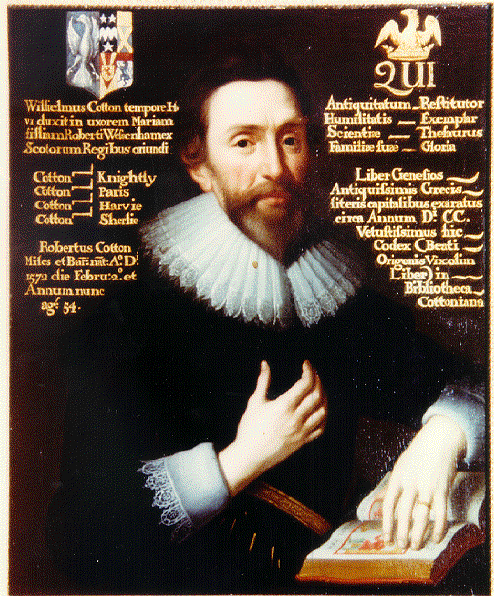
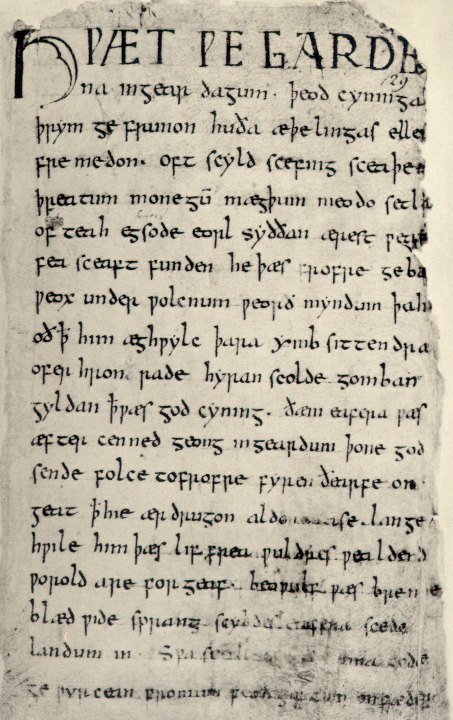
| History, Author and Backround Info. Beowulf was written before 900 AD. It was written in Old English. The oldest surviving epic in British history is Beowulf; written on only one manuscript (right) , there is only one surviving copy of the story. The oldest known owner of this document was an Anglo-Saxon scholar known as Laurence Nowell, Dean of Lichfield. Later in from 1571-1631 Sir Robert Bruce Cotton owned it. These were the ones that kept the history of the nation. After the Romans left the British Isles in 436 AD, many warring tribes inhabited the land. Some of these tribes were the Angles, Saxons, Picts and Jutes (of whom Beowulf mentions). The time period after the Roman Empire fell was called the Middle Ages or the Dark Ages. During the 600s AD Christianity became the main religion of the British Isles, overcoming the pagan rituals of the Druids and other tribal rituals. During this time monasaries popped up all over the country and monks started to record history. However as the Christians began writing down things, they got stories from the former inhabitants of the land. Before writing in Northern Europe, bards were the ones that told the myths and legends of the past. Bards were musicians who told epic stories. Bards had large repitoures of incridible stories. One of these stories was about a Scandinavian adventurer seeking glory who defeated many monsters and became cheif of a prosperous tribe. You can imagine Christians hearing this story were awed by it. Monks who heard it must have written it down along with many other legends they heard. This is how the story of Beowulf was put into writing which probobly occured sometime before the tenth century. Certainly they changed a few things for when reading it paganism and Christianity are woven together in an interesting pattern. Few of these legends that were written down survived. Henry VIII supressed many small monastaties around in 1536. Then later in 1539 and 1540, he destroyed the larger and richer monastaries. Although the king and his henchmen became rich off of this deed, the invaluable works of liturature in England at that time suffered greatly. Thinking not only of Beowulf but also the works of Shakespeare, Henry VIII was truly a jerk. A few people tried saving manuscripts from Henry's rage. John Leeland, the King's Antiquary, saved as many manuscripts as he could. Later Dr. Matthew Parker, Archbishop of Canterbury, and Sir Robert Cotton, were avid collectors. Many other pieces of work are known to us because of accidental fragments in other surviving pieces of liturature.The manuscript of Beowulf is sitting in the British Museum under the caption "Ms. Cott. Vitellius A. 15." This is one of the only relics of Germanic history surviving today. Hundreds of the Cotton manuscripts were lost and 98 more were damaged, including Beowulf. This fire consumed the Little Deans Yard, |
 |
 |
 |
| Westminster in 1731. The edges of the parchment were burned, however parchment is actually quite flame resistant. The charred edges however crumble easily and many words and letters have disappeared since 1786 when Thorkelin used the manuscript to create replicas. The manuscript is of the tenth century, but the original poems were from much earleir.The Germanic tribes that invaded England in the fifth century brought many traditions and stories, although they were not written down, just transfered by memory. When these bards became Christian, they learned to write. Naturally the greater part of the liturature of that time was religious, for instance the Biblical stories attributed to Caedmon. Some monk, somewhere must have decided to put the many stories about Beowulf into text, and if he had not we would not have this piece of work. The people who originally came up with this story, or rather told about Beowulf himself, were called Teutons (that is, a member of an ancient people, either Germanic or Celtic in origin who lived in Jutland). These people were fond of poetry, they made songs describing noteworthy events, which were then repeated for a longer or shorter time. If the story was particularly great it would be handed down from one person to another, becoming part of the tribal or natoinal literature. It is important to note that these poems would change, the longer they existed, for one bard (called in Old English scop or gleoman) would improve upon the original and so on. Stories of different heroes might after time be run together or even stories of a hero and of a god, as seems to have been the case with Beowulf. For instance when Beowulf engages in underwater combat with Grendals mother. However Beowulf is held to be a real person. He was recognized in history as a retainer and relative of Hygelac, king of the Geats, who was killed in a battle with the Frisians, Hugs, and Franks. In relatively rescent years many translations of Beowulf have been published. All of these highlight the fabulous acts of the sixth century warrior in his strougle to gain fame. It is an incredible story well worth notice. Some even call it a classic of British liturature, put into the same catagories of Shakespear, Dickens, or Kipling. And certainly mainy noticable authours have been deeply influenced by this heroic story, including my favorite Tolkien and C.S. Lewis. |