the task of translating
in the works of rajan m krishnan
Kathleen Wyma
A real translation is transparent; it does not cover the original, does not block its light, but allows the pure language, as though reinforced by its own medium, to shine upon the original all the more fully - Walter Benjamin, �The Task of the Translator� 1
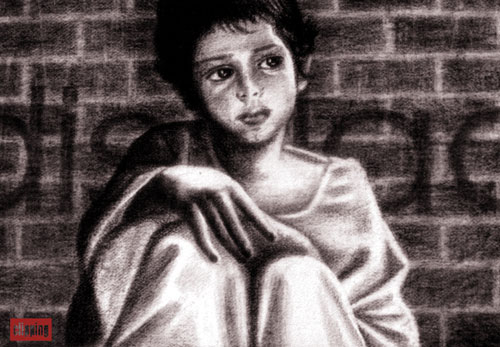
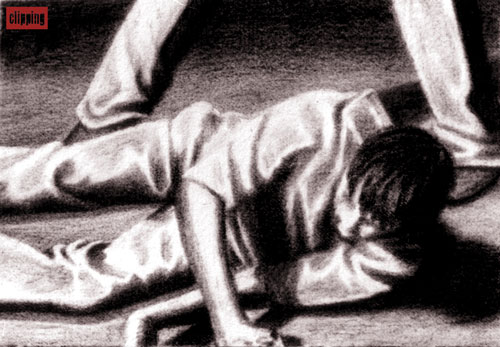
A lone man sits against a wall. Arms and legs are held close in a protective gesture. A hat sits low upon his head urging the play of shadow within the emaciated hollows of his dispassionate face. A signpost rises out of the pavement, its vertical strength contrasting with the crumpled vulnerability of the man�s solitude. Incomplete words inscribed on the wall narrate a fragmentary and fleeting social reality. The use of charcoal as a medium suggests that this image should be a hard-edged graphic representation. However, the material opacity of the black charcoal is subject to erasure and the subtractive process of the artist constructs the image. It is the in-between spaces of gray, rather than the areas of black and white that articulate form and the residual shading functions as the connective tissue of the image. The charcoal sits like a dusty membrane, a fragile skin, covering the surface of the handmade paper. Undulating areas of gray evoke a sense of restless movement. As if to arrest the endless drift, the red screen-printed word CITIZEN sits like an anchor in the corner of the image. The commanding durability of the red is incongruent with the perpetual flux of gray in the drawing. The stamp-like quality of CITIZEN recalls a logo or a trademark; yet, the permeability of the letters undermines its own authority as a visual marker of possession. The juxtaposition of CITIZEN with the ephemeral and delicate tissues of the portrayal compels dialogue and discussion and seems to pose the question: what does it mean to be a citizen? |