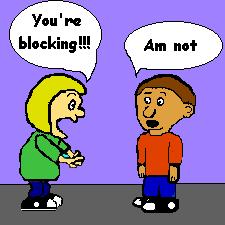
 Blocking
The ultimate No-No in Improv. If you are offered an idea by another player that you reject, ignore, or condemn, you are Blocking. The scene dies at this point and all cooperation is lost.
Waffling
Unnecessary dialogue or action that is
clearly a tactic for buying time while you think of something clever. It is also the act of talking about something rather than doing it.
Wimping
Example: Character A says, "Hey, look over there, what is that?" Character B says, "I don't know" Character B just Wimped. It is
crucial in Improv to make an effort, give something. Chances are your partner(s) can use it and take the scene somewhere with it.
Offer
Any dialogue or action that one player presents to the other(s). The person
receiving the offer must react in two ways, they can accept or deny with or without conditions.
Accepting
Basically saying yes to an offer. Specifically saying yes in a way that shows that your character will carry out the terms of the offer to-the-letter.
 Denying Denying
This is not blocking. It is a choice to work with the offer as the character in a way that creates dramatic conflict. Example: Character A
offers, "That's one big elephant." Character B Blocks by saying, "That's not an elephant." An example of Denying the offer would be fore
character B to say, "I've seen bigger." He accepts that it is an elephant, but denies the specific condition set up by character A. This leaves room for conflict.
Saying Yes
Above all, the most important thing to remember in Improv is to say yes. This means just the opposite of Blocking. You may have a
great idea, but your partner gets to their idea first. The ideas may be completely different. You must go with your partner's idea.
Yes, And...
One way to enforce the concept of saying yes is to use the, "Yes, and…"
structure. Basically you accept each offer with a "yes" followed by "and" The , "and" is a condition or qualifier. It moves the scene forward after accepting the offer.
Conditioned Accept
You accept the offer with specific conditions. In competitive performance games
these conditions might be there to stump the other player (s) but for the most part they help to move the scene forward. You may accept an offer that requires that you drop you
pants but you add the condition of, "Isn't it a good thing I'm wearing long underwear."
Condition Denial
You Deny the offer with conditions. In other words, when the player above said he or she had seen bigger elephants, they could add a condition, "On safari once at a Winn
Dixie in the frozen foods section." That is a denial of Character A's perception of the size of the elephant, but it gives Character A a place to go in terms of his or her reaction to it. If B
had merely said, "That's not an elephant." Character A would have had no place to go.
Tag Line
All scenes end, but when? Many players lose sight of the structure of a scene and get lost in a muddy conclusion, with the audience not really sure if it's over. The Tag-Line is
an obvious line with a good punch that tells the audience that the scene is over. The best Tag-Lines are ones where the audience almost beats you to it.
Narrative Structure
While C.R.O.W. helps the player know what is missing, Narrative Structure reminds the player where to go. Any story has a structure, even impromptu stories. We, as readers
or audiences, expect to see or hear an introduction, exposition, inciting incident, conflict, rising action, climax and falling action. That is basic Narrative Structure. (Not always in that
order, and sometimes components blend together.) In Improv, a player needs to be aware of structure as if they were bases in a game. If a player knows what base they are on and
what base they need to get to, then it is that area between bases where the creativity and spontaneity of Improv come into play. How will they get to the next base? That's what the
audience wants to know, but they and the player are always more comfortable knowing that the player knows what bases to cover.
Reincorporation
In comedy there is the rule of Threes: It's funny once, funnier twice, and even funnier
if it is anticipated a third time, but switched or avoided at the last minute. In a sense this is similar to Reincorporation in Improv. If, during a scene, a character sets up the physical
environment with doors, windows, etc., each player is obligated to keep that environment consistent. If the door opens in once, it should always open in. This alone will sometimes
generate a response form the audience. If a player, after several times through the door, changes how it opens, other players must be aware and respond. "How did you do that?"
"Do what?" "Switch the door around like that." The player might then realize that they made a mistake but the other players have used it, accepted it, and are making it part of
the scene. This is based on the fact that they are using Reincorporation. This term also applies to building on ideas form previous scenes and even Reincorporating characters form
other games into the present game. This is a performance condition of the term and should be separate form class room and workshop environments.
Gags
Gags can work in performance, but should be avoided. Even in performance, a gag
should not interrupt the flow of the Narrative. A Gag is any Physical act or unique sound that is intended to get laughs. We also call this Schtick.
Endowment
Improv relies on the player and his/her imagination and that of the audience. There is
rarely any furniture or props. With this in mind it is crucial that all players are able to endow the imaginary kitten in their hand with the qualities of a kitten: it's weight, it's feel, it's
movement, etc… The strongest endowment choices are specific choices.
|





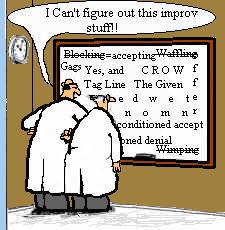 C. R. O. W. (Character, Relationship, Objective, Where/When)