>

How to Train Your Eye

This guide to training your groundsperson has several parts: one is an index of terms which you can find at:

Another is the anatomy of a horse, including some description of function of different parts in a riding horse, which you can find at:

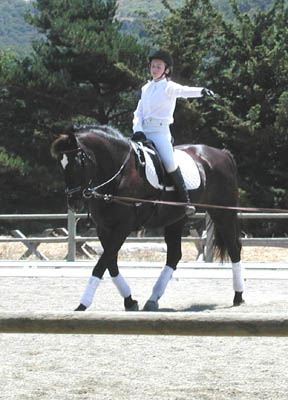
Another essential part of this page are my photos, which show both what should be and what should be avoided. I've annotated these pictures to help clarify the meanings of some terms, and so you can show someone what to look for, and can help explain what you are trying to avoid. These pictures are (mostly) of a lower-level dressage rider (me) and my incredibly wonderful, 1st level, 20 year-old thoroughbred gelding, Max. I'm hoping these pictures will be helpful to someone, somewhere, who needs to train someone how to look at a horse and rider so she can have feedback. The pictures can be found at this link:

Please bear with me, this site is still under construction! If you find any of this useful, I'd appreciate hearing it! Please either sign my guest book or email me at: [email protected].


Why read this page?


Put yourself in your horse's place. Literally. Get down on all fours. Lift up your head, and hollow your back (when a horse does this, sometimes we say he is or 'above-the-bit'). Now try taking a few steps forward. Now change your position. Arch your back upwards, let your head relax downwards. Take a few steps forward. It's a lot easier, isn't it? The same thing is true for your horse. One of the goals of riding dressage is for our horse to be in a correct frame...with his back arched upwards underneath us. Not surprisingly, most horses won't move that way naturally with a rider on their back. It is our job, as riders, to learn to ride well enough that they are comfortable rounding their backs up underneath us. It is better for them both physically and mentally. Good equitation results in exactly this...but is not always easy to know what exactly is going on with our positions.

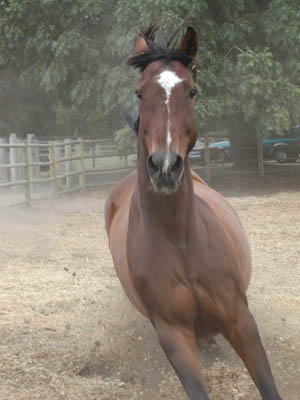
In the process of training a horse to bring his back up, one exercise commonly used is called "long and low". The purpose is to help build the horse's muscles so he can carry a rider while in a correct frame, and to let him stretch down and relax properly under saddle (for example after doing more collected work than he is accustomed to). Long and low work is frequently done incorrectly, because the horse's head goes down, but he shifts more weight onto his forehand and his hind legs don't reach up well underneath his body. Here is an example of a freely moving horse (a rare bay Lipizzaner mare) in a natural long and low frame, so you can see what it should look like!

One of the most difficult things about riding, I have found, is that our brains lie to us. What I mean by this is that what is familiar is, in some sense, comfortable, and what is comfortable we frequently perceive as being correct. Our kinesthetic senses, or mine at least, are frequently at odds with reality. For example, during the course of my admittedly not very extensive riding career, my equitational flaws have not remained constant. At one point in time, I tended to lean too far backwards. At other times, I have leaned too far forwards. In each case, there were points in time when I believed that my upper body was, in fact, vertical. What I believed to be true was, in fact, completely wrong. Absolutely invaluable to most riders is a person watching you who is trained to give you feedback on what is actually happening to both the horse and the rider, so that as time progresses your mental image of how you ride changes to reflect reality.

  • It is not until you become aware of what is wrong that you can begin to change it!

    The corollary to this is that, often, you feel the WORST about your riding just before you make the greatest improvement. This is because it is when you start to FEEL that something is wrong that you can change it. Probably, your riding hasn't actually gotten worse, you have just started to notice what is wrong. It is easy to get discouraged at this point- DON'T! You have just made an enormous stride- your ability to feel the motion of the horse has improved. When you start to feel, for example, that your body is too far forward, you notice it- and then you can correct it. Now, you become capable of making major changes to your equitation. It can be a very trying time; knowing what is wrong and struggling to fix it. If you love horses and you love riding, stick with it! All may soon be well again.

    In an ideal world, we would all learn to ride horses while being lunged on a schoolmaster by an experienced, classically trained rider with an educated eye. We would spend our first year of intensive riding without using either stirrups or reins, and would develop during the course of that year a truly independent seat. If you happen to be fortunate enough to be in that position, this website is likely to be of very little use to you.

    A few things to remember when you ride. I'm paraphrasing and quoting John Lyons here. Every time you are around your horse (riding or not) you are training him. Musts for a training session include:
  • Your safety. As John Lyons would say, 'ride where you can,not where you can't'. If it is not safe, do something else that is safe...or get professional help immediately. And please, please, wear your helmets!!!
  • Your horse's safety.
  • Your horse should end the lesson more relaxed than he began; only then can he learn what you want him to. My corollary to this is to end on a positive note. It doesn't matter what it is, go back to something simple your horse can do correctly, have him do it, reward him, and end there.
  • Don't forget to have fun! If you're not having fun, it is doubtful if your horse can...

    I'm hoping this site will be useful to help you train an assistant who is willing to watch you ride critically. I'm hoping to help clarify vocabulary frequently use by riders, and to use photographic examples to help clarify their meanings. It may also help you analyze what your are seeing on videotape or in still photographs. My personal bias is towards Dressage, but fundamentally, a good seat is a good seat, no matter what your style of riding. Dressage is much more similar to correct Western equitation than you might suspect; I'd say closer to Western than to Jumpers, Hunters, or Saddle-Seat equitation. Perhaps it I hope you will find this site useful; I welcome feedback- comments and suggestions both. You may email me at [email protected], or sign my guest book.

    Suggested Resources

    There are hundreds of books, magazines and videotapes available on horses. I haven't made an exhaustive search of everything available, but from what I have seen these are the ones I really like!
  • The Pony Club's guide to horsemanship is a very good manual to caring for a horse or pony.
  • The complete set of Kyra Kyrkland videotapes on training a dressage horse. Her explanations are short, easy to understand, and the videos show moves done correctly, then demonstrate the difference between the correct one and the most common mistakes. I can't recommend these highly enough, but they aren't cheap...
  • "The Complete Training of Horse and Rider" by Alois Podhajsky (English translation, unless you are a native speaker of Deutsch!) This book was written by the late head of the Spanish Riding School in Vienna. On occasion, books seem to contradict each other...when in doubt, I rely on this resource as the final answer. This may sound simplistic, but if you have ever had the opportunity to see the Spanish Riding School performances in person, or on video you'd probably understand why I take this to be my authority. Harmony, horses enjoying their work, and absolutely unbelievable athleticism are the results of the classically correct work the Spanish Riding School has been involved with for centuries. Enough said!
  • "Perfect Horse": a magazine published by John Lyons- this publication emphasizes the 'conditioned response' method of training, which emphasizes understanding over brute force.
  • "Practical Horseman" (or its counterpart, "Horse and Rider" with a more Western theme): contains many good articles and each issue contains a wealth of information.
  • "Equus": Articles seem to be quite in depth, with no particular emphasis on style of riding. I particularly like some of their medical articles.
  • If you *ever* have the chance to audit or ride in a clinic given by Andreas Hausberger of the Spanish Riding School don't miss it! (Unless, of course, you don't *really* want to learn how to improve your riding and your horse's carriage.) I'm certain there must be other, equally good clinicians (I'd love to attend clinics by Kottas, Kyra Kyrkland, for example, but doubt I will ever get the chance!) but this one is special. He has an unbelievably good eye; exceptional understand of horse, rider, and proper progression in the training of both; an ability to communicate his knowledge clearly; and a calmness and confidence born from long years of experiences under the best teachers available. He is honest but tactful, patient but demanding, focused but maintains a sense of humor, and has an incredible knack for getting the most out of horse and rider. If you are especially lucky, you might even get the opportunity to see him ride...it is somewhat humbling to realize that everything he asks you and your horse to do is, in fact, possible simultaneously- and it works... I've also found that what he says stays with me. What I worked on during last year's clinic gave me a foundation I could build on and actually make lasting changes to my riding. It's not something I'm only able to do only during the clinic. Last, but not least, Andreas Hausberger is a truly nice gentleman. His comments are constructive, not destructive, and he understand how important it is to praise progress, even if you haven't achieved perfection quite yet! Nonetheless, I've left both clinics having made real progress, but firmly aware what I was, and still am, doing wrong- and how to begin to correct it.

    For more information on dressage and riding please see my page of links:

    As a last note, if you own a horse, PLEASE, PLEASE take proper care of him or her! I've seen too many horses suffer because of ignorance and neglect. Horses confined to stalls and pastures need attention! They need hooves trimmed or feet shod every six to 8 weeks. They need vaccinations at least twice a year, their teeth floated once a year, to be dewormed every 8 weeks and to be fed and watered AT LEAST twice a day. Be advised, not all pastures contain enough nourishment to feed a horse without supplemental feed. If your horse has a big grass belly, but you can see his ribs he isn't getting enough to eat! Horses also need company, preferable other horses, but are not meant to be alone. They are herd animals! They also need exercise, which they may or MAY NOT get enough of just by being out in a field. If they are stall bound they need to get out, every day if possible! Horse are wonderful, generous animals who can forgive a lot of mistakes, but please take the time to LEARN what you need to know to be a good horseman as well as a good rider. Take the time to really work with your horse. You'd be amazed how many problems you have in the saddle could actually be fixed by taking the time to teach them correct groundwork (how to lead, how to tie, how to give to pressure and so forth). Ground-work, ground-work, and more ground-work! If you can't successfully (and diplomatically) lead your horse towards something they are wary of, don't be surprised when you can't load him into a trailer.

    Take the time to do it right. They're worth it; what is more, they deserve it. As my dad would say, 'It makes walking-around sense'!

    Thanks for visiting; please sign the guest book you can find on my home page!

    To return to my homepage, please click on the button below

    Hosted by www.Geocities.ws

    1