Anatomy of a Horse
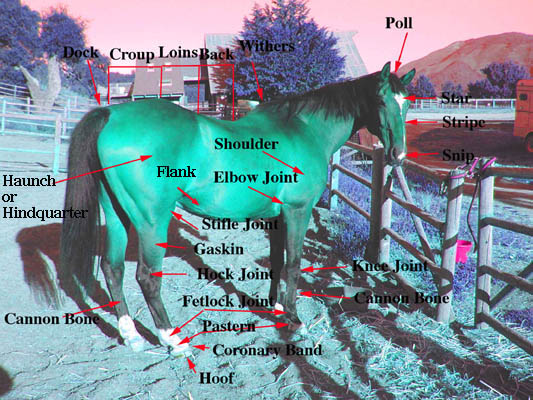
Yes, Max is standing a little funny, with his hind legs a little too far underneath himself. In his case, it's not an issue, but horse sometimes stand like this to take a little weight off of their front legs (for example, if they are suffering from Navicular disease). If your horse persists in standing like that, you might want to check for other signs of soundness. Alternately, if a horse is uncomfortable bring a hind leg underneath himself (as Max sometimes is when his arthritis flairs up), you might want to check out his hind end for signs of lameness.
The POLL is critical to dressage, because the horse needs to learn to 'give' at the poll. In other words, if your horse is carrying his head up in the air, not only does he need to bring his head down, but he needs to learn bend at the poll (making his forehead more perpendicular to the ground: Like | (not / or \). When you apply the reins when your horse is 'upside down', he should give at the poll and come 'on the bit'. He also needs to be flexible at the poll in order to flex his head correctly so you can see the outside corner of his eye when he is bent to the left, for example, when you are riding on a circle to the left.
Horses need to be trained to yield to pressure (by nature, they move into pressure. For example, horse have to be taught that pulling on the reins means 'slow down'- by nature they actually speed up. If you watch a racehorse, they lean forward into the reins, which moves their center of gravity a little forward, which helps them run faster. Hence some of the perils of retraining an off-the-track horse!). One excercise you can use to train your horse to yield to pressure at the poll is to place your hand between his ears and apply pressure on his poll. Don't press hard, just enough to get his attention. It may take awhile at first, but pressing harder or give up! Keep applying a fairly constant, firm pressure until he yields his head downwards a tiny bit. Release the pressure, since he did what you asked. Repeat, ad nauseum. As you practice, you can begin to ask his head to go lower and lower, and to stay there longer. (Note the psychological effect here: in the battle for dominance, wild stallions keep trying to get their heads above their opponents' heads). Keep practicing until he quickly responds to the signal and takes his head as low as you want (even to the ground). Why do this? Lots of reasons! Under saddle it will help get him on the bit. It makes it easier to bridle your horse if you've had trouble with that. It helps make your horse be safe when he is tied (if he doesn't yield when he feels the pressure from the halter, bad things can happen!). It makes it safer to lead your horse because you can always stop and have him put his head down and yield to you. It helps establish your dominance without getting into an escalating situation. It also helps to keep your horse from rearing. If his head is going down, his feet aren't going up! Enough said? Ground-work, ground-work and more ground-work. It really pays off when something goes wrong!
Good HOCKS are essential for the horse to carry more of the weight on his hindquarters than on his front end. This is critically important for a horse that jumps, and becomes more and more important as he goes up the levels in dressage. Hocks are frequently the site of lameness in horses involved in either discipline. Fortunately, there are numerous remedies available to help treat and alleviate the symptoms of DJD (degenerative joint disease) in horses. A good lameness exam from your vet can help isolate the causes of lameness. There are lots of medical treatments available, and herbal remedies (most of them some form of glucosamine or chondroitin sulfates) abound. Max is on prescription Cosequin (a proprietary combination of both glucosamine and a low molecular weight chondroitin sulfates which absorbs through the digestive system), has occasional injections into his joints (hocks, stifle, knee) to control flair-ups. I'm also about to try Devil's Claw (No-Bute). It is supposed to be a powerful herbal anti-inflammatory like Bute, but lacking any of the long-term digestive side-effects. I'll report on my trials of this later...Be aware, what works for one horse often won't for another. There is a lot of trial and error involved.
The STIFLE is the part of a horse that is *actually* anatomically equivalent to out knees. What is labeled in the diagram above as KNEE isn't the same joint as in a person (in fact, the analagous joint would be in your hand!)
The CANNON BONES are actually equivalent to the middle-finger (or toe) bone. There isn't much muscle here, mostly just tendons and ligaments, so the structures are actually fairly delicate. Alongside the cannon bones (in the upper half) on either side are the SPLINT BONES. These bones are vestigal fingers/toes. Most of the time, they aren't important, but when the ligaments that attach them to the cannon bones are damaged, they can flair up into an injury called a splint. In young horses, this can be as sign of improper nutrition or working too hard. Typically, splints heal quickly and fully by calcifying, so there isn't serious risk of re-injury. Old splints are not a sign of future lameness issues.
Horses HOOVES are like our fingernails. They grow continuously. Even if you are not shoeing your horse, he still needs to have his feet trimmed- usually at least every 8 weeks!
There are more bones inside the hoof. Particularly important are the navicular bone and the coffin bone (which is the bottom-most bone in the hoof). When the bursa surrounding and protecting the navicular bone are damaged or lose the cushioning fluid, a condition called navicular disease is present. It can be quite
painful and difficult disease. Horse with small hooves for their size are particularly prone to this disease. The coffin bone inside the hoof is the bone which can rotate as the result of laminitis (better known as foundering). This is often the result of problems with the digestive system (the horse got into the grain, or had too much spring grass rich in protein when he wasn't used to it), but can also result from overwork on hard surfaces. In either case, the blood flow to the legs and feet is affected and there is lots of heat present in the hoof. The hoof wall can de-laminate. The whole interior of the hoof is affected, and if the coffin bone rotates downward because it is no longer supported, the results can be serious. Treating founder requires help from both your vet and your farrier.
To view my other pages, including theglossary of terms, my guide on how to train your eye, and my page of annotated rider photos please click on the appropriate link below:
To return to my homepage, please click on the button below
For more information on dressage and riding please see my page of links:
Thanks for visiting; please sign the guest book you can find on my home page!