 _
_
by Armando Pierucci / Regina Derieva
VIA CRUCIS & DE PROFUNDIS
Musical Opinion
Classical Music on the Web

Reviews:
Musical Opinion
Classical Music on the Web
Links &
Buy CD
Musical Opinion
July 1999
PIERUCCI: Via Crucis: A Sacred Cantata for Soloists, Chorus
and Organ
Gintaré Skeryté: mezzo-soprano; Algirdas
Janutas: tenor; Mindaugas Zemaitis: baritone; Ignas Misiûra: bass-baritone
Darius Ckramtai: Organ
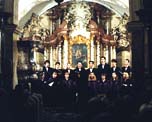
Aidija Chamber Choir. Conducted by Romualdas Grazinis
Divine Art Pilgrim's Star 2-7002
48' 44"
The genre of 20th-century Catholic Church music by members
of the clergy is a genuinely fascinating one, and this new Cantata on the
Stations of the Cross by Father Armando Pierucci follows in the notable
line of works by such masters as Don Lorenzo Perosi.
Pierucci was born in 1935, and, as we have every
right to expect, is musically a traditionalist. If there is barely a phrase,
or a progression, in this work which would have surprised Buxtehude, in
taking Christ's dictum: "The same yesterday, today, and tomorrow" as a
starting-point, Fr Pierucci has created a deeply-felt and clearly moving
work of art, given the right circumstances of performance, which is exceptionally
well performed and recorded here by Lithuanian forces, singing in Russian.
The rich acoustic suits the music well, and it is a welcome surprise to
encounter such a fine Organ in this part of Northern Europe.
In many ways, this authentic piece deserves a
wide audience, and one can readily imagine it fulfilling a need amongst
the more musical of our Parish Church choirs, particularly those looking
for a refreshing and modern, yet basically traditional piece for performance
at Easter time.
It is the text by the Russian poet Regina Derieva
that additionally sets this work somewhat apart. She was born into a Jewish
family in Odessa and managed to obtain Israeli citizenship and residence
in 1991. Since then, however, owing to her growing interest in Christianity,
her Israeli citizenship has been taken away from her. If nothing appears
to have changed much in certain aspects of Middle-Eastern life during the
past 2000 years, her lines "a man who lives in the sick Fatherland in the
Satanic years suddenly understands that the sense of life is only in God"
combine to make a thoughtful and penetrating text, well captured by this
genuine and gifted composer.
00-972-2-6282354. A fascinating and, in its way, important issue to which I have returned often with growing compulsion and interest.
ROBERT MATTHEW-WALKER
MusicWeb
December 1999
Pierucci's cantata "Via Crucis" is a most remarkable work. The text was written by the Russian poet, resident in Israel, Regina Derieva and consists of a cycle of philosophical meditations on the fourteen Stations of the Cross together with a poem "Kto tam" which forms both the prologue and epilogue. It was set to music in 1996 for soloists, chorus and organ by Fr Armando Pierucci, organist at the catholic Church of the Holy Sepulchre in Jerusalem. It has now been recorded for the first time (March 1998) in St Kasimir's Church in Vilnius, Lithuania by the "Aidija" Chamber Chorus with four soloists - all of them graduates of the Lithuanian Academy of Music and established singers on the international opera circuit.
The recent date of composition need not deter listeners who consider themselves generally untuned to music of the late 20th century. The music is highly traditional and, whilst it is in no way derivative, it will appeal to those who love the choral music of Faure, Rachmaninov and Elgar. The music does not tire after a few hearings; indeed its spiritual depths become gradually more appreciable with repetition. As with all great music, it can be perceived at different levels; individual listeners will no doubt find it their own particular exploration of interior emotion.
Two complementary but distict modes of listening recommend themselves: One is the more systematic - to follow the translated text of each meditation whilst reading in parallel the prayers from the Missal which accompany Christ on his journey from death sentence to crucifixion and burial. This approach may well appeal to practising catholics in their passiontide devotions. The other mode is to allow the ineffable qualities of the music and Russian words to take one on a less defined psychedelic journey without giving too much analytical thought to the literal meanings. Like Elgar's "The Dream of Gerontius", this work is at once both explicitly anchored in christian (indeed specifically catholic) faith, and at the same time resonates with all those (of any religious faith or none) who find inspiration in the drama of the journey of the human soul through direst adversity to an ultimate state of joy and triumph.
Throughout most of this cantata, the words and music match (either obviously or more subtly) the events of each Station: for instance, the exchange between mother and son at Station 4 is directly mirrored in the antiphonal singing of the bass and mezzo-soprano soloists. On occasions however, the connections are less clear: what precisely has the meditation on the Light of Heaven at Station 5 to do with Simon Cyreni's carrying the cross of Jesus? And why is the nailing to the cross of Station 11 set to a vigorous Allegro choral fugato? There are surreal elements in this music! Be that as it may, the joyful fortissimo ending of Station 14, with its anticipation of the Resurrection triumph, is the most fitting climax of the whole cantata toward which the earlier quiet contemplative movements have been inexorably leading.
The quality of choral and soloist singing is of high excellence throughout - likewise the organ playing; it is a pity there are no biographical notes about the organist D.Ckramtai. A question that must be asked is: Why were operatic soloists, excellent though they be, employed in this recording? Unlike oratorio, this cantata is music for church performance rather than theatre or concert hall. Would not the tonal qualities of cathedral cantors have been more appropriate? A useful addition to the accompanying booklet would have been to provide the original Russian text (transliterated please!) as well as the English and Italian translations, the better to appreciate the sonorous sound of the Russian vowels. I have a suspicion that the (unfortunately anonymous) translator concentrated too much on literal word for word translation, so that the English reads like stilted prose having lost the poetic resonance of the Russian original.
These reservations apart, this music is a major discovery and proof positive that great choral writing did not die with Elgar in 1934. It is to be hoped that this cantata will be picked up by choral societies and receive a richly deserved place in the choral repertory.
Humphrey Smith
Musical Opinion
07/01/2002
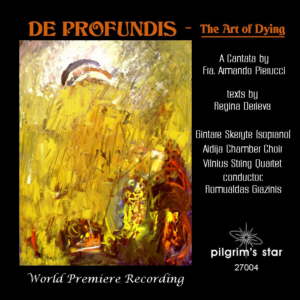
PIERUCCI: De Profundis A Sacred Cantata for Soprano, Chorus
and Chamber Ensemble; Variations for Organ on the Fourth Mode Alleluia*;
Variations for Organ on an Original Theme from the Cantata Via Crucis*
Gintare Skeryte: Soprano; Aidija Chamber Choir; Vilnius
String Quartet; Giedrius Gelgotas: Flute; Gintautas Jocius: Double-bass.
Conducted by Romualdas Grazinis
Armando Pierucci: Organ
Pilgrim's Star 2-7004 55' 07"
The Pilgrim's Star label is part of the Divine Art's
table.
Readers may recall a review of an earlier CD in this series
of Father Armando Pierucci's Cantata: Via Crucis, wherein I said that the
genre of 20th-Century Catholic Church Music by members of the clergy is
a fascinating one. Father Pierucci, who was born in 1935, follows a traditional
line in his music and in his recent De Profundis, as in Via Crucis, he
has created a deeply-felt composition of around 34 minutes' duration. It
is very well performed and recorded here by gifted Lithuanian musicians,
some of whom appeared on the earlier CD. Gintare Skeryte, actually a high
Mezzo with a full range, who again sings the solo Soprano role. Is particularly
good.
As in Via Crucis I must mention the text, by the Russian
poet Regina Derieva. Born into a Jewish family in Odessa, she managed to
obtain Israeli citizenship and residence in 1991. But, owing to her growing
interest in Christianity, her Israeli citizenship has been taken away from
her. Her Russian text here is printed in English and is worth studying
separately.
Father Pierucci's recent contemplative Organ works are
distinguished by being played by the composer at St Saviour's Monastery
in Jerusalem.
ROBERT MATTHEW-WALKER
MusicWeb
September, 2003
This is a very unusual disc - the composer is an Italian
priest resident in the Holy Land, the texts of the main work are in Russian
by a Catholic Russian poet who emigrated to Israel but now lives in Sweden,
and it was recorded in Lithuania by artists from that Baltic nation. Despite
all this there is very much a real musical identity to what goes on here
- the recording is fairly rough and readdy.
The cantata De Profundis, subtitled rather gloomily The
Art of Dying, is conceived for chamber forces and as such has a lightness
of tone rarely heard in works of this ilk. The music is neo-classical in
style, although I can almost hear Finzi, admittedly at his most Bachian,
in the slower sections, with flourishes that may fleetingly remind you
of the French religious masterpieces of Fauré, Duruflé etc.
The poems used for the text are religious, serious and often rather tragic
in nature. A glance at some of the titles will show this - "There are disgusting
things, which are impossible to count…" and "The fewer former things" -
with subject matter relating indirectly to "the new tragedy of the Palestinian
people, amongst which both the poet and the composer have lived for about
ten years". No doubt this sort of thing would go down like a lead balloon
with the Israeli right wing - no wonder Regina Derieva wasn't granted citizenship
there. This music, pleasant and well written though it is, does not match
the serious intent of the texts and, though very listenable, tends to water
down the message intended. It nevertheless remains an interesting listen.
The remaining pieces are solo organ works, recorded earlier,
actually in the Holy Land, with the composer playing. The Alleluia Variations
are beautiful, almost folklike, if an organ can be! I was less enamoured
with the "Via Crucis" Variations which are based on a theme from Pierucci's
previous collaboration with Derieva. The recorded sound is appalling but
the first set of variations transcends this because of the quality of the
inspiration at work. It is important that this sort of project is released
and people are given an opportunity to hear it. It is unlikely to top any
charts or win any awards but it speaks of emotions, events and situations
unfortunately far more real than the glitz and glam of the mainstream.
The performers do the music and its composer full justice and the whole
enterprise shines out like a beacon of integrity in the midst of compilation
and crossover driven blandout.
Neil Horner