
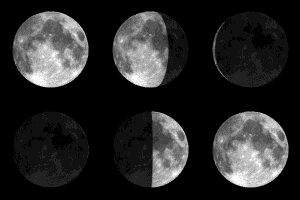
Touch the spirit of the season. Try to figure out what it's about. Open yourself to the energies and the changes taking place. Be observant. Look at the moon. Be silent, know, and dare.
Each Sabbath has its own particular lore, corresponding with the cycle of the lives of the Goddess and God, and/or the lives of humans, the cycle of the Earth, even the cycle of the moon. The myth is an metaphor for the turn of the seasons. It's a way of personifying what happens to the Earth over a year. However, if you say that the Sun is the God, that is, the physical sun is in spirit the God, and the Earth is the Goddess (the physical Earth is in spirit the Goddess), than the myth of the seasons is real.
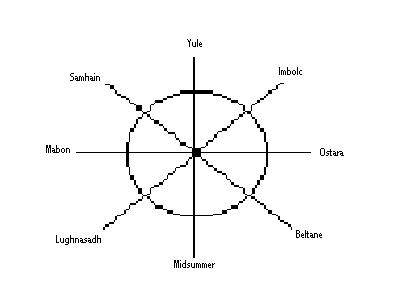
Yule is the winter solstice, the shortest day of the year. On this day the young God is born. During Yule we celebrate the birth of our God, the Sun. From Yule to Ostara the night dominates, but the days grow longer. The young God is weak, but growing in strength. It is in the spring that he enters boyhood. At Ostara, the spring equinox, the day and night become equal in length. The powers of light and dark fight, and light wins. At Ostara we celebrate the triumph of light over dark. Our Lord has been victorious and brings warmth to the land. From Ostara until Midsummer the light dominates, and the days grow longer. The young God is playful boy, growing stronger and emerging into manhood on Midsummer. Midsummer, the summer solstice, is the longest day of the year, and marks the height of the God's powers. The God is a grown man, lusty and strong. On Midsummer we celebrate the fire of his passion, and the strength with which he protects his children. From Midsummer until Mabon the light dominates, but the days grow shorter. At Mabon day and night are again equal. Again dark and light battle, but this time dark triumphs. The God is growing older, and his fires are weakening. From Mabon to Yule the night dominates, and the days grow shorter. At Mabon we celebrate the God's descent towards the underworld, where he will live until Yule comes again. Light dominates from Ostara to Mabon. Dark dominates from Mabon to Ostara. Days increase in length from Yule to Midsummer. Days decrease in length from Midsummer to Yule.
Earth
Imbolc is a holiday of lights and torches. Here the Goddess is the maiden, the waxing moon. In my mythology the Goddess is never born and she never dies, but she is young in the spring. Here during Imbolc we create fires to awaken the child Goddess, and light her playtime in the dim light, so as to bring the blossom of spring to the land. Seeds are sown in the fresh ground. The Earth awakens, emerges through the snow, and the wheel of the year turns to Beltane. Beltane is a Sabbath of fertility and vitality. Here the Goddess is the Mother, the full moon shining brightly. She has come to her full strength in young adulthood, and at Beltane we dance and celebrate the beauty of youth and the wonder of fertility. The land is full and lush, the Goddess cares for her children with joy and a bountiful love. The wheel turns to Lammas. Lammas is a day of harvest and thanksgiving. Here the Goddess is the Crone, the waning moon. She is in late adulthood, her children grown and her body faded. Her mind remains sharp, and as her days grow quiet, her thoughts turn inward, reflective. Crops are harvested for the last time before the cold of winter sets in. The wisdom of the bare trees speak softly, and the Goddess hears. Samhain is a festival of the dead. Here the Goddess is the unseen, silent one, like the dark face of a new moon. She has gone quiet, withdrawn from the upper world. Plants are dead or dormant, and all is in wait for the reemergence of spring.


