THE DIAGNOSIS AND PRE-CHEMO PERIOD
It was during the evening of
Her
daughter Mandy, a nurse, then came round and she and I became so concerned
about Ruth that, although she was totally against the idea, we insisted that
she go to see a Dalriada doctor at the local Whiteabbey Hospital, where,
incidentally, Mandy was still employed as a nurse And so it was into Mandy’s car and over to
the hospital.
The
hospital was silent and almost deserted and, as there were no other people
waiting to be dealt with, Ruth was seen almost immediately by a lady doctor,
who took her away to a consulting room.
At one stage, the doctor came out of the room to make a phone call to
Ruth told
me very mournfully that the doctor thought her problem was serious and reckoned
that she could be suffering from a blood clot on the lung or even TB. So she had gone to make a phone call to
Antrim Hospital A & E to tell them that she was referring Ruth to them for
further investigation. Poor wee Ruth did
not want to go to any hospital and just wanted to go home instead. But Mandy and I insisted that going to the
hospital was her best option and off we set again on that dark night towards
Antrim. Poor wee Ruth was feeling so
nauseous and was in such pain, that it was a very distressing journey for
her. In fact things got so bad that
there were a couple of occasions when we almost had to stop the car.
The A &
E staff in
On
When Mandy
and I arrived, we were surprised to find Ruth already waiting outside A &
E. We then learned that because of a
shortage of beds in the hospital, Ruth had had to spend the whole night on a
trolley in A & E and she had become so upset about remaining there any
longer, that she had discharged herself some time before, which was a decision
that made me feel rather uneasy.
She was in
a very distressed state because when the doctors had examined her earlier that
morning, they had apparently talked over her (as if she was not there) rather
than to her and it had appeared to Ruth from what they had said to each other,
that they thought she had a very serious condition. For example they had noticed that she had
“club fingers” which can indicate a serious underlying condition such as lung
cancer! Furthermore, during that
examination, Ruth had felt that the doctors’ facial expressions and body
language had clearly indicated that they regarded her as being a hopeless
case. Ruth mentioned one of the doctors
placing his hand on her shoulder in a way that signified to her that he felt
really sorry for her. After the
examination was over, Ruth had managed to get talking to one of the younger
doctors and she had more or less confirmed that they felt that Ruth did indeed
have an extremely serious condition.
Before Ruth
had discharged herself from A & E that morning, she had been told that
arrangements would be made for her to have a bronchoscope examination in
another part of the hospital on a date to be arranged later.
Ruth was so
glad to get into the car and away from that hospital. Although she spoke animatedly for a while
about what had gone on during the night, she eventually fell asleep in the back
seat and when we arrived home, she went upstairs to lie on the bed. I went out to the garage, where I cried a few
tears. I just wished that it could have
been me rather than her in this position, because she had so much more to lose
than me.
Later on, I
went up to see Ruth in the bedroom and could not stop myself weeping again,
because deep down, my instinct told me that she was indeed very seriously ill
and that it might be lung cancer.
However, later on, after studying all her symptoms and reading various
medical books in the house, I began to I perk up and feel a wee bit more
hopeful that maybe the shadow on Ruth’s lung was not necessarily lung cancer
and could instead be as a result of either Ruth’s pleurisy when she was younger
or even TB, which she could have caught from someone at the Sanctuary. But when I showed Ruth the medical books and
put my ideas to her, she was not convinced and was sure it was something a
great deal more serious. Furthermore
she said that she did not want to read any medical books and that she did not
want me reading them either. But I
ignored her wishes and continued secretly reading medical books either in the
house or down in the library. I also
rang my very good friend Mary Harkin over in
Although
Ruth had been in terrible pain during the evening of
This
medical condition obviously had implications for Ruth as regards employment. In her formative years, she had attended
After
leaving college, she had worked as a secretary for a number of people in the
Enniskillen area and had been very highly thought of by them all. Ruth had certainly had the work ethos and, as
a result, had been an extremely hard worker, who had always done an excellent
job to very high standards. Furthermore,
because she had always found it hard to say no, she had often worked late into
the night typing projects for university students, teachers and anyone else who
had needed a typing job done in a rush.
But then in
1996, after she had moved over to
And when
she worked with people with learning difficulties, it was exactly the
same. She treated them like normal human
beings and devoted so much of her time and energies to making their little
worlds so much brighter. Later when she
went to work in the Sanctuary crisis centre with people with all sorts of
serious social problems, she really found her niche and was able, through her
humanity and devotion, to help so many people there.
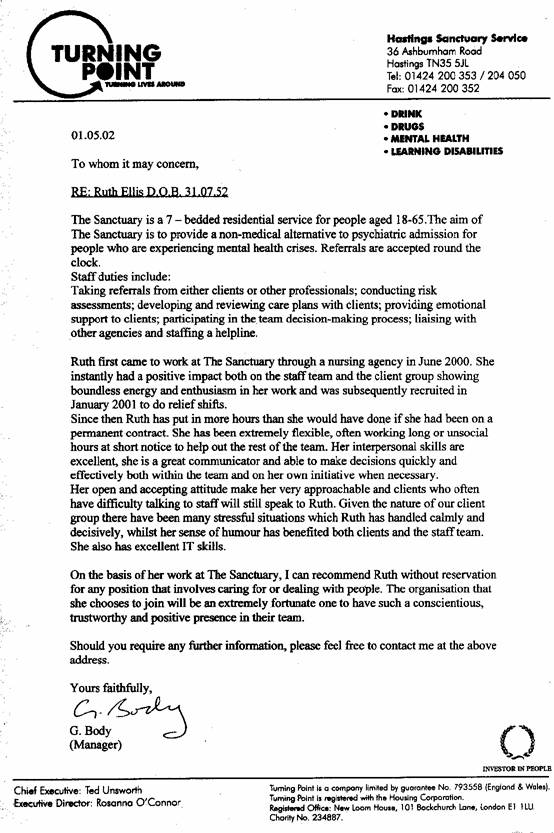
For example
here is the work reference she received from the crisis centre and it gives a
clear picture of what sort of a worker Ruth was and also lists some of her many
qualities:
When Ruth
returned to Carrickfergus, N Ireland at the beginning of June 2002, she would
have liked to have continued working in a crisis centre, but as there was not one
locally, she had opted instead to work part-time as a care assistant in
Ravenhill Nursing Home just outside Carrickfergus, where she had fitted in very
well and been highly regarded. But then,
this health scare changed everything and we decided that she should give up all
work until everything had been sorted out.
So our local GP Doctor McAllister gave her an extended sick note and she
was able to start claiming Incapacity Benefit.
During the
week beginning
One day,
around about that time, while Ruth and I were out the back of our house, she stopped
and looked down at the little garden I had dug over for her. She said that she was going to call it “The
It was
about this time that I began to think back to when we were living in England
and when Ruth had suffered from strange inexplicable symptoms for some time,
which we had always put down to her HRT not agreeing with her. She also used to complain some times when she
came back from a nightshift in the Sanctuary that she could not wait to take
off her bra because it was so uncomfortable on her. She’d also had a lot of regular pain in her
back which I believed was caused by muscle spasms resulting from many years of
bad posture when she was typing and, as a result, I used to frequently massage
her back
And
then there was that strange thing about her swollen ankles. Wee Ruth had driven all the way from
While on
the subject of booze, I was desperately hoping that this health scare was no
more than a “wake up call” and I concluded that it would be a very good idea
for Ruth to really start looking after herself.
So I decided that I should set her a good example and give up drinking
completely myself, which I managed on
I also
decided to give up smoking and achieved this on
Ruth
subsequently received an appointment to go for a bronchoscope examination and,
on
On
We had hardly got ourselves settled
down in our seats when Doctor A informed Ruth that they now knew what they were
dealing with and that Ruth had cancer (this information was delivered in a
rather abrupt and chilling way, but then again, how does one deliver such bad
news nicely?). When Ruth heard this she
gasped, gripped my hand and burst into tears.
Doctor A said that although she had not been able to get down far enough
into Ruth’s left lung with the bronchoscope to see what was going on, the ”lung wash” had revealed, beyond any
doubt, that she had squamous cancer cells in her lung and that therefore the
shadow on her lung was a squamous non-small cell lung carcinoma. At this point Ruth suddenly said that she
felt sick and although the McMillan nurse directed her towards a sink, Ruth
went flying by her and burst into another room where a consultant was speaking
to another patient. If the situation had
not been so serious, it would have been funny.
When Ruth
had settled down again, Doctor A went on to say that although it all sounded
very bad news, it might not be all doom and gloom i.e. because the tumour was
squamous (as opposed to small cell) and therefore relatively slow growing and
because it seemed to be peripheral, the first indications were that it might be
operable, which was something she could not tell many people who had a lung
carcinoma. She added that before any
operation could be arranged, Ruth would have to have a CAT scan to ensure that
the cancer had not spread. Although poor
wee Ruth was stunned, she soon regained her composure. I thought she was extremely brave and I was
to think this on many occasions during the subsequent months.
After we
left the doctor’s consulting room, Ruth had to go for a test on her lung
capacity because they had to be sure that she would have sufficient lung
capacity left, if she lost part of her left lung through the operation. But she sailed through that with flying
colours, with the test revealing that her lung capacity was above average. While Ruth was in having the test, she was
still very upset, but the nurse was extremely nice to her and gave her a lot of
comfort. Furthermore, another extremely
nice nurse called Dolores, told Ruth that she could tell from looking at Ruth
that she would be okay.
With regard to myself, although I was shocked
by the news, I still felt quite optimistic, because I had been encouraged by
what Doctor A had said about the tumour on Ruth’s lung possibly being operable
and assumed that the CAT scan was just a routine procedure that would show no
spread. Having said that, I remember
being somewhat alarmed that there were so many cancer cells floating around in
Ruth’s lung. But no matter how much I
tried to reassure Ruth, she was convinced things were a lot more serious.
[Note: After Ruth’s death, it became clear
that Ruth had probably had cancer for a very long time, as it normally takes
many years to develop e.g. 20-30 years.
One of the really terrible things about lung cancer is that it is
develops in such a silent and insidious way that, in most cases, it is detected
far too late, which means, as a result, that it cannot be treated
successfully! Sadly it is almost
impossible to detect lung cancer in its very early stages, when it could be most
successfully treated.]
On
On Monday
11/11/02, we returned to Antrim Hospital for the results of the CAT scan. When we entered Doctor A’s room, we once
again found the McMillan nurse there, which was most unsettling (i.e. her
presence seemed somehow synonymous with death and terminal disease and,
metaphorically speaking, she was therefore a wee bit like a vulture, ominously
hovering around). Doctor A then gave us
the very bad news that, according to the scan, the cancer had spread to the
lymph nodes in her chest and also her liver (i.e. stage 4 cancer). This was a terrible shock, as we had been
under the impression that because Ruth’s form of cancer was normally a slow growing
one and because she was still relatively young, it was improbable that her
cancer would have spread. This ghastly
news meant that her cancer was inoperable.
But what made it so much worse was the fact that her condition was now
deemed as being incurable. Needless to
say Ruth was extremely upset. But one of
her main concerns almost immediately was Mandy who was sitting just outside the
door i.e. she wanted the news to be broken to her in as gentle a way as
possible. So I left the room and took
Mandy outside into the open air to tell her.
Although
Ruth was still very upset when she left the doctor’s room, she managed to calm
down quite quickly and regain her composure.
We then went to meet her sister Ethel and her husband Billy in the front
reception area, where she gave them the bad news in a very calm and brave
way. Billy and Ethel were very sorry for
Ruth and over the following months they became regular visitors, both to our
home and also the hospital. They were
so kind and helpful and I appreciated their love and support so much,
especially as it must have been so very tiring for them driving down so often
from Portstewart.
As for myself, my initial reaction to Ruth’s
bad news was that I was relieved that she was not going to have to endure a
painful operation. But this was
actually a really stupid reaction because an operation would have been her only
real chance of a cure. The fact that
Ruth’s cancer was inoperable meant, in effect, that it was definitely going to
kill her eventually. But that had not
really sunk in yet.
Later on
that day, Ruth became very upset about the fact that her condition was now regarded
as being incurable, because to her way of thinking, it meant that she was
doomed and definitely going to die. I
realised that, in the absence of a miracle, this was obviously what the word
‘incurable’ would actually mean ultimately.
But I felt that it was very important for Ruth to retain hope in her
heart and so I told her that the word ‘incurable’, was not as gloomy as it
sounded, that it was only a technical term that was applied to any cancer that
had spread to other parts of the body. I
explained it by saying that once a cancer had spread, it would not matter how
much radiotherapy or chemotherapy was thrown at it, they could never be sure
they had got all the cancer cells and that this was why they therefore had no
choice but to classify metastatic cancer as being technically incurable. I knew this was a load of nonsensical waffle
but she seemed to buy it, which was good.
Later while
out walking along the seafront, I wished once again that it was me rather than
Ruth who was in this position. After
all, apart from her, I had nobody else really.
But she had her son and daughter and all her family and friends. She had so much more to lose compared to
me. Furthermore life was more precious
to her than to me. If someone had come
up to me and told me that “the party called life is nearly over for you”, I
would not have been too disappointed because, as far as I was concerned, I had
had a fair shot at it and also, apart from my time with Ruth, it had never been
much of a party anyway. But I knew she
was really enjoying the party and desperately wanted to remain at it for as
long as she possibly could!
On Monday
18/11/02, we returned to Antrim Hospital for an appointment with Doctor H from
Belvoir Park Hospital. Once again the McMillan
nurse was there and she accompanied us into the meeting with Doctor H, who said
that because Ruth was not in any pain from her cancer, she would not consider
radiotherapy at this stage and that instead, she would arrange chemo treatment
for Ruth as an outpatient at Belvoir Park Hospital, Belfast (Ruth was offered
the option of going in as an inpatient but because we were so keen for
treatment to start as soon as possible, we decided to go for the outpatients
option to avoid the delay of waiting for a bed). Doctor H then went on talk about the various
nasty side effects of chemotherapy.
When we
left, we were relieved that treatment would soon be starting but worried and
fearful, at the same time, about how awful it might be. However, we did not know at that point just
how effective chemotherapy might be against stage 4 lung cancer, but we assumed
that it would definitely produce some beneficial results.
While we
were at Antrim Hospital that day, the McMillan nurse offered us counselling
assistance. I wanted as much support as
possible for Ruth and thought this was a good idea. So I persuaded Ruth to accept the offer. However, when the councillor rang up a few
days later, she really upset Ruth (who had been in very good form prior to that
call) by mentioning the phrase “palliative care” very early on in the
conversation. Ruth still had hope in her
heart that she would beat this cancer and survive. However, to her, the words “palliative care”
meant caring for the dying, which was obviously not what Ruth wanted to
hear. No doubt the lady had been trying
her best but it might have been better if she had initially had a friendly wee
chat with Ruth to build up her trust before getting down to the nitty gritty.
I was, of
course, very disturbed that Ruth had been so badly upset, especially as she
remained distressed for days after that call.
I felt very guilty because it had been me who had persuaded Ruth to
accept the offer of counselling! But I
was also very alarmed because that call had put Ruth off McMillan Nurses
completely, which I did not consider to be a good thing as I felt Ruth needed
as much sensitive and professional support as possible. So on Sunday 24/11/02, I wrote the following
letter to the McMillan nurse at
“Dear
A
RUTH ELLIS
First of
all Ruth does not know that I am writing this letter to you and I would
therefore be grateful if you would not mention it to her please.
Secondly I
would like to thank you very much for everything you have done for Ruth so
far. I also thought I would write to you
to let you know how she is at the moment.
Unfortunately it is not good news.
Although she is reasonably well physically, she is in a terrible state mentally. She is convinced that she is going to die
very soon and that there is nothing anyone can do to help her. The main reason for this is that although she
has received plenty of bad news over the last 7 weeks, nobody at any stage has
been able to offer her even a glimmer of hope and, as a result, she feels
doomed. This is very sad because she had, in fact, been doing well up until a
couple of weeks ago. It is a horrible
to see such a good wee soul - who has done so much for so many people over the
years - suffer in this way. It all seems
so cruelly unfair. Every waking moment
is a torture for her and, at the moment, the only respite the poor wee soul has
from this continual torment is when she is asleep
I have
tried to reassure her as best I can. For
a start I know from my own experience of having had cancer at 23 what it is
like to be told you have cancer. I also
believe that one of the fundamental principles of nature is that there are
always a few survivors no matter how dire the circumstances and that,
ultimately, it would be better for her if only she could ‘hope and cope’ rather
than ‘cry and die’. But no matter what I
do or say, it is not easy to make any headway at all. Although she does not know I am writing to
you, I feel both Ruth and I need further help to cope with this awful
situation. It is just such a shame that
they have changed the name of your nurses from McMillan Nurses to Hospice
Nurses. The former name had such a friendly, comforting, reassuring ring to it,
whereas the latter name would scare the wits out of most people, including
Ruth.
Ruth starts
her treatment at the Belvoir Park hospital on Wednesday 27/11 and she is
terrified at the prospect of it. But
perhaps when we are there, her daughter Mandy and I can find out more about
what support is available to Ruth and then we can try and persuade her to avail
herself of it, because God knows what ghastly horrors are looming up for her!
You
mentioned something about her possibly being able to apply for LDA
support. So I sent off for the
application pack today.
With best wishes,
MICHAEL A W LAVERY”
I was
hoping that the McMillan nurse would respond quite quickly to this letter but
it was not until about two weeks later that she rang Ruth. Ruth immediately apologised for being a wee
bit short with the councillor and went on to explain her position in a very
nice and friendly way. I was, therefore,
happily confident that we had turned a wee bit of a corner and that there would
be some further help and support forthcoming from the McMillan Nurses. However we unfortunately never heard from
that particular McMillan nurse again.
To read
more, click on THE CHEMO PERIOD
To return
to the start of this section again, click THE
DIAGNOSIS AND PRE-CHEMO PERIOD
To return
to the very start, click on RUTH ELLIS