Although we
knew that we would be going to
With regard
to getting back from
But to return to the story, we headed for
When we
entered the outpatients’ reception area, we felt distinctly anxious about what
was looming up next. This feeling was
not helped by the fairly large number of people in there who looked extremely
ill compared to Ruth, who looked a very healthy person and totally out of place
there. If you hadn’t known, you would
never have guessed there was anything at all wrong with her.
A short while after booking in at
reception, a very kind, efficient and friendly nurse called Maggie O’Reilly
came for Ruth and took her away for a blood test. Maggie was really good to Ruth and an
extremely good nurse. In fact, as the
months passed, it became clear, that ALL the nurses in Outpatients were
excellent. It was obvious that they had
been carefully selected and specially trained to reassure patients and put them
at their ease. They were all very
professional and, without any hesitation, I would give them all 10 out of 10.
After a
wait while her blood was being tested, Ruth was called in to see Doctor S, a
very pleasant big man who instantly put us at our ease and inspired
confidence. He talked at some length
about the possible side-effects of chemotherapy and added that the purpose of
the chemo was to shrink the tumours to a manageable size, the inference being
that if he could achieve this goal, he would then be in a position to control
it for as long as possible. He then
asked Ruth if she wanted to proceed and she said she did. I agreed with her wholeheartedly, because I
felt that despite some unpleasant side-effects, this would be the first step in
gaining control over the cancer and, whereas I realised that it was not going
to be a cure, I was sure that the chemotherapy would produce beneficial results
of some sort, which would prolong her life for several years at least.
[Note:
Unfortunately I was being overly optimistic because chemotherapy is actually
only effective in shrinking tumours in 40% of non-small cell lung cancer
cases. Although it
was thought that Ruth’s age and relative good health might possibly help
the chemo work in her favour, she was, sadly, one of the unlucky 60%. Furthermore, the vast
majority of people who are diagnosed with stage 4 lung cancer rarely live
beyond 12 months of diagnosis and, even if the chemo had shrunk Ruth’s tumours,
it is still very unlikely that she would have lived much longer than she
did. With stage 4 lung cancer,
chemotherapy is never a cure and the most you can hope for is that it might
help you live a few extra months, before the inevitable happens and you
die!]
After a
further longish wait while the chemotherapy drugs were being prepared, Ruth
finally started chemo treatment at
However,
one of the very noticeable things about the chemo treatment, was the fact that
the chemo drugs always came in clear bags covered in black plastic and that
black plastic was never removed throughout the treatment. Apparently the black plastic is necessary
because daylight can play havoc with the molecules in the chemo drugs. However, the black plastic was very sinister
and ominous looking and I subsequently wondered, if the chemotherapy bags could
not have been covered by black plastic and then further covered by some other
more colourful plastic.
When we got
home with Mandy, we both expected Ruth to soon experience some awful side
effects, but apart from a mild form of discomfort on the evening of day 1, she
felt nothing else adverse. Furthermore,
she felt okay the next day and, within a day or so, you would not have thought
she had had any chemo at all.
On the two
days immediately following the treatment, Ruth had to take steroids and other
anti-sickness tablets.
On
I was to
witness more tears and despair on quite a few other occasions, when the poor
wee soul would cry out that she loved her children and her house and did not
want to die. Watching Ruth in physical
pain was one thing, which I could just about manage. But watching her in such emotional pain was
another. I really did find it difficult
to see her distressed and sobbing her wee heart out in total despair. I always felt so helpless, because there was
so little I could do, to ease the torment in her soul.
Poor wee
Ruth, although she tried her best to carry on life as normal, the pressure of
this awful thing hanging over her head was terrible. As soon as she awoke in the morning, it was
the first thing on her mind and, even though she tried her best to forget about
it during the day, by keeping herself busy and working, it was never far away. It was probably easier for her when people
were around her because, being such a people person, she would get herself
totally wrapped up in their company and, for a short time at least, she would
forget her plight. But then the
visitors would leave and, once again, the spectre would return to haunt her.
She used to
love her long lingering herbal baths, with the radio on, the phone, her ciggies
and a beer all within easy reach and, while she was in the bathroom, it seemed
to be a wee bit of an escape for her.
And of course, when she went to sleep, she could escape more or less
completely. I used to love to see her
sleeping, because I knew that it meant, that she was free from her torment for
a few hours at least. But there were
many nights, when she would awake at say
It was
absolutely horrible for her and the pressure of it all was never far below the
surface. One of the unfortunate side
effects of the cancer had been to make her slightly clumsy and I remember one
time, when she was down in the kitchen cooking, she accidentally dropped a
glass saucepan lid and it smashed into smithereens. Now Ruth knew that such things never
bothered me and if it had happened a year or so before, she would probably have
just shrugged her shoulders. But that
day, she burst into floods of tears and it took me ages to calm her down. However, the incident just demonstrated all
the pent up anxiety and fears that were in her all the time. I felt so sad and sorry for her.
While we
were at the hospital, on Wednesday 04/12/02, we were referred to the nearby
Gerard Lynch Centre for Ruth to be fitted with a free wig, which she was not to
need until after the first course of the second combination of chemo
drugs. We also saw a social worker, who
told us that not only Ruth was eligible for Disability Living Allowance (DLA),
but because her condition met the ‘Special Rules’ criteria, she would receive
it quickly. When Ruth read the section
pertaining to the ‘Special Rules’, she became very alarmed because of the way
that it talked about people suffering from ‘terminal illness’. I told her that because her disease had been
classified as ‘incurable’, it therefore fell into the ‘terminal illness’
category, even though her condition was actually far from being terminal
because of the chemo etc. Thankfully
she seemed to accept this nonsense of mine.
Ruth
received DLA relatively quickly. Around
about that time, I remember reading a
newspaper article about DLA, in which it stated that lots of people getting DLA
under the ‘Special Rules’ were living beyond 6 months and that because this was
costing the Treasury such a lot of money, they were considering changing the
rules. Because I was so sure that Ruth
had at least two years left to live, I remember fretting that any change in the
rules might lead to Ruth’s DLA being cut off after 6 months, thereby leaving us
in a poorer financial position for a longish period of time. But I should not have worried, because Ruth
unfortunately only lived long enough to receive 6 months worth of DLA.
There was
no treatment on
On
Throughout
the whole of Ruth’s illness, Doctor McAllister was absolutely magnificent. Although a very busy man, he never hesitated
to come out if Ruth needed him. He also
paid her regular unsolicited visits, always examined her most carefully and
listened to everything she said most attentively. Furthermore, he readily prescribed her
everything that he thought might ease her plight and her pain, and once,
without any hesitation at all, he called an ambulance for her, when she thought
she was having a heart attack. He
really was a nice, kind gentleman and Ruth was so lucky to have had him as her
doctor.
I remember
the first time I met him, when Ruth was describing to him how Doctor A in
Antrim had broken the news about her condition and how it had left her feeling
so depressed. He patiently listened to
every word Ruth had to say and then he summed it up so neatly by saying “They
took away your hope.” It was so
true. Ruth was the sort of person who
could have coped with anything, just as long as she had hope. However, although the news she had received
in Antrim had initially knocked the stuffing out of her, Ruth had,
luckily, eventually managed to dredge up
a wee bit of hope again from somewhere, even though it took a long time.
On
When it
came to Christmas, Ruth was still a fully functioning human being, who did not
appear to be suffering from any noticeable side-effects from the chemo and she
went to extraordinary lengths to make it a very good time for everyone, which
meant doing a great deal of housework, cooking, shopping, hanging up Christmas
cards etc. She seemed more than fit for
it all and, anybody who didn’t know, would not have thought for one second,
that there was anything wrong with her at all.
So we all had a lovely Christmas because of all her efforts. However, it never really crossed my mind
that it might be her last, because, although I knew her cancer would eventually
kill her, I just assumed that the chemo would give her at least another two
years, and with any luck even up to five.
On
On
However,
there was another factor that used to bother me quite a lot. It struck me that Ruth was relying totally
on the chemo to attack the cancer and I felt that she should be doing a lot more to help herself. It really worried me that she was continuing
to smoke heavily and drink cans of beer.
Although she ate quite well sporadically, there were often times when
she did not. Furthermore, she did not
eat enough fruit or take any healthy exercise, such as walks in the fresh air
etc. I felt that to help the chemo work
properly, she should really have been boosting her immune system and looking after
herself. I was also always very anxious
in case the alcohol might have been interfering with the effectiveness of the
chemo drugs. But I always felt
disinclined to say anything. Ruth’s
predicament was miserable enough without me making it worse for her by giving
her lectures.
On Monday
06/01/03, a District nurse came to get pre-chemo bloods.
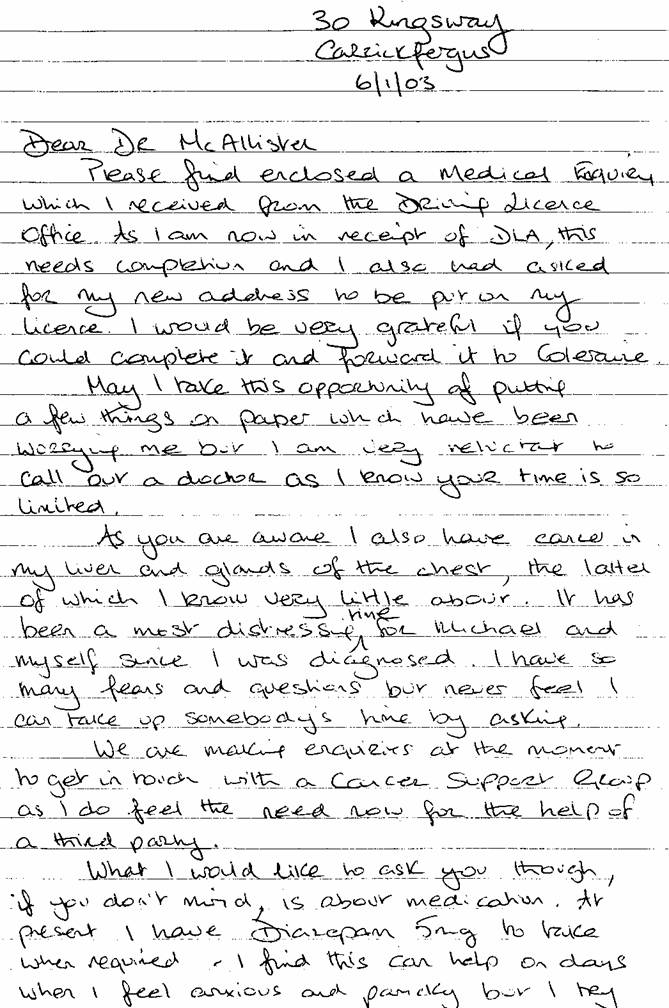
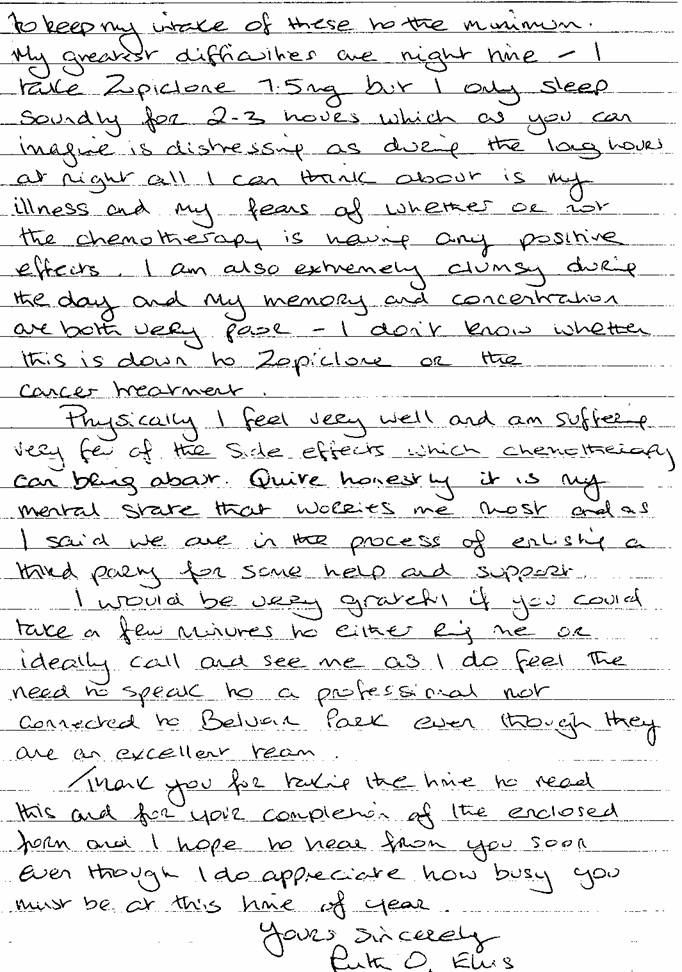
Ruth wrote
the following letter to Doctor McAllister on Monday 06/01/03:
On
Ruth also
got the good news from Doctor S, that the bone scan had been clear, which was
about the first bit of good news we had had since October. However, it was ironic, because it was
subsequently the cancer in her bones that probably caused her the most of her
pain problems and stopped her from coming home from the hospital, when she was
an inpatient there. Furthermore,
although the bone scan showed that the cancer had not spread to Ruth’s bones by
December 2002, I think it must have done so sometime shortly after the
beginning of January 2003, because it was in the February and March, that we
first noticed that Ruth’s handwriting was becoming weaker and that she was
becoming noticeably clumsier, which, on reflection, was obviously the result of
her cancer spreading to her spine and pressing on her spinal cord. Although the loss of all the power in her
right hand seemed to happen out of the blue while she was in hospital, the
whole insidious process probably actually started away back in the first few
months of 2003.
Another
thing I noticed about this time was the fact that Ruth’s power of speech seemed
to be deteriorating. I found myself
having to ask her to repeat herself more and more and, although she used to
scold me and tell me that I should go and get my ears seen to, it was quite
clear to everyone, that she was beginning to mumble a lot. Again this was probably as a result of the
cancer in her spine.
On
On
On
[Note: I
learned subsequently that the scan results revealed, that not only had there
been no shrinkage in Ruth’s tumours, but the cancer in her left lung and liver
seemed slightly bigger than before and that there were now secondary deposits
in the adrenal glands. But Doctor S,
being a kind, sensitive man, had decided it was not appropriate to give Ruth too
much bad news at the same time].
On Sunday
evening
It was a
very difficult day in the treatment room, because Ruth was so restless. The staff there put it down to the steroids,
but I suspected it was also something to do with the weepy mood Ruth had been
in the night before and earlier that morning.
Furthermore the equipment kept malfunctioning, which did not help
things.
When, after
an extremely long, tiring day, we eventually got home after
Although
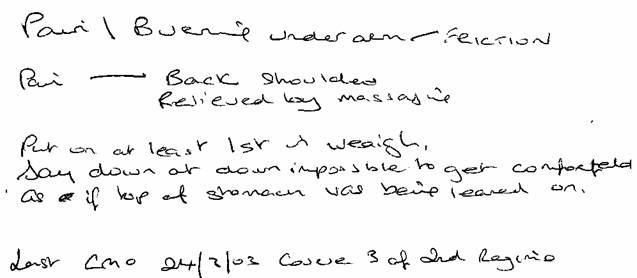
Ruth had a 2003 diary, she usually only used it to remind her of forthcoming
appointments. However, I came across
the following entries, which were in very weak handwriting (as opposed to her
normal very clear and bold style) and were rather confused and incoherent,
which was also very untypical of Ruth: -
Monday
03/02/03
“New regime
– bad reaction to steroids (20), very tearful and fidgety, no sleep previous
night!
About 3
hours on sofa 3-6 am. Head in turmoil.”
Tuesday
04/02/03
“Really bad
day – mind churning, lay on sofa, felt isolated upstairs. Visited by family – sister (Ida) did
reflexology – very calming. Enjoyed
company but experienced strange mood swings – very emotional. Slept about 1.30 – 4.30 (TOW). Think I’ll be able to sleep again.
Dozed pm –
pains started in back, progressed down legs, painful but manageable.
Took Brufen
+ sleepers.”
“Slept
until
Temp stable
at 36 degrees
Slept
reasonably well”
“Very tired – feeling completely drained –“
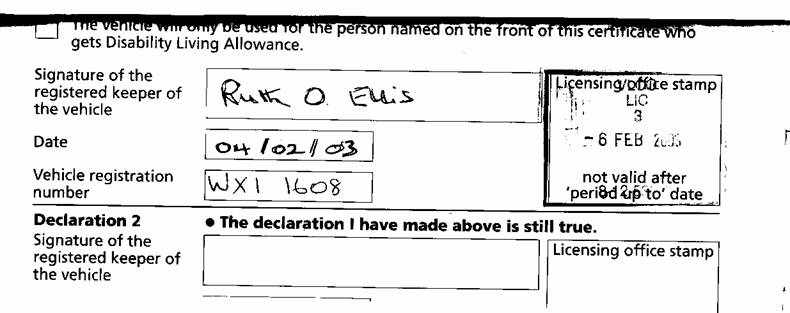
The
following document also demonstrates the noticeable change in Ruth’s
handwriting, which had always been so distinctively bold. Furthermore, note the way she had started to
almost double-write things, which is something that I had begun to notice more
and more.
On Monday
10/02/03, I wrote the following:
“My
prognosis for Ruth.
Stage 4
lung cancer is an extremely serious condition.
Although cure rates for most cancers have improved over the years, there
has been virtually no progress with lung cancer, where cure rates have remained
static at under 10% for the last 30 years.
Unfortunately once cancer has spread, an operation (the only real cure!)
is out of the question, which only leaves radiotherapy (which is only really used
to alleviate symptoms) and chemotherapy, which is rarely very effective against
Ruth’s type of cancer e.g. although the Carboplatin and Gemcitabine combination
of drugs halted any further growth, they did not shrink the tumours as
hoped. On top of that there is no
guarantee that the Carboplatin and Paclitaxel combination of drugs will do any
better and, even if they do, another sad fact about chemo, is that cancer cells
gradually become resistant to it.
Unfortunately less than 2% of people with Ruth’s condition live beyond 5
years after diagnosis. Furthermore
around 80% die within 1-2 years of diagnosis.
All in all,
the outlook for Ruth is ultimately very bleak.
Luckily her cancer was discovered when it was last October and not at
some stage in the future, when it would definitely have been too late for
anything effective to have been done.
One hope is that the chemo will actually shrink the tumours and, to use
Doctor S’s phrase, make them more manageable, thereby extending Ruth’s life. Another hope is that Ruth’s tumours turn out
to be slow growing and that, as a result, it will therefore be quite some time
before they take over her body and destroy it.
However, no
matter what way you look at it, it seems inevitable that the cancer will
eventually kill her and unfortunately this terribly sad event could take place
within the next two years, unless she is extremely lucky, which seems unlikely.
In
the meantime, there seem to be some nasty times inevitably looming up. For a start, I am afraid that the second
scan is not going to show the positive results that Ruth is hoping for and this
will be an extremely bad blow to her morale.
Furthermore, if this current combination of drugs is shown not to be
working, I am afraid of Doctor S telling her that further chemo is pointless,
which will be an even bigger blow to her morale. If it does get to that, then Ruth will be
left in no doubt but that the cancer is going to kill her in the foreseeable
future and I dread to think what her reaction to this will be or how she will
cope.
But
even if she does come to terms with her imminent death, she still has to endure
all the horrors that will start to occur when the cancer begins taking over her
body e.g. using up more and more essential nutrients, gradually overwhelming
surrounding organs and pressing on other body tissues, which could cause a
great deal of pain etc.
Another
thing that is worrying me a lot at the moment, is the fact that Ruth is
drinking around 6 cans of 5.2% beer and smoking between 40-60 cigarettes per
day, which is far too much. I cannot
believe that this is doing her body any good or helping in any way to fight
this terrible disease. At the same
time, I do not want to say anything, because maybe I am wrong and the smoking
and drinking are not doing as much damage as I fear. I would hate to deprive her of “pleasures”
that at least give her some comfort during these very difficult and upsetting
days.”
On
It was
about this time that Ruth began to lose her hair. But neither of us was too concerned.
On
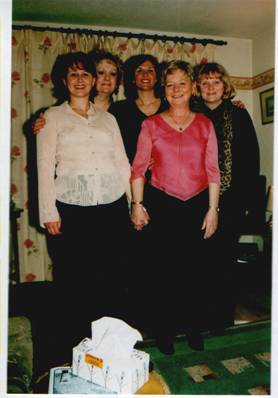
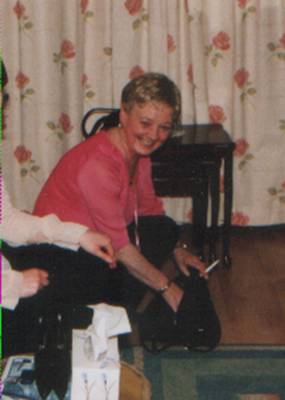
On Saturday
22/02/03, Mel, Lisa, Joy P and Joy H (Ruth’s former work colleagues from the
Sanctuary in
Ruth wrote
the following in her diary:
“Mel, Lisa
+ Joy H & J P – Brilliant”
RUTH WITH THE SANCTUARY SAINTS TO SEE RUTH LAUGHING WAS A JOY
On
Later on,
Ruth took her 10 steroid tablets at
On
On
Thursday, 13 March 03, I wrote the following note:
“Once
you have got stage 4 cancer, it is a bit like being in a lottery with the
prizes being shared amongst those very few who survive. Although the outlook for Ruth is
particularly bleak and although her condition would suggest that she will be
dead within the next 12 months or so, there is always that chance that she
could be one of the very few lucky ones who survive longer. However, I wish I could feel even slightly
optimistic about this i.e. her luck has been so bad so far, that it is hard to
see it improving at this stage.
With
regard to the current treatment involving Carboplatin and Taxol, the Taxol is
really taking its toll on her and I am beginning to wonder how much more of it
she can take i.e. she is in constant pain and in very poor shape. One can only hope that the scan will give us
some hope, as this would be a tremendous boost to her morale and help her
through further Taxol.”
Around
14/03/03, Ruth’s pain was such that Doctor McAllister prescribed her various
drugs including Diazapam, Zopliclone, Zamadol, Kapake, Diclofenac, Cipralex,
Cyclizine and then MST and Sevredol breakthrough tablets, which subsequently
had to be increased in strength.
On
On
On
[Note: I learned later, that there is
currently some debate amongst cancer specialists as to whether a CT scan should
follow the second or third course of chemo.
It is also not easy for a consultant to arrange a CT scan for the day that
he would like, because of the unrelenting demand for that service and, as a
result, he often has to accept whatever slot is offered to him. Although Ruth’s CT scan was only 3 days
after her third infusion of Carboplatin/Taxol, it was, apparently, not too
early to reach a judgement as to the effectiveness of that particular
combination of chemo drugs. However, it
would appear that the third infusion was actually therefore unnecessary, but
because of the time factor and the constant demand on CT scan resources etc,
this sort of situation is very hard to avoid at times.]
On
Wednesday 02/04/03, the District nurse came to take blood.
On
When
pressed by Ruth as to how long she had to live, Doctor S told her most
reluctantly that, based on averages, she had only a short time to live,
somewhere between 4 to 9 months!
Needless to say the poor wee thing was extremely upset and had to go
outside to get some fresh air. When I
went out to find her, I found her sitting on a chair beside the entrance door
to Outpatients, smoking a cigarette and in floods of tears.
[Note: One of the best defences against the spread
of cancer is your own immune system and it had been a fear of mine, that the
chemo might actually have weakened her immune system to such an extent that it
had ‘opened’ the floodgates’ to the spread of the cancer. However, Doctor S confirmed that my fear was
groundless]
Around about that time,
Ruth was beginning to suffer from such pain, that she was often in extreme
discomfort. But, even so, she was a very
brave wee soul and very rarely complained.
Instead, she just kept on trying to live as normal a life as possible,
doing housework or cooking or whatever, even if it was at a very slow
pace. But it was at bedtime, that her
pain was most apparent. I used to have
to help the poor wee soul get into bed and then manoeuvre her into a
comfortable position. Then when I got
into bed, she would lie in the safe warmth of my arms for a long time, before I
would help her turn on to her side, so she could sleep comfortably. When I could tell from her breathing that
she was asleep, I used to feel relieved, for it meant that for a few hours at
least, she was free from all her pain and torment.
Despite
taking hefty doses of MST and Sevredol, Ruth developed such pains in her chest
and left arm on
Although we
had had plenty of visitors over the previous few weeks, it had seemed quite a
long time since Ruth had been outside the house and, because the weather had
been so nice, I suggested to Ruth one evening, that if it was nice the next
day, we should take a taxi down into Carrickfergus and wander around the town
or sit near the Castle and watch the world go by. She thought that this was a great idea and
was really looking forward to it.
However, although the weather was lovely again the next day, Ruth was in
such pain that we had to scrap the idea and she never got down into
Carrickfergus ever again. Poor wee
soul, her luck was so bad, that no matter what wee plan we thought up for
improving things for her, something always seemed to crop up to ruin it.
Around
about this time, Ruth told me one morning, that she had had a strange but very
vivid dream, in which her sister Laura (who had died suddenly in 2001) was
calling to her and beckoning her to join her.
Over the
next few days, poor wee Ruth’s pain did not subside, even though she was taking
very large doses of MST and Sevredol. So
when Ann Fallis (an excellent McMillan Nurse) came to visit on
During the
evening of
The doctor
who was due to come and see Ruth on
When Ruth
had been allocated a bed in a single room, the next thing they wanted to do was
X-ray her and a very nice friendly porter took her round to the X-ray
department on a trolley. However, Ruth
was in such terrible agony, that they were unable to do any X-rays. So she was taken back to her room, where
they put her on a diamorphine syringe driver, which eventually reduced the pain
to such an extent, that they were able to do the X-rays about 2 hours
later.
[Note: I
subsequently learned that it was probably the tumours in Ruth‘s liver, together
with faeces and trapped gas, that had made Ruth’s abdomen so swollen and that
this was borne out by those X-rays that night]
I stayed
with Ruth until quite late and then Mandy took me home.
On Tuesday,
“The
results of the scan were negative. Not
only that, but Doctor S informed her that chemo was no longer an option, that
all they could do from now on was try and deal with her symptoms. In answer to a question from Ruth, he told
her that, based on averages, she had only between 4 – 9 months to live. Needless to say the poor wee soul was
totally distraught. But what made it all
the worse, was the fact that she started developing these awful pains, which
eventually became so bad that she had to be taken to
[Note: When
we saw Doctor S on Wednesday, 9th April 03, it was my understanding
that his 4 – 9 months life expectancy estimate related to the time that Ruth
actually had left with effect from that date.
However, it was Ruth’s contention that it actually related to the period
following Doctor A’s initial diagnosis of stage 4 lung cancer in early November
02. Ruth was to repeat this on several
other subsequent occasions and it could well be, that she was right – yet
again!]
To
read about Ruth’s first week as an inpatient in Ward 8b,
To return to
the start of this section, click on CHEMO PERIOD
To return
to the very start, click on RUTH ELLIS