
Star Trek: Earth Strike
Episode 13: At the Cliffs Edge
�Why don�t they finish us off?� Ensign J�Fwaal asked, the universal translator rendering his words as somewhat mechanical. �They could destroy us in a moment.�
�They do appear to be very single minded.� Data observed.
�It is the tactics of the K�Tala nest.� Worf said, naming an odious insect species from the Klingon homeworld. K�Tala�s were somewhat similar to wasps, but, needless to say, much more dangerous. �When one has neutralised the defending K�Tala warriors one must destroy the nest
before they recover - we are, effectively neutralised. No doubt the aliens will turn their attention to us once the Earth is destroyed.�
�Indeed,� Spock said, �I believe that the six remaining capital ships are the only vessels capable of producing the planet destroying beam and while they are doing so they are incapable of manoeuvring or defending themselves. The smaller ships are evidently being held back to defend the capital ships until their job is done.�
�They�ll ignore us until they consider us a threat.� Picard observed.
�I would say that was a logical assumption captain.� Spock agreed. �After Earth is destroyed they might simply leave and let interstellar politics take it�s course. The United Federation of Planets would become a thing of the past.�
�Don�t you think that�s overstating it a little,� Hawke asked, �I mean the UFP is hundreds of worlds, Earth is important, yes, but...�
�All planets of the United Federation of Planets are theoretically equal, however, the Earth, being not only the seat of government but also the head-quarters of Starfleet Command, might be said to be �more equal than others.� Without Mars or Betazed or Andora or even Vulcan the UFP can survive - without Earth it�s fate would be assured.� Spock insisted. �Mr Worf, what would the Klingon Empire do if Earth was destroyed and Starfleet thrown into disarray?�
�They would invade.� Worf stated instantly.
�Chancellor Martok doesn�t strike me as the sort who would turn on an ally just because he was weakened.� Picard protested.
�He would have no choice,� Worf explained, �either he would order the invasion or he would be deposed and his successor would. The Federation would be just too tempting a fruit not to pluck.�
�An imperative of the same nature would doubtless influence the Romulan Empire too.� Spock added.
�So we are all that stand in the way of the destruction not only of Earth, but the whole Federation.� Picard said. �And we are powerless. Dead in the water and out of range.�
�Are there any other Starfleet vessels on an approach course?� Picard asked.
�Scanning,� Spock replied, �indications negative at this time.�
�This is an intolerable situation!� Picard said, slapping at the intercom panel on his command chair. �Mr LaForge; if you don�t get this ship moving soon I�m going to order you to get out and push!� Data swivelled in his chair and looked at his captain calmly. Slowly the android raised one eyebrow. Picard slumped for a moment then tapped the intercom again. �Geordi I... do what you can.�
�Understood Sir.� The Chief Engineer�s voice responded. �Scotty and I are working on a new approach, we�ll keep you informed. LaForge out.�
Spock, who had observed the silent exchange between the android and his captain nodded in approval.
* * *
Dr Brahms read the measurements on the console before her with disbelief. The Yellowstone Geothermal Energy Plant had for over a century now been able to vent or channel enough power from the caldera above which it was located to keep the pressure levels from building towards explosion, in recent years even reducing pressure somewhat. The YGPP had been in uninterrupted operation for over 300 years, ever since the late 20th Century when the threat that the caldera represented for the planet was first realised. It had survived the chaos of the great upheaval; the masters of the Easern Coalition and other parties acknowledging that targeting the plant would result in a global catastrophe.
Since it�s beginning the plant�s problem had never been the production of energy, rather the disposal of the same. There were those who claimed that it was this abundance of virtually free and limitless power that enabled the Earth to eventually discard its monetary based economy and allowed weather control, transporter and replicator technology to become widespread and commonplace.
Although Leah�s main area of interest was in the development of warp engine design, a corollary of that was a study of energy management and transference and she had been asked by the plant�s supervisors to advise on a recurrent problem that they had been having with a dissonant feedback effect in the secondary conduit coolant systems.
�Miles; have a look at this.� Leah asked her fellow consultant on loan from Starfleet Academy.
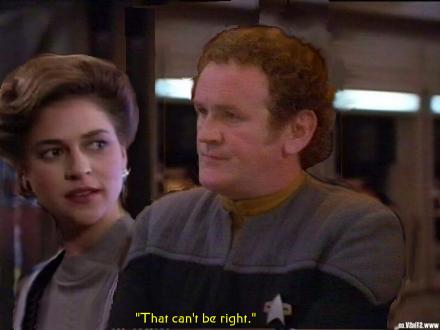
�That can�t be right.� Miles O�Brien said in consternation as he studied Leah�s data. Commandeering an adjacent station he began running diagnostic routines on the plant�s systems. It did not take long before each looked up and saw fear in the other�s eyes. �Right or not; it�s true.�
Pressure levels within the caldera, stable for centuries, had taken a sudden jump and were rising rapidly. Already they had reached a level commensurate with when the first reliable measurements were taken. �The caldera will blow if this continues!� Dr Brahms exclaimed, �We have to go; get out of here!�
�Go? Go where?� O�Brien asked. �If the caldera goes Earth is finished!� Although O�Brien was slightly overstating the case essentially his observation was true. While the initial blast and clouds of poisonous
gas would likely only wipe out most animal life on the North American continent, the volcanic winter and mini ice age that would follow would mean freezing or starvation for the rest of the world. Millions of refugees could be saved by the efforts of the Federation, millions, yes, the billions of Earth: no.
�There�s got to be something we can do, we can�t just give up!� O�Brien said, frantically searching the plant�s subsystems, �some way we can lower pressure levels, dispose of the energy! Something!�
* * *
�I�m receiving some reports from the surface now,� Spock stated, �transmissions are garbled and breaking up but there is a increase in volcanic and tectonic activity... earthquakes, eruptions, tidal waves, widespread panic.�
Picards attention was riveted on the rosette of alien ships pouring their lethal fire into his homeworld.
�Captain Picard,� Spock said formally with all the considerable gravity that was his to command, �if you have any straws left to clutch, I suggest you do so now, before it is too late.�
Data swivelled in his chair. �How would grasping dried vegetation...�
�Not now Data,� Picard interrupted impatiently, momentarily thinking that perhaps after this crisis was over he should order his android officer to assimilate a database of colloquialisms. His mind raced, seeking alternatives, possibilities, but try as he might he could think of only one - and he didn�t want to use it. Nevertheless he stood up and sought to focus his mind on the one being that he knew could help them now. He intoned loudly, projecting his voice as he tried to project his thoughts to wherever in the wide cosmos that entity might be.
�Q!� Picard said, �This is Jean Luc Picard! I need you Q! We need your help!�
There followed a moment of stillness while the bridgecrew anticipated with both hope and dread that tell tale flash of light that heralded the arrival of the capricious and powerful multidimensional being. The moment stretched... and passed. Shoulders slumped and people breathed again.
�Captain!� Data said suddenly, re-orienting the view on the screen to an apparently empty area of space. �Something�s happening...�

