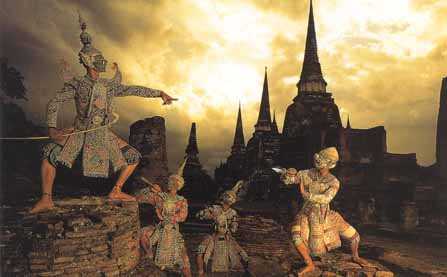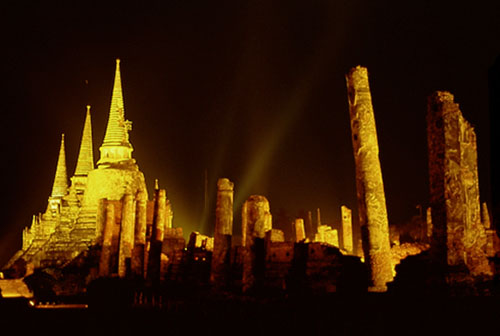
Of the many historic sites frequented by visitors to Thailand, the ruins of the ancient Thai capital, Ayuthaya, are among the easiest and most satisfying to take in.In 1351 a man named U Thong established the city of Ayuthaya (variously Ayudhya, Ayudhaya, Ayutthaya) as his capital city on the Chao Phraya River not for from Thailand's modern capital, Bangkok. U Thong was probably the son of a Chinese merchant who had married into local nobility; he changed his name to Ramathibodi and set about creating a new center for the Thai world. In 1378, Ayuthaya defeated Sukothai in battle and became the capital, not just of Ramathibodi's dynasty, but of the entire Thai world. In 1431, the Thai army of Ayuthaya defeated the declining Khmer kingdom of Angkor Wat and sacked Angkor. Ayuthaya was now the leading imperial power of Southeast Asia. The switch from Sukothai to Ayuthaya is historically important for a couple of reasons. One is the change which took place int he nature of the kingship. The king of Sukothai had been called a Dhammaraja (something akin to "lawful king"); the king of Ayuthaya was called a Devaraja -- a godking. The change was permanent; the king of Thailand today remains a god in the eyes of his subjects. Another reason the move was historically important is that the center of Thai power shifted closer to the coast. The Thai people became more oriented toward commerce. Their capital would never again move inland.
King U Thong (1350-69) was the first of 34 kings in his line; King Ekathat (1758-67) was the last. The royal line of Ayuthaya lasted over a period of 400 years. An excursion to Ayuthaya is one of the most popular sightseeing trips available to tourists based in the Bangkok area. Ayuthaya is a mere 50 miles (85 km) from Bangkok. The city is filled with ancient and majestic architecture. Ayuthaya was at one time considered the "Venice of the East" -- with canals, palaces and temples. Today the ruins of the city are still worth seeing. Ayuthaya can be visited as part of a bus excursion or by cruise ship on the Chao Phraya River. It is also possible to take the train to Ayuthaya. The modern city oAyuthaya is not particularly remarkable. Tuk-tuks (the little Thai three-wheeled taxis) can be hired in Ayuthaya for about 250 baht ($5 US) per hour. They will be quite happy to carry you out to the site of ancient Ayuthaya. If you manage to get to Ayuthaya, Chao Sam Phraya Museum is a must see. The museum holds a good quantity of Ayutthayan-style art objects, many excavated from local temples. The museum is open Wednesday through Sunday (except on national holidays) between 9.00 AM and 4.00 PM. Admission is 10 baht. Another important stop is Wat Phra Si Samphet. This structure was Ayuthaya’s largest temple and a favorite for the royalty. It later became the model for the Emerald Buddha Temple in Bangkok. The complex is dominated by Wat Phra Si Samphet's three towering chedis. Adjacent to the site is the Phra Mongkhon Bophit Chapel, which houses a massive bronze Buddha image. Built in the early 14th century, Wat Phanan Choeng is older than Ayutthaya itself and its origins remain uncertain. The riverside temple includes a Buddha image was built in 1325. It is held in high esteem by local residents. Also on the list should be Wat Mahathat (generally considered the most beautiful temple in Ayuthaya) and Wat Phra Rom (one of the city's older temples, build in 1369).This list is by no means exhaustive. A good history buff could spend days (or even weeks) inAyuthaya without experience boredom.