
Phool kay baaD,naye pHool khileiN , Kabhi kHaali na ho daaman teraa
RosHni RosHni terii raaHeiN , Chandni Chandni aaNgan teraa
MahtaaboN kay watan ....Kaifi Aazmi
"A City built as the replica of Pardise,on the foundation of love."
Mohammed Quli Qutub Shah
Home | Fikar
| Islam| Hyderabad| Tahzeeb | Meri Baat
Urdu ka Safa | Hyd-Pictures
| Links | Dost
Islam in Urdu
Sarzameen-e-Hyderabad
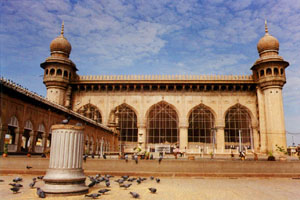 |
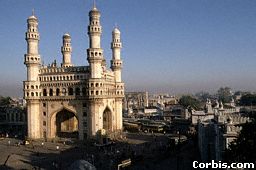
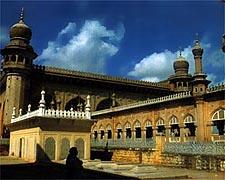
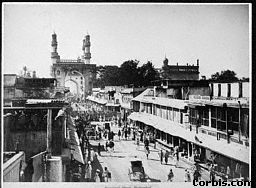
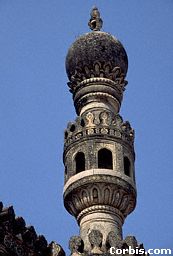
The Mecca Masjid is the biggest mosque in Hyderabad and lies 100 yards south west of Charminar. The name is derived from the Grand Mosque at Mecca on which it is patterned. The hall is 67 metres by 54 metres and 23 metres high. The roof is wupported by 15 arches, five on each of the three sides.The building of the Mecca Masjid was begun by Sultan Muhammad Qutb Shah under the direction of Daroga Mir Faizullah Baig and Choudhary Rangaiah. Nearly 8000 mansons and labouresrs worked on it. The construction work continued during the reigns of Abdullah Qutb Shah and Abul Hasan Tana Shah. Finally 77 uears after it was begun, Mecca Masjid was completed in 1694 by the then Mughal Emperor Aurangzeb. There is an interesting story regarding this mosque. When the foundation was being laid, Sultan Muhammad Qutb Shah is said to have invited all the pious religious elders of the city. It was announced that the king wanted the foundation stone to be laid by onewho had never missed his prayers. none came forward, therefore Sultan Muhammad himself laid the foundation for he had never missed even his midnight prayer since the age of 12. |
 |
 |
 |
The beginnings of Osmania University can be traced way back to 1873, when the need for a university in Hyderabad with an Indian language as the medium of instruction was first mooted. Two eminent scholars, Rafat Yar Jung and Jamaluddin Afghani, were the active inintiators of this move. In 1913, an old boys'association of Dar-ul-Uloom was formed, and this association raised the issue of starting a university. By this time, the seventh Nizam had succeeded to the throne.He took a keen interestin the proposal. During thefirst meeting of the association in 1914, which was held in the Town Hall situated in the Public Gardens, Sir Akbar Hydri, after due consultation with the Nizam, in his inaugural speech assured the gathering of the setting up of a university. He submitted detailed proposals to the Nizam in 1917. The Nizam gave his consent and suggested the name "Osmaina University". |
 |
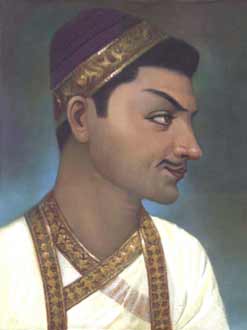
Mir Osman Ali Khan, maker of modern Hyderabad was born in Hyderabad on 5th April, 1886 at Purani Haveli. After the death of his father, Nawab Mir Mahboob Ali Khan, on 29th August, 1911 Mir Osman Ali Khan was proclaimed the Nizam by Nawab Shahab Jung, the Minister of Police. Mir Osman Ali Khan, at the very outset, made up his mind to build up a modern State on a par with the most advanced countries of the world. He declared: "In every wayI will do my best to do good to my people and my State".The outstanding eventof this period was the epoch-making "Farman" (Charter) of His Exalted Highness issued on 17th August, 1917 in which he announced his decision to start a separate university for Hyderabad with Urdu as themedium of instruction. With the formation of Osmania University on 17th August, 1917 the university became the first university in India to impart university education through an Indian language while retaining English as a compulsory subject of study. A landmark in hisregime was the inauguration of a new constitution of the Government on 17th November, 1919 with an executive council. In 1927, Osmania Medical College was inaugurated and in 1929 Osmania Engineering College was opened. |
| Hyderabad at its best | |
Home | Fikar
| Islam| Hyderabad| Tahzeeb | Meri Baat
Urdu ka Safa | Hyd-Pictures
| Links | Dost
Islam in Urdu