Though the present Japanese educational system
is similar to that of the U.S. (six years of
elementary school followed by three years of
junior high school then three years of high
school, and four years of college) the actual
school culture will be different than its counterpart
found in the U.S.
For many students school is their complete
life. Many students even attend juku
or "cram school"
after regular school
hours. Entrance exams are given only once a
year in February or March. If a student fails
these exams then he or she has to wait an entire
year to retake them. Therefore studying is an
important part of their daily life. Some students
even attend school on Saturday a
nd Sunday to
participate in their club activities. Club activities
occur almost everyday after school and usually
won't end until you have already left for the
day. Club activities vary from school to school
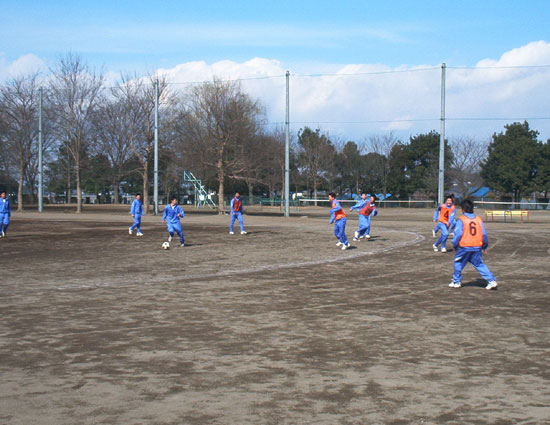
but are generally sports such as basketball,
baseball, soccer, or for some can be art or
music. These are very important to the students
as they provide a social interaction as well
as a few moments of entertainment.
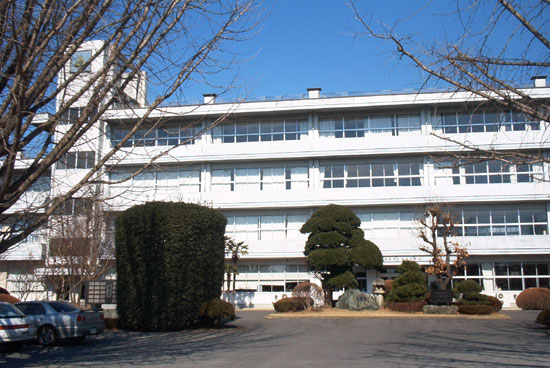
In Moka there are six junior high schools:
•Moka Chu
•Higashi Chu
•Nakamura Chu
•Nishi Chu
•Ouchi Chu
•Yamazaki Chu
As an AET you will be required to work Monday
through Friday, from eight in the morning until
four forty-five with an hour for lunch. Sometimes
school events will require you to work on a
Saturday or a Sunday but you will usually be
compensated with a day off later in the week.
Depending on the amount of students in the school
you will have around 15 to 20 classes a week.
You will be the only AET at your particular
school and you will teach every student in the
school including the special education students.
You will be expected to teach English with a
Japanese teacher. This is considered "team
teaching". As each individual person has
a unique personality so does each Japanese Teacher.
Hence just as in everyday life there are some
teachers that you may enjoy more than others.
You must learn to adapt to each situation if
you are to succeed as an AET.
There are times when you will attend an elementary
school to teach for a day or half a day. In
the Nakamura area for example, there are four
elementary schools. Each one is visited at least
twice a year for an English lesson ranging from
11 students to 33 at a time, depending on the
size of the school.
Notable differences:
You will find that the students will remain
in the same class and it is the teachers who
will change from period to period. Before each
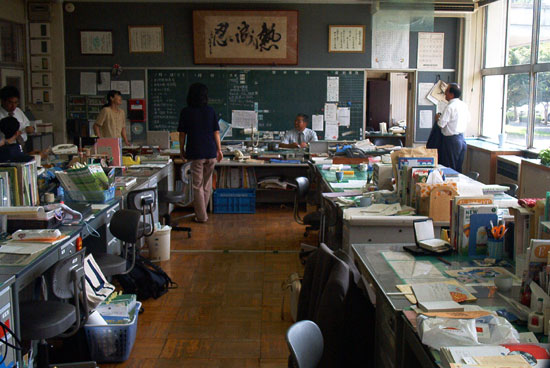
class you will be in the teachers room and one
or two students will approach you and request
your presence. Once the bell rings you will
follow your co-worker to the classroom. Once
you are in class the students in unison will
stand and greet you and then take their seats.
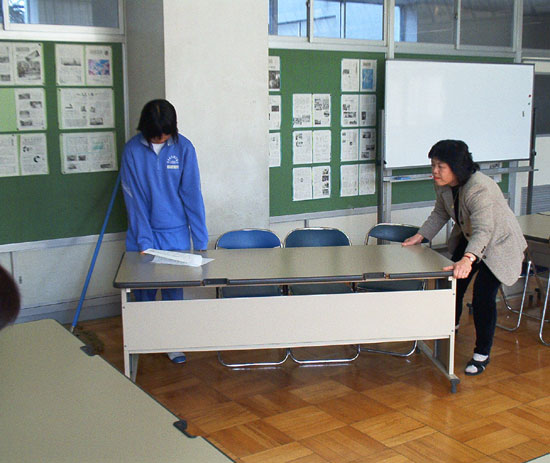
Janitors - There are no school janitors. Students
and school staff are responsible for the general
upkeep and cleanliness of the school. It's not
an uncommon sight to walk by an unattended classroom
and witness a group of students climbing a carefully
stacked mound of desks and chairs to change
a light bulb.
There are no showers at the school. Bring a
towel if you happen to ride your bike on a particularly
hot summer day and try to freshen up as much
as possible.
Most japanese teachers tend to dress business
casual. Wearing a t-shirt and ripped jeans would
not be acceptable. A tie is not always necessary
but most male japanese teachers do wear one
everyday. There are numerous school ceremonies
(i.e. graduation) when a suit and tie would
be required. You are given a locker and it is
advised that you keep a spare suit as well as
a tie or two for those occasions when someone
forgets to inform you that it was picture day
or some other event. Since all students are
required to wear uniforms it's probably a good
idea to always try to look professional.
Shoes: As in most japanese
buildings you are not allowed to wear your outdoor
shoes inside. There is an area in most buildings
where you slip off your shoes and change into
your "indoor" shoes. These indoor
shoes are used in all the rooms of the school
with a few exceptions. If you want to enter
the gym you must change into your "gym-shoes".
Note:This is based upon an
average day in the 300 student school of Nakamura
chu.
| 7:45 - 8:00am |
Arrive with about
fifteen minutes until work begins. Change
clothes in the locker room and be at the
desk by eight. |
| 8:00 - 8:45am |
The morning meeting begins
promptly at eight. After the meeting this
is the time to ask your sensei what if any
events are scheduled for the day. The meeting
is followed by preparation for the days
classes. |
| 8:45 - 12:35pm |
Periods one through four
take place. Depending on your schedule you
could teach only two classes or all four.
You will have a schedule that you can refer
to. |
| 12:35 - 1:30pm |
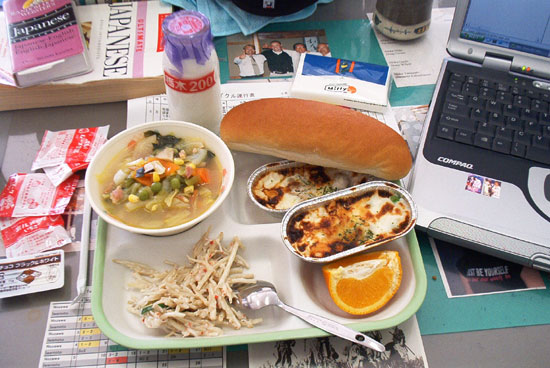
Lunch
is served. If you choose to pay the monthly
fee of ¥5,000 then your lunch will be
served in the teachers room. |
| 1:35 - 3:25pm |
Periods five and six |
| 3:30 - 3:45pm |
Cleaning time. You along
with everyone else will begin to clean the
school. The students are all assigned an
area to clean. Bathrooms, classrooms as
well as raking leaves outside are all done
by the staff and students. |
| 3:45 - 4:05pm |
Students homeroom meeting |
summer:
4:10-6:15pm
winter:
4:10 - 5:00pm |
Club activities. Leave school
at 4:45pm |
|