|
Legal and Illegal Immigrants in the U.S. |
Be educated! Research more on immigration topic with links below: ====>>>>>> |
Let's Play Devil's Advocate |
||
Introduction: Laws are passed and introduced into our society each
day. The issue of immigration effects us all and should be examined.
There are three classifications for immigrants: 1. Legal immigrants
already in the U.S. 2. Illegal immigrants living in the U.S. for more than
5 years, and 3. Immigrants on their way here. The following essay is
to help readers understand how Prop 187 in California effects the lives of
legal and illegal immigrants. The essay focuses on social issues and
challenges faced by both legal and illegal immigrants who have lived in
the U.S. for numerous years. It also takes a look at how the U.S.
depends on immigrant participation in the work force and economy.
Please reflect on where you would stand morally and ethically on this
issue by posting your questions or concerns with the guestbook.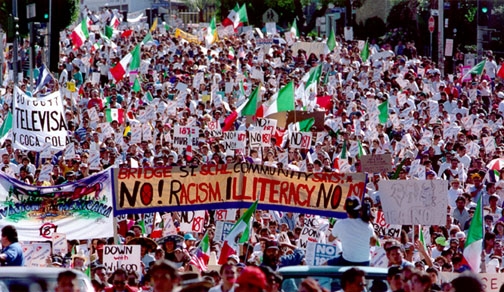 Protest of Proposition 187 in 1997
America is the land of the free. In America, where M& M bags are oversized and value meals come with super-sized French fries. America does not need to publicize its greatness and freedom. The thousands of immigrants coming into the U.S have heard enough propaganda and decide to see for themselves. But many foreigners will tell you freedom is not free after all. Like most advertisements and countless Hollywood dreams, immigrants found life in America not exactly as they imagined. There are many challenges and unjust situations faced by legal and illegal immigrants in social settings, education, health, employment and legal issues. Many arrive without understanding of the immigration policies and laws that apply to them. Prior to September 2001, President Bush arranged to meet Mexican President Fox to discuss immigration problems in the U.S. and the possibility of granting legal status to Mexicans working and living in the U.S. for many years. After the terrorist attack, meetings in Mexico were cancelled and immigrant lives put on hold, the American security was under attack. Immigrants accumulating status at the time suffered from the aftermath of the September 11 event. Since then, levels of security rose and questions pertain to lack of immigration laws and policies were discussed. Many Americans blamed the lack of border control and screening of immigrants for contributing to the loopholes of national security. Yet the issue of September 11 was not just allowing terrorists to come into the U.S. in the form of immigration. Terrorists found linked to the September 11 attack were granted visas by the INS was an unfortunate event that led to the thousands of lives lost that day. What drives these people to do this type of terror and why do they pick on the U.S.? Immigration cannot be blamed; more than 36,000 non-citizen service members are making up about 5 percent of active duty service members have helped to fight against the war in Iraq. Not to mention the 50,000 immigrants who fought the Civil War (Gotham Gazette). What should be explored is the foreign policy and national interests within the U.S. and Middle Eastern countries that caused this conflict should be looked into. For example, the American CIA supported Osama Bin-Laden and provided Saddam with bio-chemical weapons during the Iraq-Iran War; over 50,000 Iranians died. If immigration was to be blamed for this, then what about past immigrants of all ethnicity, that turned into rapists, molesters, murders, and criminals? Then it was wrong to admit them into the U.S. too? What was over looked was the immigrants applying for legal status and has settled in the U.S before the attacks. These groups of immigrants and the undocumented now have to suffer the new regulations imposed on immigration policies. What most do not realize is how immigrants have settled and rooted in the U.S., would now have to wait longer to achieve status. Certain temporary immigrants are still allowed to work and receive health benefits; yet undocumented immigrants have laws imposed on them to prevent employment, basic civil rights, and education. Most do not notice these groups among the daily busy American lives. These are immigrants who have applied for legal status and put on a waiting list. The wait list for legal status is an effort that will take up to 20years depending on how much you pay your immigration lawyer and which condition you apply under. The wait list has been postponed after the September 11 attack since most Americans believe lack of immigration policy and screening was to be blamed. For those who wanted to be granted automatic status, they could chose to listen to Attorney General John Ashcroft’s advice in reporting all suspicion of terrorism, report or turn in friends and family in hopes of getting U.S. green card or citizenship (Mazrui). Legal and illegal immigrants alike now have an extra precaution in mind, to watch what you say or one could get deported or detained even if you are not affiliated with any terrorist group at all. Hubert Humphrey once stated the racist philosophy as fear and distrust in foreigners, fear or threat of losing Anglo-Saxon character (Hayes 15). Part of the problem with immigrants was the perception of blaming economic and social problems on them. This country has a tendency to cast new immigrant groups as scapegoats in time of distress. The film “Gangs of New York” provided an excellent example of early Irish immigrants and their lives in the United States. They came here to escape the potato famine, poor economy, and depression in Ireland, yet the film displayed how their religion and culture were looked down upon due to their entrance as foreigners. The British came over for work and to escape religious rule. Africans were forced immigrants at the time and it took them over one hundred years to gain normal citizen voting rights. Those who were native-born Americans viewed immigration as theft. But who owned American land? If to take claim ownership of this land, then it should belong to the Native’s, since the Europeans slaughtered and pushed them aside. These groups have donated most to the American cultural identity and future generations. But it makes no difference whether if they were “old” or “new” immigrants, either way it was not easily acceptable by native-born Americans at the time. Almost all of American’s ancestors were immigrants of some kind, but do Americans today think about how hard life was for their foreign ancestors to migrate to the U.S for in order for their future generation to experience a better life. 60% of voters in California passed Proposition 187 did not consider how much their ancestors had to sacrifice for their lives now, instead they voted against immigrants in the same situations as their ancestors. Freedom served as a huge attraction for immigrants. There was a choice here to do or say things that was not allowed at their country. Others were curious and led by the idea of being free, yet not too many realize there is a cost for freedom, especially if you are a different ethnicity. As Jason Scott Lee once said while playing his father Bruce Lee, in The Dragon: “America is not free after all.” In 1921, Congress passed a quota that severely affected Asia, Russia, Europe, Middle East, Africa, Australia, New Zealand, and islands in the Pacific and Atlantic. But in 1924, the law was expanded to let in only northern and western Europeans and exclude almost everyone else. Even though migration from Europe was more acceptable and welcomed, President Coolidge stated before signing the quota into effect, “America should be kept American.” President Coolidge does not seem to realize his contradicting statement meant America could be kept American by accepting more European immigrants and less from other nations. Since each culture adds to the melting pot, it is not just to say America could be preserved by taking in only European immigrants. U.S allowed two benefactors that contributed to the waves of immigration: Gold rush and the need for labor such slaves and railroad workers and the Bracero Program. Gold rush pushed the beginning of the American dream. Rumors of America’s streets paved with gold were expressed in foreign countries, drawing a major population of immigrants at the time. Africans forcefully taken away from their land were not considered a whole person to begin with. Their legal status came longer after their first arrival in the U.S. Greedy businessmen that offered false advertisement of America and labor contracts to attract cheap labor tricked the Chinese to come work on railroads. Both groups have contributed to the foundation of early U.S.economy, yet due to their ethnicity and difference with the other early Anglo inhabitants, laws at the time excluded their rights to become legal residents and citizens. Certain groups also had literacy test imposed on them in order to prevent Asians from entering and Africans to become U.S. citizens. Between 1882 and 1904, the government passed 6 Chinese exclusion Acts to prevent further migration of Chinese immigrants (Hayes 29). These were groups who put in their services in the labor force to set the roots for American economy. But after the Emancipation Proclamation, the completion of the railroad and the invention of the cotton picker, the black workers were left to discrimination, illegal status, and exclusion. In 1942, Mexico and U.S brought together the Bracero Program to allow temporary workers by guaranteed minimum wage and work protection. Bracero program was evidence of the willingness of U.S. government to subsidize the southwest and California agriculture with cheap labor. These temporary farm workers were the foundation of undocumented immigrants granted with H-2 permits. These H-2 permits were granted mostly during harvest season when California can’t afford to lose workers. Hiring Mexican workers to work on American soil could make more profit by paying lower wages. Similar to other labor groups, the H-2 workers were exposed to American life, even after the program ended; many stayed to search for better jobs, thus causing more illegal status. Under this program, nearly 450,000 Mexicans participated and the dependence between American employers and Mexican workers has continued into the twenty first century (Bischoff 26). According to Juan Vicente Paleim, immigrant workers are in the lowest paid jobs but in key industry of California’s economy. In 1990, 91% of immigrants from Mexico were in the farming industry and agriculture served as a gateway for Mexican immigration (45-68). As regulation imposed on undocumented workers increased, Hispanic population boomed in rural towns such as Santa Maria, Salinas, Fresno, Stockton, and San Diego. Labor groups such as Mexicans, Africans, and Asians, either by force or signed agreement were all exposed to the American way of life. Dependence on work in the U.S. to support families has led many to stay. Many immigrants become illegal by staying past their visa time, or temporary working status. Most saw how much power and potential one could collect in the U.S. and decide to stay past their designated time period. The U.S. needed labor at the time of construction, after completion of the task, the well being of the workers were not taken into consideration. Due to government restrictions and laws preventing minorities, most of these groups found it hard to establish a living in the U.S. Proposition 187 played an important role in California economy and social status regarding anti-immigration issues. Supported by former Governor Pete Wilson at the time, he argued to eliminate public health, welfare, and education provisions for undocumented migrants. His programs recreated demeaning depictions of undocumented workers, primarily from Mexico. Although undocumented immigrants pay taxes on just about everything they buy, anti-immigrant supporters argued how California’s economy had crumbled due to extra funds for public programs for the undocumented. Jaime Gutierrez, an activist stated in “Shifting Borders”, argued differently: “Let’s face it. Fifty percent of the agricultural work force in this is illegal. We’d sink economically without them. These people are the backbone of the California economy…Immigrants are the backbone of the agricultural industry, the service industry and manufacturing. And we pay taxes.” (Ono 31). According to Helene Hayes book, two-third of the tax dollars paid by legal and undocumented immigrants go directly to the federal level, yet state and local government pay for most of the health, education, and social service costs. At the same time, undocumented immigrants are not eligible for public benefits but they pay taxes and payroll deductions (38). Proposition 187 affect the voiceless, the vulnerable, and attacked the dignity and humanity of defenseless people. Furthermore, to cut off education for children is to end future investments, and labor returns from educated children. Educational systems since then had imposed tougher entrance policies for students entering certain school districts. Although a serious educator would not deprive any child of a proper education, many schools in California do not deploy current students that might have an illegal status. Certain undocumented parents are fearful of placing their young child at the state funded public pre-school. First they do not have the specific documents to submit: social security number, and U.S birth certificate. Second, due to language difficulties, explaining their status would be a hard task. One Chaffey College student from Rancho Cucamonga reported to have helped a Mexican family at the local San Bernardino County elementary school. The father was afraid of rejection of education service for his young son, thus he asked for translation help to describe his situation when he applied for enrollment. The application asked for him and his child’s social security number, his current employment information, and his source of income. With no social security number and no direct source of payment information, he feared the school would report his situation as an undocumented immigrant. Luckily, the teacher understood his situation, and she stated, “I would never deprive any child education, despite his or her legal status. It is wrong and unethical to pass laws to keep children of illegal status out of any educational system. It is like telling a child to never dream again.” Another influence Proposition 187 and other anti-immigration laws have affected children was in those seeking college. While many high school children in California attend school each day, many do not realize there are many undocumented students who turn down acceptance to well-known universities. These students work hard and have shown excellent academic achievement and some of them qualify as low-income. Tuition for those undocumented students who have been in the same school district since elementary school would have to pay out of state tuition for any university because of their status. Certain undocumented students come from working class to low-income families, therefore many would have to delay or reject their opportunity for seeking higher education due to cost. These students also do not qualify for any government financial aid such as FAFSA or a chance to apply for federal loans. The federal state simply asks all applicants to provide evidence as U.S citizen, permanent resident or temporary resident. International students to not qualify for government aid, but it does not make sense for undocumented students who have spend many years in the U.S educational system to be deprived of a chance to seek education due to economic and legal status In 2002, California passed the Dream Act S.1291. Introduced by Republican Chris Cannon of Utah and co-sponsored by Democrat Howard Berman of California, the Act was to allow undocumented students to enjoy the same tuition level as the residents. Many congressmen have notice the number of their personal employees as illegal immigrants and sense their lack in resources, especially for the children. Most of these students speak English and have lived in the U.S. for at least 5 years will no longer have to face the uncertainty of their educational future. The relieve would acquire the students to have spend at least 3 years in an U.S school system and in addition they must graduate from an U.S high school. The LA Free Cash for College web site has interviewed many students who can now attend the university of their dreams. Julia L. senior at Belmont High School with a 3.5 GPA stated: “When I found out about the price of college for people like me, I felt like they were cutting my wings. Instead of being allowed to fly high towards my dreams, I no longer know where I’m heading” (Maldef). The state of California is now recognizing of the aftermath of anti-immigrant laws and Proposition 187. Children no matter of what legal status should not be the scapegoat of any society’s decision to punish a group of people. In California, undocumented immigrants are deprived of health and employment. Although children received limited health benefits, many adults could not afford to see doctors or get treated for serious illness. If employment of undocumented immigrants is illegal, how is health care or private insurance going to be affordable? They have families to support, college tuition to pay, and other mouths to feed. Many of the illegal status seek low-waged jobs since other paying jobs do not accept their status. Forced to fit into a specific social class, many basic functions to operate as a human being are denied. For example, undocumented immigrants may not drive in California. Everyone in California knows you need a car to survive; it’s a basic tool to live in California. Although most do take public transportation, but identification is needed to open bank accounts, to establish credit, and to work. These requirements do not allow undocumented immigrants a chance to step out of their economic social class, yet they contribute to the economy by paying taxes from purchases, and taking up agricultural and service industry jobs that most Americans don’t fulfill. Mexican immigrants remained as the number one migrating group to the U.S. The economic policies and social conditions drive many Mexicans to the U.S. for work. The U.S. pushed NAFTA agreement with Mexico and Canada to drop tariffs on imported agricultural items into the U.S., thus causing competition among rural farms to sell at the best price to the U.S. Many small farms have been driven out by large competition, thus the workers on the farms begin a migration towards the city. In the city, Mexican workers faced the U.S. influenced maquiladoras. The maquiladoras adopted the capitalistic ways of U.S. methods of production. Maquiladoras are assembly plants setup by American and other foreign companies in cities and towns along the U.S-Mexico border. Minimum wage there was as low as 50 cent an hour and the migration to the city has increased crime rates and environmental hazards caused by factory plants. Workers for the maquiladoras do not receive health benefits, safety prevention, or medical reimbursement. Many Mexican look forward to seek job in the U.S. for better wages instead of working in Mexico. Leo R. Chavez did a case study in undocumented immigrants in American society with a focus on Mexicans residing in San Diego County in 1994. During his investigation, he found many of them living in self-built shacks in fields where they work in, campsites, or in well-hidden areas away from any Immigration authorities to detect. Although living conditions may have increased to apartments housed by multiple families, there is still a common fear among all undocumented immigrants who have spend many years working in the U.S. Enrique Valenzuela stated his many years in San Diego as similar to being in jail: “In all these 16 years I feel like I’ve been in jail. I don’t feel free. I came to this country to work, not to do things on the streets that you shouldn’t do. That’s not what I mean by freedom. I ‘m referring to the feeling of being in a prison because if you go out, like when we go out for fun, it’s always in the back of your mind, will immigration show up?”(Chavez 159).
For undocumented immigrants, any unsuspecting moment can turn into a dangerous confrontation with the authorities. Their daily lives are conducted under heavy caution and fear. They would rather not take chances of crossing the border again, even if it means to never go back to Mexico to visit family members. There are countless events similar to Enrique’s life. As a result families stayed separated for years as the younger generation watches the older generation pass away on the other side of the border. Undocumented immigrants who have in been in the United States many years often desire to become legalized, which makes them easy targets for lawyers or by individuals who acts as immigration consultants. Many undocumented immigrants would be willing to spend a good amount to become legalized, but lawyers tend to scam immigrants due to their limited knowledge of American laws. An anonymous individual agreed to share his experience: “I spend over $15,000 to arrange a lawyer to help my family and I become legalized. Good friends recommended him therefore I trusted my money with him. He said the process would not be immediate and we might have to wait, but it will be worth it. 2 years later he said this method might not work and I have to wait for amnesty.”
The individual found out after he was pulled over for a minor traffic violation, there was a warrant out for him. It appears the lawyer lost his documents and landed in the hands of criminals. The individual ended up spending extra money in court hiring another lawyer to defend his case. He testified that he was innocent and never conducted any criminal activity in the past. Two months in county jail and one year of house arrest later, the individual still remained as an undocumented immigrant. He was lucky the U.S. did not deport him back to his country. With a spouse and children to support, his illegal status does not help him obtain a job. Eleven years after his first step in American turf, either him or his family has yet to hear a word back from the time they first applied and reapplied again to the INS. As of now he can only wait as he watches his undocumented children grow and hope they will not experience the same fate he did. Among the variety mixture of immigrants that have settled in the U.S. already, some are political refugees. Currently the U.S. has extended its temporary protected status for Honduran and Nicaraguan. Other countries under this protected status program include El Salvador, Sudan, Somalia, Sierra Leone, Liberia, Burdini, and Montserrat. The U.S. does serve as a political refuge for certain nations because of its own political characteristics. Another example: during the Vietnam War the U.S. was fighting another secret war in Laos. According to Anne Fadiman’s The Spirit Catches You and You Fall Down, a group of traditional Chinese descents called the Hmong were trained to help the U.S. fight communists in Laos. When the war was over, the Hmong were severely damaged by the communist regime, but by that time, U.S. troops had pulled out. After the Hmong fled their country they settled in Thailand’s refugee camps, the U.S. finally took in the refugees and settled them in parts of Northern California, Wyoming, and Minnesota. These are immigrants under political refugee status, but are legalized and nationalized to be U.S. citizens. Although life in the U.S. was better than refugee camps in Thailand, the Hmong found it hard to settle in with the culture due to their cultural identity, superstition, and religious practices. Complicating enforcement even further is the fact that agricultural and business interests in the U.S. continue to encourage and utilize undocumented workers for profit. How to enforce laws or solve the problems faced by undocumented immigrant remains as a contentious issue with no likely public consensus as to its resolution in the near future. Amnesty or status needs to be granted for those living in the U.S and waiting to become legal. Then less fraud of fake identifications would be issued, and less poverty would settle in high-illegal immigrant population areas. The skilled newcomers benefit the American economy by bringing knowledge resources and new productive processes, and all immigrants pay taxes in some form or another. In LA, undocumented workers in the garment industry have grown in the last decade in order to meet the demands of the fast paced fashion industry. American consumers support cheap labor since we typically buy well known brands such as GAP and Nike and shop at Wal-mart for value. Not to say that GAP, Nike or Wal-mart hires immigrants, but their products are bought from manufactures that may use illegal immigrants with or without their knowledge. This is the only way American corporations can maximize profit without getting into trouble hiring illegal labor. But as more basketball shoes, and more GAP jeans are purchased, the demand for cheaper labor will continue. Another example where illegal immigrants aid the economy with labor is in the agricultural industry in California. Fruits and vegetables require intensive labor and consume 40 percent of total farm wages. Broccoli for example requires 52 labor hours per acre. Yet, we contribute for this demand in agriculture since broccoli consumption is at 4 pounds per person on the average (Fierman 59). Illegal immigrants work under low wages and provide their labor to meet the daily essentials of American lives: clothing, restaurant service, and produce. The American law does not provide them with the tools to achieve more, such as laws that constrain illegal immigrants to drive, to work, and to receive health care. Legal immigrants on the other hand receive about $1.1 billion in cash welfare system through taxes. But by working and spending on food, rent, and clothing, they contribute $5 billion annually to the economy. Net gain for the U.S would be $4 billion (Fierman 69). The government gains from the immigrant’s contribution to labor, consumption, and taxes and therefore the national budget is becoming more dependent on immigrant taxes and purchases. Since fewer Americans will be working when the baby boom generation begins to retire each year in 2010. By that time, the federal budget will be spending on social security retirees. Taxes from both legal and illegal immigrants will be used to pay medi-cal and social security for the older generation. As Scott Thurm wrote in the Wall Street Journal: “Ethnic Chinese and Indian immigrant run nearly 25% of the high tech companies started in the Silicon Valley since 1980…The 2,775 immigrant-run companies total sales of $16.8 billion and more than 58,000 employees.” Looking at the past, among the new immigrants, many have become entrepreneurs and led to the variety of ethnic establishment that has increased in the food, entertainment, and service sectors. Other immigrants wait patiently in fear of returning to their homeland and to conduct a legal life in the United States. There are many ways to apply for legal status, even when your temporary status has expired. The real issue evolves around how much money one has and whom you know. Residency can be applied through citizens of a spouse or a direct family member with the priority given to the parent, sponsorship, current employer, and the green card lottery. Obtaining a green card can allow applicants to work legally and settle as lawful residents. Residency application could take up to five years at the shortest amount of time and up to as long as 10-20 years. During that time, immigrants with limited resources may find themselves at harsh economic positions. For example, illegal immigrants could apply for status, but in the mean time the immigration polices made it illegal to drive, to work, to go to school, to apply for health aid and to open bank accounts. If living in a westernized world where the basics ingredients are food, shelter and water; how could these be achieved if laws make it illegal to seek for them? The laws have led many illegal immigrants turn to those low wage jobs, but are not enough to support a family of four or five. Recently, Democratic Minority House Leader Richard A. Gephardt of Missouri reintroduced legislation to give legal status to illegal immigrants. He argued that the illegal immigrants have lived in the U.S. for years and deserved to receive status due to their contribution to the taxes in the economy and the knowledge of their children in the future market to come. Yet Republican James S. Brenner Jr. of Wisconsin and the House Judiciary Committee stated there would be no time to consider such a bill this year; just like there would be budget cuts in our education system (Seper and Dinan). According to Mr. Brenner Jr, the illegal shall remain illegal, and the students would still have to pay a higher tuition fee. His statements greatly deprived humanity for not just illegal immigrants but for people. Politicians should not deprive people they should listen to them. After all America is a democracy and “demos” is suppose to be for the people. In the defense of national security, immigration procedures should be tighten. But the INS should not forget those who are still waiting for a proper status, those who paid the $1,000 or more for each application, those who are currently living and working in the U.S. and the INS is still asking the government to grant them more funds. The question is, if the INS still not quickening the pace to issue status as they are being filed each day, where is the money going to? The government can put end to one problem to protect the nation. But it should not neglect to finish the remaining pieces of the immigration issue: how to deal with the legal and illegal immigrants residing in the U.S. already. Immigrants flock to this country every year, risking their lives over borders or boats. They want to seek freedom in the U.S. and to achieve success like all the other men and women in the capitalistic system. Some immigrants empowered with wealth could establish a business and gain legal status quicker than those immigrants who have to save up money first. Bottom line is they all pay taxes and they should pay taxes, but should they be denied of benefits U.S. taxpayers receive? Immigrants and illegal immigrants both contribute to the capitalistic ways of the U.S. by the means of consuming and producing. U.S. has something to offer that their country cannot, U.S. currency is worth more than their own, and people have freedom and a choice here. Excluding immigrants and undocumented immigrants is a type of silent punishment to a group is a way of excluding human rights by civilized and democratic countries. The tools of living in a modern society are different from third world nations. Human rights violation in un-stabilize nations may include starvation, beating, torturing, and killing. Those are all physical abuses conducted by those types of government. Fortunately for the U.S government, no physical abuses take place, yet by excluding rights from immigrants it is a form of mental abuse. For undocumented immigrants their tools for survival in this country are reduced and excluded: transportation, jobs, health care, and education. As the U.S. pushes for globalization in everyway, national borders will diminish and information from other culture will come in all sorts of packages in shapes of material objects or in forms of people.
Works Cited
Academy Projects. “Law Restricting Immigration.” 29 Mar 2003 http://www.bergen.org/AAST/Projects/Immigration/laws_restricting_immigration.html. Bischoff, Henry. “Immigration Issues.” Westport: Greenwood, 2002. Chavez, Leo R. “Shadowed Lives: Undocumented Immigrants in American Society.” Orlando: Harcourt, 1998. Dragon: The Bruce Lee Story. Dir. Rob Cohen. Perf. Jascon Scott Lee, and Lauren Holly. Universal, 1998. Dinan, Stephen. And Jerry Seper. “Washington Times: Illegal Immigrants Involved in Rally for Legal Status.” 12 Oct, 2002 11 Mar 2003 http://www.washtimes.com/national/20021012-87366893.htm. Fadiman, Anne. “The Spirit Catches You and You Fall Down.” New York: Farrar, 1997. Hayes, Helen. “U.S. Immigration Policy and the Undocumented.” Westport: Praeger, 2001. Dragon. Dir. Rob Cohen. Perf. Jason Scott Lee, Universal, 1997. Maldef “Dream Act s.1291.” 20 Jun, 2002 20 Mar 2003 http://www.lafreecashforcollege.com/pdfs/maldef_english.pdf. Mazuri, Ali A. “Who Killed Democracy in Africa? Clues of the Past Concerns of the future.” Jan. 2002 13 Apr 2003 http://igcs.binghamton.edu/igcs_site/dirton9.html. Ono, Kent A. and John M. Sloop. “Shifting Borders: Rhetoric, Immigration, and California’s Proposition 187.” Philadelphia: Temple, 2002. Paleim, Juan Vicente. “The Expansion of California Agriculture and the Rise of Peasant Work Communities.” Immigration: A Civil Right Issue for the Americas. Ed. Susanne Jonas. Wilmington: Scholarly, 1999. Ritthichai, Chaleampon. “Immigrant Soldiers.” GothamGazette.com. May, 2003 10 May 2003 http://www.gothamgazette.com/article/immigrants/20030501/11/368. Thurman, Scott. “Asian Immigrants are Reshaping Silicon Valley.” Wall Street Journal, 24 Jun, 1999: B6.
|
U.S. Immigration Laws-Compiled chronologically
Laws, Regulations, and Guides-How immigration laws are made, and also check out- Making Federal Regulations
LII: Law about...Immigration and Naturalization-From the constitution to the federal regulations, a complete source.
See what others have to say-
You do make a difference. Let your voice become active in the community. Write to you local politician. Currently representing San Bernardino/Riverside District- Senator Brulte Senators' Public Email Addresses Write to them regarding your concerns with immigration issue. What kind of actions would you like to see happen? These politicians are supported by people like you, therefore your opinion is important to them. The decisions they make directly effects you. Let them know what you think.
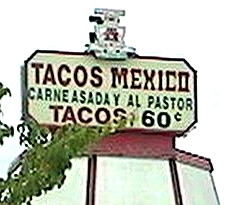
Local Mexican food joints are now popular among the general population for its value and good taste.
Traditional sushi from Japan are now a trendy and pricey commodity. Yet "All you can eat" Sushi buffets are an alternative. The diversity of culture is introduced by immigrants. |
Chain Migration-
Problems of Immigration
How Guestworker Programs Harm America- Alarming issues on legal immigrants and how they effect the U.S News! News!CLICK FOR- Gotham Gazette's Best Immigrants Links for New York City
|
||
|
|
||||
|
|
||||
Created by Monica Yu Email questions, suggestions and concerns to- [email protected] |