|
Chaotic World � ��
Let's start with a simple
question. How long is the coastline of England? or to our local people, how long
is our Malaysian coastline? It may look like a test of your general
knowledge but it isn't and anyway most probably you can't remember the figures.
So, how long is it? You might think of looking it up in an encyclopedia or
measuring the coastline preferably with a measuring tool like a ruler that is as
short as possible with accurate scale so that the jagged lines of the coast and
coves can be measured too and thus the measured length will be more
trustworthy. Common perception will suggest that although the measured
length of the coastline will vary depending on the measuring tool, they will
approach a final fixed value which is the true length of the coastline if one
were to use even more accurate measuring devices or by mean of a satellite. But,
it doesn't. Surprisingly, the measured length of a coastline rises without
limit, i.e. it has no fixed value and is infinite. This nonsense have become one
of those typical phenomena to illustrate a new field of modern mathematics known
as chaos which deals with complex situations having unpredictable behavior which
seems chaotic and with no order whatsoever such as water turbulence and the ups
and downs of the stock market. � ��
Chaos theory is stemmed from a simple yet interesting phenomenon known as
"sensitive dependence on initial conditions" or sometimes referred to
as the butterfly effect, colloquially states that a flap from a butterfly's
wings in China can result in a tornado in the US. In other words, even small
changes can produced large effects on the outcome of a situation. The butterfly effect�is
a reason why weather forecast are not accurate after several days (two or three
days perhaps). No one in his right mind is going to give a forecast several
months ahead. In chaos, no numbers after certain decimal places are to be
neglected. For example, the values 3.351234 and 3.351 seem to be identical if
the former value is rounded to three decimal places. Our act of rounding it
seems reasonable since these two values have only a difference of 0.0001234.
Very small, indeed. Often, we think that it would be better off if we
"simplify" values such as the former since it seems tedious. However,
these two values above are not the same although their value difference is
extremely small since they will provide two different outcomes in the study of
chaos and another closely related field known as fractal. They are certainly not to be
rounded in accordance with the butterfly effect. ���
Fractals
are pictures which are generated from iterations of nonlinear mathematical
equations or a set of rules. Its geometry does not follow the
Euclidean's. While we only have 1, 2 and 3 dimension, fractal has non-integer
dimensions also called fractal dimensions, e.g. 1.5, 1.33, 2.433 etc. To understand the meaning of iteration, consider
this equation xn+1
= xn2 - 1 In
simple language, it is a process of repeating over and over again an action: new
number = old number x old number - 1 For
a demonstration, we'll need an old number or an initial value also called a seed. We'll
take the number 0.2 as our seed. Iterating, x1=
0.22 -1 = -0.96 x2
= (-0.96)2 - 1 = -0.0784 x3
= (-0.0784)2 - 1 = -0.99385344 etc. To
proof the butterfly effect, try graphing the equation for the seed values 0.2 and 0.199 and their following x values obtained
from the iteration. Using
iteration, the convergence or divergence property of the seed value will
determine the color the seed value will be assigned on a graph. Using the
iteration process, a few hundreds or thousands of seeds will have to be selected
and each will be assign a color. After this painstaking process, a colored image
known as a fractal will appear. This is where a computer comes into handy to take over this tedious
job. Some fractal images are very interesting since they mimic objects in
nature depending on the rules or equations you have chosen to iterate, e.g.
tree, fern, clouds, mountain terrains, coast, snowflake and Moon or any planet's
rough surface. Some fractal images are appraised merely for their aesthetic
values.�Mandelbrot set, Julia sets, Koch snowflake, Newton's method are
some well-known fractals. ��
Chaos and fractals have wide applications in various fields including �
1. predicting stock market condition �
2. economics and finance �
3. weather forecasting and modeling �
4. statistics �
5. movie industry �
6. creating cheap computer graphics and movie graphics �
7. music (e.g. fractal music) �
8. art �
9. plasma physics 10.
astronomy and the motions of heavenly bodies in space 11.
chemistry (oscillating chemical reactions, e.g. Beluzov-Zhabotinsky reaction) 12.
fluid dynamics 13.
biology and medicine (evolution, heartbeat etc.) � 14.
ecology � 15.
population dynamics and genetic distribution � Here
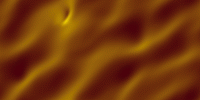
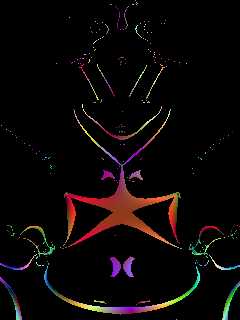
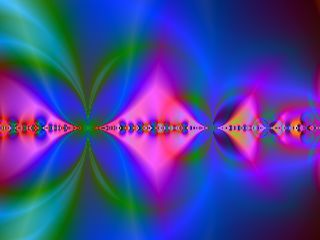
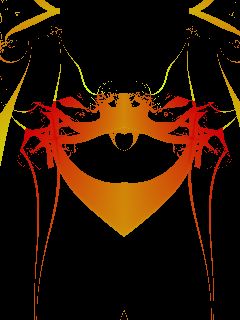
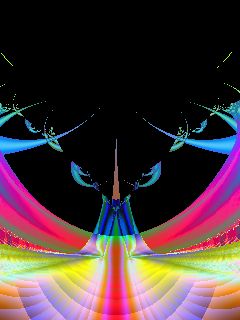
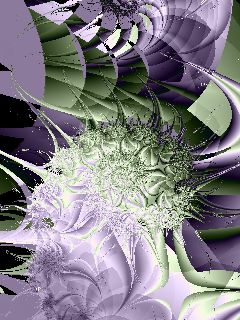
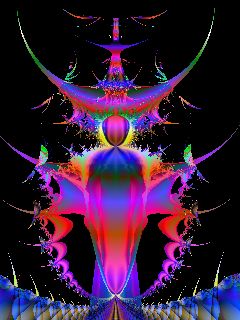
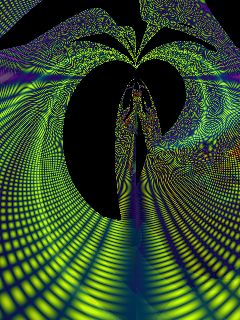
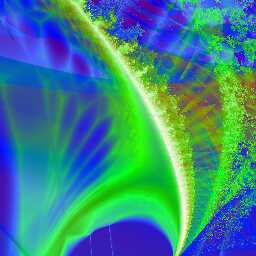
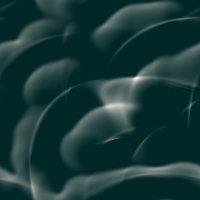
are a few fractals I've created using a fractal generator, Tierazon and another generator:
�
�
�
��
�
  
Copyright-[email protected]-
�
�
|