Radio architecture
Bluetooth radio is an integral part of a Bluetooth device as it
provides an electrical interface for transfer of packets on a
modulated carrier frequency using wireless bearer services (CDMA,
GSM, DECT). The radio operates in the 2.4 GHz ISM (Industrial
Scientific Medicine) band which requires a very small and efficient
antenna (smart antenna), a good RF front end (LNA, Up-converter,
down-converter) on chip, power controller, GFSK modulator and a
transmit/receive switch for it work as a transceiver. Below we
discuss radio architecture in reference to Bluetooth radio modem
and controller developed by SiliconWave.Com on two
separate chips using high performance silicon-on-insulator (SOI)
BICMOS process.
�
Bluetooth Radio Modem IC
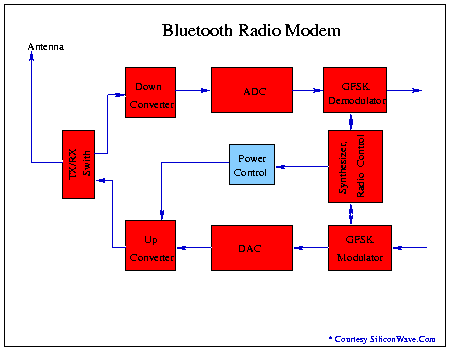
The radio modem performs the GFSK modulation and demodulation,
symbol and frame timing recovery. The modem also contains a fully
integrated radio transceiver and frequency hopping synthesizers on a
single chip. This radio essentially looks like below:
�
Bluetooth Controller IC
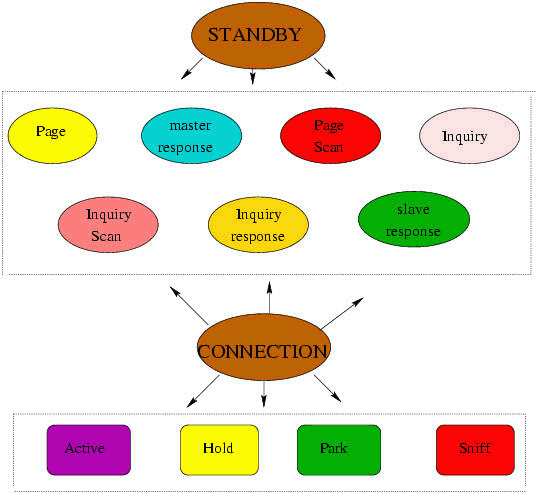
The controller implments the baseband protocol and functions. On
the receive side it performs error detection and de-scrambling. The
link controller hardware implements the basic, repetitive actions of
paging, inquiry, page and inquiry scans etc. It also provides a USB
and audio CODEC interface to the host system. The controller is
shown below:
Radio bands and channels
As said before, the Bluetooth radio operates in the 2.4 GHz ISM
band. In the US and Europe, a band of 83.5 MHz is available; in this
band, 79 RF channels spaced 1 MHz apart are defined. Japan, Spain
and France use only 23 RF channels spaced 1 MHz apart.
�
| Country |
Frequency Range |
RF Channels |
� |
| Europe and USA |
2400 - 2483.5 MHz |
f = 2402 + k MHz |
k = 0,....,78 |
| Japan |
2471 - 2497 MHz |
f = 2473 + k MHz |
k = 0,....,22 |
| Spain |
2445 - 2475 MHz |
f = 2449 + k MHz |
k = 0,....,22 |
| France |
2446.5 - 2483.5 MHz |
f = 2454 + k MHz |
k = 0,....,22 |
�
The channel is represented by a pseudo-random hopping sequence
hopping the 79 or 23 RF channels. The hopping sequence is unique for
the piconet and is determined by the Bluetooth device address of the
master; the phase in the hopping sequence is determined by the
Bluetooth clock of the master. The channel is divided into time
slots, each 625 microsec in length, where each slot corresponds to
an RF hop frequency. The nominal hop rate is 1600 hops/s. All
bluetooth units participating in the piconet are time and
hop-synchronized to the channel.
Transmitter and Receiver requirements
Transmitter uses GFSK (Gaussian Frequency Shift Keying) where a
binary one is represented by a positive frequency deviation and a
binary zero by a negative frequency deviation. The definition of
Bluetooth modulated signal is given below:
| Modulation |
GFSK |
| Modulation index |
0.32 +/- 1% |
| BT |
0.5 +/- 1% |
| Bit
Rate |
1Mbps +/- 1 ppm |
| Modulating Data |
PRBS9 |
| Frequency
accuracy better than |
+/- 1 ppm | �
The bluetooth devices are classified into three power classes
depending on the maximum output power of the transmitter. A power
controller can be used for limiting and optimization of the output
power depending on the power requirements of the device.
| Power
class |
Maximum
Output Power |
Minimum
Output Power |
| 1 |
100 mW (20 dBm) |
1 mW (0 dBm) |
| 2 |
2.5 mW (4 dBm) |
0.25 mW (-6 dBm) |
| 3 |
1 mW (0 dBm) |
N/A |
The actual sensitivity level is defined as the input level for
which a raw bit error rate (BER) of 0.1 % is met. The requirement
for a Bluetooth receiver is an actual sensitivity level of -70 dBm
or better.
�
Next step: Baseband
We now move from here to the Baseband
level where we will talk about the physical layer of the
Bluetooth devices.
|