Bluetooth Baseband
This is the most comprehensive part of the Bluetooth protocol and
one which is most important. This tutorial page touches the
different aspects of baseband only very briefly. For more
information on the subject in context, please click�� More
.. on the right side wherever the link is provided.
Baseband
Baseband is the physical layer of the Bluetooth which manages
physical channels and links apart from other services like error
correction, data whitening, hop selection and Bluetooth security.
Baseband lies on top of Bluetooth radio in Bluetooth
stack and essentially acts as a link controller and works with
link manager for carrying out link level routines like link
connection and power control. Baseband also manages asynchronous and
synchronous links, handles packets and does paging and inquiry to
access and inquire the Bluetooth devices. Baseband transceiver
applies a time-division duplex (TDD) scheme. (alternate transmit and
receive). Therefore apart from different hopping frequency
(frequency division), the time is also slotted. In the normal
connection mode, the master shall always start at even numbered
slots and slave transmission shall always start at odd numbered
slots (though they may continue to transmit regardless of the number
of the slot).
ACL and SCO links
Baseband handles two types of links : SCO (Synchronous
Connection-Oriented) and ACL (Asynchronous Connection-Less) link.
The SCO link is a symmetric point-to-point link between a master and
a single slave in the piconet. The master maintains the SCO link by
using reserved slots at regular intervals (circuit switched type).
The SCO link mainly carries voice information. The master can
support up to three simultaneous SCO links while slaves can support
two or three SCO links. SCO packets are never retransmitted. SCO
packets are used for 64 kB/s speech transmission.
The ACL link is a point-to-multipoint link between the master and
all the slaves participating on the piconet. In the slots not
reserved for the SCO links, the master can establish an ACL link on
a per-slot basis to any slave, including the slave already engaged
in an SCO link (packet switched type). Only a single ACL link can
exist. For most ACL packets, packet retransmission is applied.
Logical Channels
Bluetooth has five logical channels which can be used to transfer
different types of information. LC (Control Channel) and LM (Link
Manager) channels are used in the link level while UA, UI and US
channels are used to carry asynchronous, isosynchronous and
synchronous user information.
Bluetooth Addressing
There are basically four types of device addresses in
Bluetooth:
| BD_ADDR |
48 bit
Bluetooth device address (IEEE802 standard). It is divided
into LAP (Lower Address Part of 24 bits), UAP (Upper Address
Part of 8 bits) and NAP (Non-significant Address Part of 16
bits). |
| AM_ADDR |
3 bit active
member address. The all zero AM_ADDR is for broadcast
messages. |
| PM_ADDR |
8-bit member
address that is assigned to parked slaves. |
| AR_ADDR |
The access
request address is used by the parked slave to determine the
slave-to-master half slot in the access window it is allowed
to send access messages. |
Bluetooth packets
The data on the piconet channel is conveyed in packets. The
general packet is shown below:
| A standard blueooth
packet |
| ACCESS CODE
[72] |
HEADER
[54] |
PAYLOAD
[0-2745] |
Access code are used for timing synchronization, offset
compensation, paging and inquiry. There are three different types of
Access code: Channel Access Code (CAC), Device Access Code (DAC) and
Inquiry Access Code (IAC). The channel access code identifies a
piconet (unique for a piconet) while DAC is used for paging and its
responses. IAC is used for inquiry purposes. The header contains
information for packet acknowledgement, packet numbering for
out-of-order packet reordering, flow control, slave address and
error check for header. The packet payload can contain either voice
field, data field or both. The packet can occupy more than one slot
(multi-slot packets) and can continue transmission in the next slot.
The payload also carries a 16-bit CRC for error detection and
correction in the payload. SCO packets do not include CRC.
There are five common types of packet, four SCO packets and seven
ACL packets. There brief description is given below.
�
| TYPE |
NAME |
DESCRIPTION |
| Common |
ID |
Carries device
access code (DAC) or inquiry access code (IAC). Occupies one
slot. |
| Common |
NULL |
NULL packet has
no payload. Used to get link information and flow control.
Occupies one slot. Not acknowledged. |
| Common |
POLL |
No payload.
Acknowledged. Used by master to poll the slaves to know
whether they are up or not. Occupies one slot. |
| Common |
FHS |
A special
control packet for revealing Bluetooth device address and the
clock of the sender. Used in page master response, inquiry
response and frequency hop synchronization. Occupies one slot.
2/3 FEC encoded. |
| Common |
DM1 |
To support
control messages in any link type. can also carry regular user
data. Occupies one slot. |
| SCO |
HV1 |
Carries 10
information bytes. Typically used for voice transmission. 1/3
FEC encoded. Occupies one slot. |
| SCO |
HV2 |
Carries 20
information bytes. Typically used for voice transmission. 2/3
FEC encoded. Occupies one slot. |
| SCO |
HV3 |
Carries 30
information bytes. Typically used for voice transmission. Not
FEC encoded. Occupies one slot. |
| SCO |
DV |
Combined
data-voice packet. Voice field not protected by FEC. Data
field 2.3 FEC encoded. Voice fiels is never retransmitted but
data field can be. |
| ACL |
DM1 |
Carries 18
information bytes. 2/3 FEC encoded. Occupies one
slot. |
| ACL |
DH1 |
Carries 28
information bytes. Not FEC encoded. Occupies one
slot. |
| ACL |
DM3 |
Carries 123
information bytes. 2/3 FEC encoded. Occupies three
slots. |
| ACL |
DH3 |
Carries 185
information bytes. Not FEC encoded. Occupies three
slots. |
| ACL |
DM5 |
Carries 226
information bytes. 2/3 FEC encoded. Occupies five
slots. |
| ACL |
DH5 |
Carries 341
information bytes. Not FEC encoded. Occupies five
slots. |
| ACL |
AUX1 |
Carries 30
information bytes. Resembles DH1 but no CRC code. Occupies one
slot. |
�
Error correction
There are three kinds of error correction schemes: 1/3
rate FEC, 2/3 rate FEC and ARQ scheme. In 1/3 rate FEC every bit is
repeated three times for redundancy, in 2/3 a generator polynomial
is used to encode 10 bit code to a 15 bit code, and in ARQ scheme a
packet is retransmitted till an acknowledgement is received (or
timeout is exceeded). Bluetooth uses fast, unnumbered
acknowledgement in which it uses positive and negative
acknowledgements by setting appropriate ARQN values. If timeout is
exceeded, Bluetooth flushes the packet and proceeds with the
next.
�
Bluetooth Controller
Flow control and
synchronization
Bluetooth recommends using FIFO queues in ACL and SCO
links for transmission and receive. Link Manager fills these queues
and link controller empties the queues automatically.
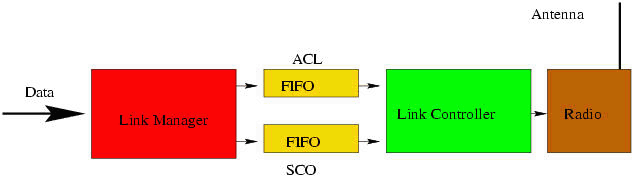
If these RX FIFO queues are full, flow control is used
to avoid dropped packets and congestion. If data cannot be received,
a STOP indication is transmitted inserted by the Link Controller of
the receiver into the header of the return packet. When the
transmitter receives the STOP indication, it freezes its FIFO
queues. If receiver is ready it sends a GO packet which resumes the
flow again.
We already know that Bluetooth transceiver uses a
time-division duplex (TDD) scheme. This means that it alternately
transmits and receives in a synchronous manner. The average timing
of master packet transmission must not drift faster than 20 ppm
relative to the ideal slot timing of 625 microseconds. Jitter from
average timing should be less than 1 microsecond. The piconet is
synchronized by the system clock of the master. The Bluetooth Device
Address (BD_ADDR) of the master determines the frequency hopping
sequence and the channel access code; the system clock of the master
determines the phase in the hopping sequence. Master controls the
traffic on the channel by a polling scheme. The master never adjusts
its system clock during the existence of the piconet. The slaves
adapt their native clocks with a timing offset in order to match the
master clock. The Bluetooth clocks should have a resolution of 312.5
microseconds.
A 20 microsecond uncertainty window is allowed around
the exact receive time in order for the access correlator for the
receiver to search for the correct channel access code and get
synchronized with the transmitter. When a slave returns from the
hold mode, it can correlate over a bigger uncertainty window till
they dont overlap slots. A parked slave periodically wakes up to
listen to beacons from the master and re-synchronizes its clock
offset.
Controller States
Bluetooth controller operates in two major states:
Standby and Connection . There are seven substates
which are used to add slaves or make connections in the piconet.
These are page, page scan, inquiry, inquiry scan, master
response, slave response and inquiry response .
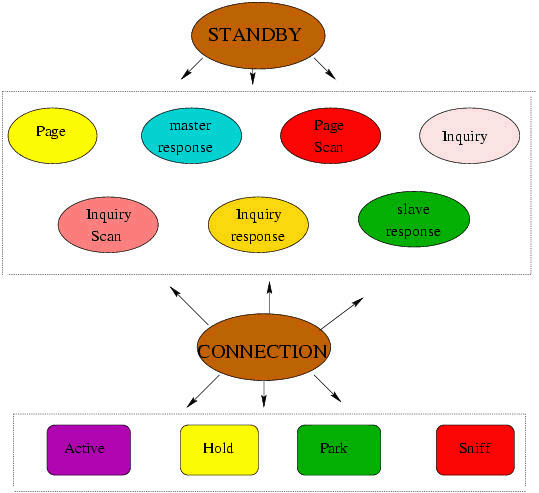
The Standby state is the default low power
state in the Bluetooth unit. Only the native clock is runnning and
there is no interaction with any device whatsoever. In the
Connection state, the master and slave can exchange packets.
using the channel (master) access code and the master Bluetooth
clock. The hopping scheme used is the channel hopping scheme.
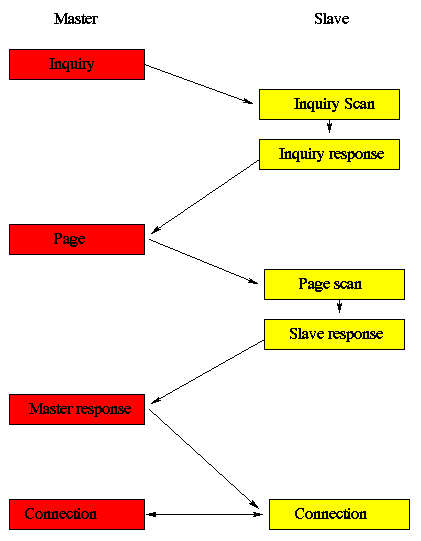
Normally, a connection between two devices occur in
the following fashion. First master uses the GIAC and DIAC to
inquire about the Bluetooth devices in the range (Inquire substate).
If any nearby Bluetooth device is listening for these inquiries
(Inquiry scan substate), it responds to the master by sending its
address and clock information (FHS packet) to the master (Inquiry
response substate). After sending the information, the slave may
start listening for page messges from the master (Page scan). The
master after discovering the in range Bluetooth devices may page
these devices (Page substate) for connection setup. The slave in
page scan mode if paged by this master will respond (Slave response
substate) with its device access code (DAC). The master after
receiving the response from the slave, may respond by transmitting
the master's real time clock, master's BD_ADDR, the BCH parity bits
and the class of the device (FHS packet). After slave has received
this FHS packet, both enter into Connection state.
Below we describe each of these states briefly:
�
|
Page |
This substate is used by the master to activate
and connect to a slave. Master sends page messages by
transmitting slave's device access code (DAC) in different hop
channels. |
|
Page scan |
In this substate, a slave listens for its own
device access code (DAC) for a duration of scan window. The
slave listens at a single hop frequency (derived from its page
hopping sequence) in this scan window |
|
Slave response |
Slave responds to master's page message in this
substate which is resulted if slave correlates in the page
scan substate to the master's page message. Slave enters
Connection state after receiving FHS packet from
master. |
|
Master
response |
Master reaches this substate after it receives
slave's response to its page message for it. Master sends a
FHS packet to slave and if slave replies then master enters
Connection state. |
|
Inquiry |
Inquiry is used to find the identity of the
Bluetooth devices in the close range. The discovering unit
collects the Bluetooth device addresses and clocks of all
units that respond to the inquiry message. |
|
Inquiry scan |
In this state, the Bluetooth devices are
listening for inquiries from other devices. In this scanning
device may listen for general inquiry access code (GIAC) or
dedicated inquiry access codes (DIAC). |
|
Inquiry
response |
For inquiry, only slave responds but not the
master. The slave responds with the FHS packet which contains
the slave's device access code, native clock and some other
slave information. |
�
Connection States
The Connection state starts with a POLL packet
sent by the master to verify that slave has switched to the master's
timing and channel frequency hopping. Th slave can respond with any
type of packet.
A Bluetooth device in Connection state can be
in any of the four following states: Active, Hold, Sniff and
Park mode. One of the challenges in Bluetooth is to move
between these states especially from Park to Active and vice versa.
These modes are described briefly below:
�
|
Active |
In this mode both master and
slave partcipate actively on the channel by listening,
transmitting or receiving the packets. Master and slave are
kept synchronized to each other. |
|
Sniff |
In this mode slave rather
than listening on every slot for master's message for that
slave, sniffs on specified time slots for its messages. Hence
the slave can go to sleep in the free slots thus saving
power. |
|
Hold |
In this mode, a device can
temporarily not support ACL packets and go to low power sleep
mode to make the channel available for things like paging,
scanning etc. |
|
Park |
When a slave does not need
to participate on the piconet channel, but still wants to
remain synchronized to the channel. it can enter park mode
which is a low power mode with very little activity. The
device is given a Parking Member Address (PM_ADDR) and it
losses its Active Member Address
(AM_ADDR). |
Bluetooth Security
Bluetooth security is an important if we have to allow
keyless doors and automatic billing in super-stores. At the link
layer, security is maintained by authentication of the peers and
encryption of the information. For this basic security we need a
public address which is unique fro each device (BD_ADDR), two secret
keys (authentication keys and encryption key) and a random number
generator. First a device does the authentication by issuing a
challenge and the other device has to then send a response to that
challenge which is based on the challenge, it's BD_ADDR and a link
key shared between them. After authentication, encryption may be
used to communicate.
There are four types of link keys: combination key,
unit key, temporary key and initialization key .
�
Move to Link Manager
After looking at the Baseband and its various
important features, lets move to understanding Link Manager
Protocol (LMP) which is a link layer above
Baseband. |