Introduction
Smart appliances
Bluetooth is essentially
a protocol for wireless connectivity of diverse set of devices
ranging from PDA, mobile phones, laptops to cooking oven, fridge,
thermostat etc. in home-like environment. An environment where each
device in your home is connected to each other, where devices think
and care about themselves, where they think and care about you; who
identify "you" as an individual different from your spouse and
children. A connectivity which makes your note-pad or cell-phone as
your identity in a crowded room or air-port lounge.
Bluetooth SIG
Bluetooth came out of the womb of Ericsson somewhere around
late 90's and is currently led by the Promoter Group of Bluetooth
SIG comprising of Ericsson, Nokia, IBM, Toshiba, Intel, 3Com, Motorola, Lucent Technologies and Microsoft. Currently
Bluetooth SIG has more than 1400 members and is one of the fastest
growing SIG. This is the first big effort by all the major companies
of the world to come out with a global standard for wireless
connectivity in home-like environment after previous mess of first
and second generation in cellular communication.
The piconet kingdom
The name
of Bluetooth comes from a Dutch ruler " Harald Bluetooth " in
late 900 A.D. who ruled greater part of Denmark and Norway during
his reign. More than the yesterday's Bluetooth, today's Bluetooth is
all set to reign the greater part of our home - from Japan to Europe
to America.
�
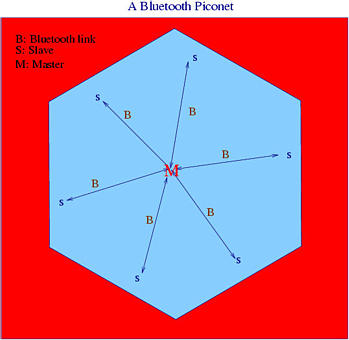
The Bluetooth system has both the point-to-point connection or a
point-to-multipoint connection. In point-to-multipoint connection,
the channel is shared among several bluetooth units. Two or more
units sharing the same channel form a piconet . There is one
master unit and upto seven active slave units in a piconet. These
devices can be in either of the states: active, park, hold and
sniff. Multiple piconets with overlapping coverage areas form a
scatternet .
�
Bluetooth architecture and operation
The Bluetooth system consists of a radio unit, a link control
unit and a support unit for link management and host terminal
interface functions. Bluetooth radio operates in the 2.4 GHz ISM
(Industry, Science and Medicine) band. The range of Bluetooth radio
is anywhere from 10 m. (home) to 100 m. (Airport lounge) depending
on the power of the transmitter at the antenna. Depending on the
class of the device, a bluetooth radio can transmit upto 100 mW (20
dBm) to minimum of 1 mW (0 dBm) of power. It uses frequency hopping
for low interference and fading, uses TDD (Time-Division Duplex)
scheme for full duplex transmission and transmits using GFSK
(Gaussian Frequency Shift Keying) modulation.
Bluetooth protocol uses a combination of circuit and packet
switching. The channel is slotted and slots can be reserved for
synchronous packets. Bluetooth protocol stack can support an
asynchronous connection-less (ACL) link for data and upto three
simultaneous synchronous connection-oriented (SCO) links for voice
or a combination of asynchronous data and synchronous voice (DV
packet type). Each voice channel supports a 64 Kb/s synchronous
channel in each direction. The asynchronous channel can support
maximum of 723.2 Kb/s uplink and 57.6 Kb/s downlink (or vice versa)
or 433.9 Kb/s symmetric links. The stack primarily has a baseband
for physical layer and link manager and controller for link layer.
The upper layer interface depends on how these two layers are
implemented and used with applications. The stack is shown below.
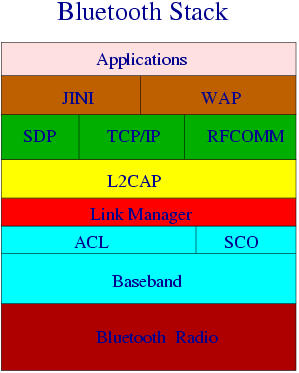
The stack primarily contains a physical level protocol
(Baseband) and a link level protocol (LMP) with an adaptation layer
(L2CAP) for upper layer protocols to interact with lower bluetooth
stack.
�
From here to Radio�
With this bluetooth overview, we move to the next section which
talks about the electrical and physical characteristics of Bluetooth
radio. |