 |
|
|
|
|
|
|
|
|
|
|
|
|
|
|
|
|
|
|
|
|
|
|
|
|
|
|
|
|
|
|
 |
|
|
 |
|
|
|
|
Nuclear Reactors |
|
|
|
|
|
|
|
|
HOME |
|
|
|
|
|
|
Chem-X home |
|
|
|
In a nuclear reactor there is contained, self-sustaining nuclear fission. The three largest uses of nuclear reactors are; power, research, and propulsion. Power reactors are used to create power which is converted to electricity which we use all the time. Research reactors are used for research around nuclear fission. And propulsion reactors are used to power nuclear submarines and ships. The most common out of these three is the nuclear power reactor. Nuclear power reactors provide 17% of the world�s power, including 15% in the US. So far there are 400 around the world and 100 in the US. There are six types of reactors that are used in the world, and two that are commonly used in the United States, The six kinds are: Pressure water reactor, boiling water reactor, gas cooled reactor, pressurized heavy water reactor, light water graphite reactor, and fast neutron reactor. The two reactors used in the United States are boiling water reactors and pressure water reactors. The big difference in theses six is the amount of volts that are produced in a given amount of time, and how the reaction is controled.
In a reactor the fission takes place in the fuel rods. There rods are surrounded by control rods made out of graphite or other materials that absorb neutrons. These control rods can be removed or stuck into the fuel rods to either speed up or slow down the chain reaction. This chain reaction can be a subcritical, critical, or supercritical state. A subcritical state is when the rate of the chain reaction is slowed down and eventually stops. This happens when there is less then one neutron released from each fission. A critical state is when one neutron is released from each fission. A supercritical state is when the rate of the chain reaction is such that more than one neutron is released from each fission. Most nuclear reactors are at a supercritical state so that the reactions continue to happen.
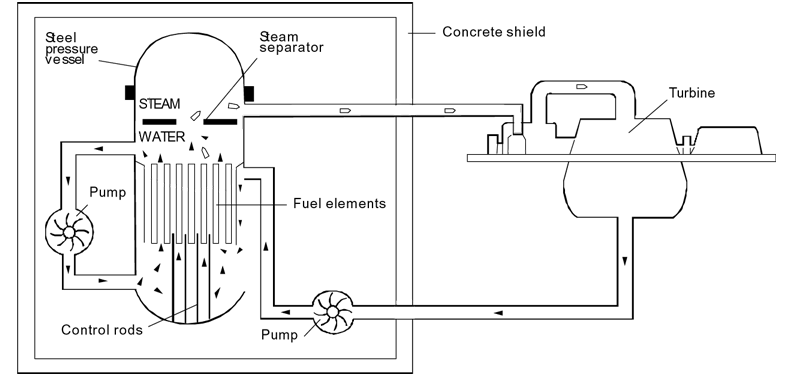
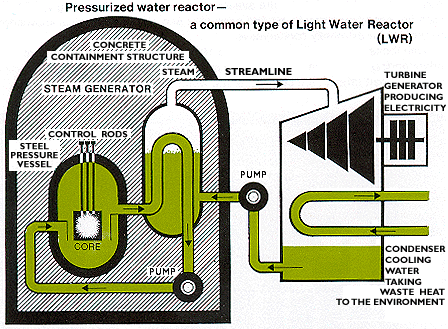
In a boiling water reactor the fuel rods and control rods are in a large swimming pool that acts as a coolant for the reaction. When the reaction produces heat it causes the water in the pool to boil which gives off steam. This steam turns turbines that produce energy. This entire system is incased with concrete in the event that something was to go wrong and the reaction got out of hand. A pressure water reactor works in a similar way. The control rods and fuel rods are incased in a steel pressure vessel. Water is run through this vessel which gets hot and causes the water to boil. The boiling water produces steam and the steam turns a turbine which makes electricity. |
|
|
|
 |
|
|
|
This is a boiling water reactor. |
|
|
|
|
|
http://www.world-nuclear.org/info/inf32.htm |
|
|
|
 |
|
|
|
This is a Pressurized water reactor. |
|
|
|
|
|
Yet another cool picture that I can't put on this sight... |
|
|
|
|
|
The other kinds of reactors are: Gas-cooled reactors, pressurized heavy water reactors, light water reactors, and fast neutron reactors. The big difference between all these reactors is the kind of moderator (control rods) and coolant (liquid or gas) they use. The coolants are usually water, CO2, heavy water, and liquid sodium. The moderators are usually water, graphite, and heavy water. |
|
|
|
That's cool. Let's see a real one... where something went wrong. |
|