 |
|
|
|
|
|
|
|
|
|
|
|
|
|
|
|
|
|
|
|
|
|
|
|
|
|
|
|
|
|
|
|
|
 |
|
|
 |
|
|
|
|
How does nuclear fission work? |
|
|
|
|
|
|
|
 |
|
|
|
|
|
|
HOME |
|
|
|
|
|
|
|
|
|
|
Chem-X home |
|
|
|
|
|
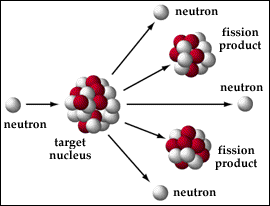
Here's one picture of nuclear fission. |
|
|
|
|
|
http://www.atomicarahive.com/Fission/Fusion1.shtml |
|
|
|
Nuclear Fission is how energy is produced in a nuclear reactor. Nuclear fission happens when the nucleus of an unstable isotope, such as Uranium 235, is hit by another slow moving neutron which is shot at the atom using energy. This causes the atom to split into two different elements, usually having a middle atomic mass (not really heavy, but not really light) such as Krypton and Barium or Strontium and Xenon, as well as giving off an average of 2.5 neutrons which allows the process to continue. This is called a chain reaction and is one of the reasons why fission produces so much energy in a reactor, since if is self sustaining so it can keep going on its own. Another reason that it produces so much energy is that every time fission happens it gives off 200 million electron volts of energy, or enough energy to keep a 100 watt light bulb buring for 30,000 years, 85% of which is from the atom splitting and the rest is from the products decaying.
|
|
|
|
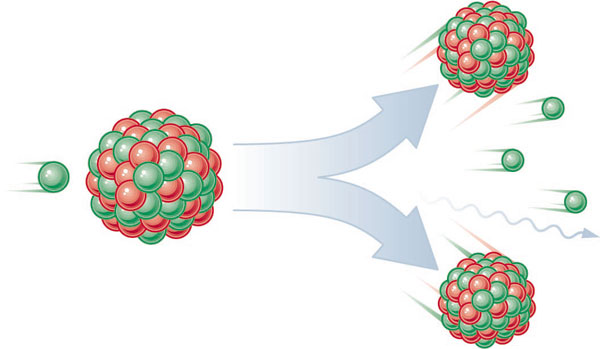
And here's another. |
|
|
|
 |
|
|
|
http://www.oup.co.uk/.../yoes/pictures/atoms/fission/ |
|
|
|
The fuel in nuclear reactors is usually natural uranium which is made up of mostly Uranium 238 and some Uranium 235. When Uranium 235 is hit by a neutron it breaks into two parts and more neutrons, as explained above. Uranium 238, however, absorbs the neutron and becomes Uranium 239. Uranium 239 has a very short half life of 23.5 minutes, which is the time it takes for an atom to decay. This means that the atom soon converts a neutron to a proton and gets rid of an electron, which makes it Neptunium 239. This also has a short half life of 2.35 days and soon gets rid of an electron to become Plutonium 239, which has a half life of 24,400 years. This production of Plutonium is one of the problems with fission since Plutonium is very radioactive and decays slowly.
What would happen if the chain reaction were to get out of control? This is what happens in a nuclear bomb. There are two pieces of a highly fissionable element that are both under critical mass. Critical mass is the smallest amount of the element you can have and still have fission. Then the two smaller pieces are brought together quickly (usually using dynamite, or another explosive) resulting in one piece of the element that is over critical mass. This causes fission, but there�s nothing to control it, so it heats up with all the energy and becomes a bomb. If one kilogram of Uranium 235 was released to fission uncontrollably, it would be the same as 20,000 tons of TNT, and explosive which is used in bombs. |
|
|
|
Here's another interesting picture, but I'm not cool enough to be able to put it on my sight. |
|
|
|
That's all very well and good, but when would I use it? |
|