



|
|
|
John J. Adie John Adie enlisted in the United States Marine Corp November 12, 1942; it was a cold morning. Basic training lasted from November 13th to December 22nd, at Paris Island, South Carolina. Dates Paris Island, South Carolina: November - December 1942 Hadnot Point, North Carolina - January 1943 - February 1943 Hospital - February 1943 Radio School - May 1943 - October 1943 Camp Pendleton, California - October 1943 - December 1943 Hilo Hawaii - January 1943 - May 1943 Saipan, Guam - June 1943 - July 1944 Hilo Hawaii - August 1944 Iwo Jima - February 19, 1945
"There go the Colors"
By Matthew Hession and Joan Hession
A Tribute to John J. Adie And His Fellow Marines Gilbert "Cisco" Carbajal, Frank "Big Nick" Nichols, Roscoe, "Mole" Amick, Polie "Muscles" Ames, Jerome Lafferty, Bill Coffin, and Reginald St Pierre
This would be the sixth ship to shore invasion for the men of the 3/10 75mm Howitzer Battalion, 2nd Marine Division. John ‘Horse’ Adie would be landing on hostile South Pacific shores for the third time. Going in on Saipan, his first invasion, "Waded in water up to chest, radio dry – ok. From OP we saw a Jap ship sunk by U. S. destroyer with 3 salvos – perfect firing by U. S. Navy. Correspondent wrote home", John wrote in his service record.
3/10 75 mm Howitzer Battalion, 2nd Marine Division and 2nd 155mm Howitzer Battalion "The Forgotten Battalion"
Saipan Baptism of Fire John Adie’s baptism of fire began as the sky lightened the morning of D-Day, June 15, 1944, the invasion of Saipan had begun. A naval bombardment fired on the beaches as marine landing craft circled offshore. Marine and Navy bombers rained their lethal loads on the island defensive positions. Fighter planes strafed enemy strong points, smoke and dust rising above the island, obscuring the terrain below. The order "to land the troops" was received by the circling armada of Amtracs and LVT’s. The first wave broke from the armada and headed for the coral reef. As the first wave of landing craft climbed over the coral reef that ringed the island landing site they came under intense enemy fire. During the night the Japanese had marked their range with colored flags along the reef and in the lagoon. Pin-point artillery and mortar fire poured down on the incoming Marines. In one section alone 31 landing craft, out of 68, were destroyed or disabled. Men jumped from the disabled or sinking craft and began wading to shore. Water spouts shot into the air as enemy artillery shells exploded in the shimmering blue water. Exhausted, some men crawled from the water on hands and knees. Amphibious tanks that had made it to the beach opened fire, providing cover for wading troops and landing craft. Once on the beach the Marines came under intense machine gun, artillery, and mortar fire from Agingan and Afetna Points. 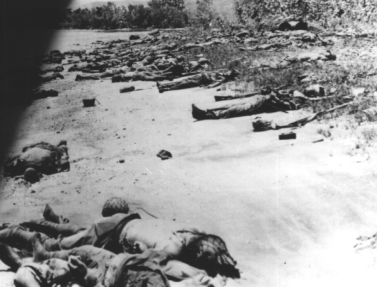 The FO’s were attached to infantry units and landed in
support of the 25th Regiment, 4th Marine Division. John
‘Horse’ Adie, a forward observer radio operator, waded in water up to his
chest. ‘Horse’ pushed toward shore, aware that the 50-100 pound radio he
carried needed to stay dry. Other Marines waded with him, spreading out in the
water to prevent bunching up in a group, which could spell disaster should a
shell hit The FO’s were attached to infantry units and landed in
support of the 25th Regiment, 4th Marine Division. John
‘Horse’ Adie, a forward observer radio operator, waded in water up to his
chest. ‘Horse’ pushed toward shore, aware that the 50-100 pound radio he
carried needed to stay dry. Other Marines waded with him, spreading out in the
water to prevent bunching up in a group, which could spell disaster should a
shell hit
Struggling through the water he finally reached the beach. Soaked and exhausted he found some cover and checked the radio, it was dry. John’s code name for the invasion was ‘Hemlock’. Somewhere along the surf, Mole, Muscles, Cisco, Big Nick and the remainder of the Forward Observers waded ashore.. They were members of the 3/10 75mm Howitzer Battalion. Before the sun set over 2,000 Marines were killed or wounded during the first day of the landing. After the landing John and the other men returned to the 2nd Marine Division. The 2nd Division alongside the 4th Division landed at Charan Kanoa, a small town surrounded by sugar cane fields. The designated beaches for the 2nd Division, red and green; the 4th Division, blue and yellow. The forward observers landed with their respective unit, 25th Regiment, 4th Division, on yellow beach. The objective, to drive across the island and capture Aslito airfield. By the end of D-Day the 2nd Division front line extended from the coast at Afetna Point, to about a mile south of Garapan. During the first night numerous counter-attacks were destroyed by Marine units. One night 0330 in the morning the 25th Marines were hit. At first they saw a crowd of civilians, their hands raised in surrender. However, hiding behind them was Japanese infantry. Realizing they were being duped the Marines called for artillery. By this time the artillery was ashore and ready to fire. Within minutes shells shrieked over the Marine positions, slamming into the approaching contingent, ending the Japanese scheme. The second night of the invasion was a long and dangerous one for the artillery men of the 3/10. All night long an artillery duel raged between the artillery men of the 3/10 with the opposing Japanese artillery. Shells shrieked back and forth in the dimly lit night. Some enemy shells found their targets, by morning only three howitzers remained undamaged, and casualties were heavy. On D+2 bigger and better guns began firing in support. They were the guns of the 2nd 155mm Howitzer Battalion that had been formed in Hawaii with half of the veterans of the 3/10 and was commanded by Lieutenant Colonel Marvin Floom. The 3/10 2nd Marine Division remained in general support.
During the next few days the beachhead was expanded. The expansion prevented the enemy from observing the landing forces still coming in from the ships offshore. Artillery was expected to land early in the invasion, but the big guns didn’t make it until
much later in the day. The casualty rate for the artillery men was extremely high. When the artillery finally managed to reach shore four of them were hit immediately by Japanese mortar fire. Over the next several days the 2nd Division captured Garapan, Tanapag Harbor, and Mount Tapochau. As usual the invasion progressed behind schedule, a result of poor information and planning. Nothing is ever as it is expected to be in war. Nevertheless, the Marines were there to stay. All hopes the Japanese had of driving the invaders back into the sea vanished with the passing days. One by one each objective was taken by the relentless Marines, enemy resistance weakening day by day. As the battle slowed in the 2nd Division area, there was still a lot of mopping up to be done. On the afternoon of the 4th of July the 3/10 was moved to positions north of Tanapag Harbor in general support of the 4th Division, under Corp Artillery control. From observation posts the forward observers could see down the island towards Marpi. The 3/10 pounded the Japanese whenever they were spotted. The 2nd Division Marines enjoyed a relatively quite afternoon on July 6th. The 27th Army Division and the 4th Marine Division kept up the pressure along their fronts. The 105th Regiment of the 27th Division was deployed above Tanapag, two Battalions abreast with a gap between them. As evening came the Battalions of the 105th dug in, with the gap still undefended. They had planned to cover the gap from the two exposed flanks. The terrain consisted of rolling hills and sugarcane fields, and some small meandering creeks and flat paddies. About 1200 yards behind the 105th were the men and guns of the 3/10. H Battery was forward, I Battery back and to the right, and G Battery farthest back and to the right on slightly higher ground, forming a slanting line of artillery. By the night of June 25th General Saito’s, commander of Japanese forces on Saipan, position was hopeless. With only 4,000 effective troops left on the island it was only a matter of time before they were completely wiped out. On the night of the 27th Japanese planes bombed Aslito airfield, a futile attempt to help the beleaguered Japanese. On the 6th of July Saito’s troops were in a desperate situation. The General’s headquarters was located in a cave outside the village of Makunsha, an area known as Paradise Valley or "The Valley of Hell" as the Japanese troops called it. Half starved, the staff gathered in the headquarters cave for their final orders. General Saito, already wounded, gave the final plan to his Officers. During the early morning darkness his troops would launch a final bonzai attack on the Americans. There was no gain to be made by the attack. In Japanese military tradition, the attack was just a last glorious attack for the Emperor, they could not surrender. "Whether we attack or whether we stay where we are there is only death", Saito said. That night he ordered the stores he had saved for the occasion to be brought out. For a final meal the staff ate canned crab meat and drank sake. Saito excused himself, claiming he was going to retire for the night and lead the attack the following morning, he lied. Tired and wounded he went to a secluded area of the cave and took his own life, a la, seppuku. Marine commander General Holland ‘Howlin Mad’ Smith knew that a bonzai was imminent The flat rolling terrain of Tanapag was the logical place for such a charge. The Army’s 105th Regiment was now squarely in the middle. Behind the 105th Regiment was the 2nd Marine Division, poised to drive through the 105th positions for the attack across the island. However, before morning the men of the 105th were startled from their sleep by a screaming horde of Japanese attackers. Hollering and screaming ‘bonzai’ the attackers stampeded straight into the lines of the 105th. Japanese tanks were knocked out almost immediately. The attackers carried machine guns, but never stopped to set them up. The gap between the 1st and 2nd Battalions was discovered by the Japanese and became the avenue of approach to the rear. Over-running the 105th positions the attackers swarmed in three directions. By this time the Japanese were worked up into a frenzy. Doubtless, the Marines of the 3/10, to the rear, were already awakened by the sounds of battle before they saw the charging hoard. Before the sky brightened the enemy was on top of the 3/10 Howitzer Battalion. Attacking with tanks, rifles, machine guns, swords, and makeshift spears several hundred Japs slammed into G Battery. The men of the Battery fought furiously with everything they had, rifles, automatic weapons, grenades, mortars, and even leveled their guns, using them as anti-tank weapons. Soon the attackers veered to the Marine’s left, joining up with another wave that had run into H and I Batteries. Being the closest to the 105th positions, H Battery had actually been hit first and overrun. Moving to an abandoned Japanese motor pool about forty men set up in a circle to fight the suicidal Japanese. They continued to defend this position until 1600 in the afternoon, when an Army tank and truck came to their rescue. By this time there were only nineteen men that were still able to fire a weapon. 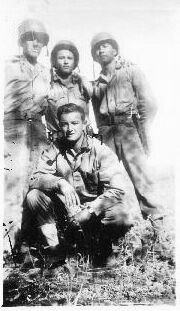 PFC Robert A. Olsen
wrote of the attack. "At the time two enemy tanks, one amphibious, with
about thirty Japanese behind the first tank, passed within three feet of my
position. Which was in the rear of H Battery. At the same time, there was a
breakthrough in the Army lines, and approximately 2,500 Japanese charged our
position from that direction." The artillery men were firing point blank
into the enemy, cutting the fuses to 4/10th of a second. When that
wasn’t fast enough they fired into the ground ricocheting the shells into the
charging Japanese. Men not on the large guns were firing every type of weapon.
Some fought the enemy hand to hand among the foxholes. PFC Robert A. Olsen
wrote of the attack. "At the time two enemy tanks, one amphibious, with
about thirty Japanese behind the first tank, passed within three feet of my
position. Which was in the rear of H Battery. At the same time, there was a
breakthrough in the Army lines, and approximately 2,500 Japanese charged our
position from that direction." The artillery men were firing point blank
into the enemy, cutting the fuses to 4/10th of a second. When that
wasn’t fast enough they fired into the ground ricocheting the shells into the
charging Japanese. Men not on the large guns were firing every type of weapon.
Some fought the enemy hand to hand among the foxholes.
Traditionally a bonzai charge ends as quickly as it begins. However, in this case the rest of the morning and into the afternoon the Army and Marines continued to dig out and kill the attackers. A sugarcane field directly in front of 3/10 remained alive with enemy troops. Marines of the 4/10 came to the aid of the survivors of 3/10. Volumes could be written about the unrecorded acts of heroism of that night and morning. The Marines in the Fire Direction Center were among the first to be hit by the bonzai charge and they had not retreated one inch, remaining to fight and die at their posts. The final tally, 3/10 had lost forty five killed and eighty two wounded during the battle, the Japanese lost an estimated 2,500 men, 300, of which, were found in front of the 3/10 positions. More importantly, they had formed an impenetrable line which the enemy could not break through. A week later the invasion of Saipan was over, John ‘Horse’ Adie had survived his baptism of fire. Guam John Adie commented once that Guam was the most important invasion. This was because Guam was an American territory when the Japanese invaded the island and it would be the first taken back by the United States. For John, it felt like a "Coup de Grace", it was payback time. Less than two weeks after the bonzai charge on Saipan John, Gilbert, and Frank were transferred from the 3/10 to a new unit, the 2nd 155mm Howitzer Battalion. Guam had been an American possession since 1898 and the native Camorros were known to be loyal to the United States. The 2nd 155mm Howitzer Battalion was attached to the Marine 3rd Division for the invasion. Guam was three times larger than Saipan, mountainous terrain and thick jungle. The invasion force consisted of 37,000 Marines and 19,000 Army Troops. The Marines were scheduled to land on two beaches, Asan north of Apra Harbor and Agaf across from Orote Peninsula. Once again the Navy intended to destroy the enemy with intense bombing prior to the Marines hitting the beaches, intent on "getting the Marines ashore standing up". D-Day pre-invasion bombing began at 0530, 21st July. Battleships, Cruisers, and Destroyers joined together in an ear shattering crescendo. Dive Bombers, Fighter Planes, and Torpedo bombers came screaming in at 0715. Eighty five fighters, 62 dive bombers, and 53 torpedo planes bombed and strafed the landing beaches as the landing craft made their final run to shore. By now the landing procedures were well established, results from previous invasions. Air observers flying over the 3rd Division beaches reported they saw no Japanese movement along the shore, not a shell was fired at the approaching landing craft. The Amtracs approached the reef and as they crossed the situation drastically changed. Undetected underwater mines exploded when the Amtracs made contact. Marines jumped from their disabled craft and began wading to shore. The enemy beach defenses opened up with a barrage of machine gun, mortar, and artillery fire. Armor piercing shells hit LVT’s. The Navy opened fire on the, so far, undetected enemy positions, temporarily silencing the guns. The Third Marines were the hardest hit. John wrote that he worked the 22nd Regiment, 4th Division and the 12th Regiment, 3rd Division. The Japanese defenders along the beach retreated during the bombing to caves and shelters on the reverse slopes of the hills, but when the shelling stopped they emerged from their protective shelters. Quickly manning their hidden guns they resumed their deadly fire on the Marines on the beach. The cry of "corpsman" filled the air. Casualties rose alarmingly and soon the allotted number of litters were used up. With makeshift litters, from ponchos, Marines carried the wounded to whatever cover they could find. The jungles of Guam were infested with snipers, their favorite targets, Officers and radio operators. Counterattacks were expected in every sector, in the form of the customary bonzai charge. The Japanese did not disappoint the Marines. Preparation by the artillery had included zeroing in on every avenue of approach along the front line. Forward observers, radioed their units with coordinates. Ships offshore moved into position to help with supporting fire. Just before midnight mortars began to fall on forward positions. Screaming bonzai, the Japanese attack surged forward. Parachute flares fired into the night sky, illuminating the terrain, created a ghostly scene of snarling, fanatic Japanese waving swords which glistened in the eerie light. Marines in forward foxholes were overrun, their defenders bayoneted to death. This all happened before the artillery fire could intensify. All along the front lines the same story repeated itself. Charging, screaming Japanese slammed into forward positions until the artillery found them and they were killed or driven back. By the time the fighting ended the Thirty-eighth Regiment of the Japanese Imperial Army ceased to exist. Ultimately, the Americans moved forward. The Japanese counterattacked again and again. In the end all they could do was fight a delaying action, which they did extremely well. As the enemy retreated they were compressed into smaller and smaller areas, becoming more vicious. John stated that the Japs treated the natives of Guam atrociously. This was confirmed when troops found the battered bodies of many Chamorros, they had been beheaded. Forced to work on Japanese defenses they were apparently killed to prevent them from talking to the Americans. During the Battle for Guam John contracted Dengue Fever. He was sent to a Field Hospital to rest. August 8th Admiral Nimitz announced that he was coming to Guam. The Marines rushed to complete the mop up of the island. On August 10th General Geiger declared the island secure. Sometime on August 11th, after a failed counterattack General Obata committed seppuku. The remaining Japanese soldiers, literally, starved to death. Some were hunted down and killed by the Chamorros who had survived their brutality. The Battle for Guam was over. John ‘Horse Adie’ survived his second battle, it would not be his last. The cost, 7,000 Marines killed or wounded. The Army suffered 1,000 casualties. The final count for the Japanese defenders, 26,500 killed. Interlude
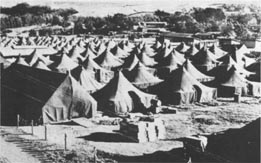
Hawaii. The war had its share of good times too. After Guam John returned to Camp Tarawa in Hawaii with the 2nd 155mm Howitzer Battalion. After two hard fought campaigns they needed the rest and relaxation offered them in the Tropical Paradise. Camp Tarawa, was located high in a saddle between two snow-capped mountains, Mauna Kea and Mauna Loa. Because of the elevation it was cold.
IWO JIMA
A forward observer team including John "Horse" Adie, landed on the shores of Iwo Jima with the 5th Marine Division, V Amphibious Corp, 2nd 155mm Howitzer Battalion on Green. The main objective of the 5th Division was to capture Mount Suribachi. The FO team mission, to act as forward observers for A Battery 155mm Howitzer Battalion; nicknamed "The Forgotten Battalion". John's radio name for the Iwo campaign was "Oil Tank One". The Marines of A Battery were on LST 760. An LST (Landing Ship Tank) is a ship that is not large enough to have a name. LST's were built to carry troops and supplies to the beaches during an invasion. After several days at sea, the men received information on their destination, the mission, the Island of Iwo Jima. This would be John’s third ship to shore invasion. February 18, 1944 the following message was read to all Officers and enlisted men by the Commanding Officer;
"This operation for the landing on and capture of the Island of Iwo Jima will be, perhaps, the most difficult and dangerous operation which the Marine Corp has ever been engaged in. We will be victorious if each man does his duty to the utmost of his ability. Let every man’s conduct be such that his country and his family will not be ashamed of him and that in later years he will always recall with pride the manner in which he conducted himself at Iwo Jima."
Good Luck and Good Shooting
J. S. Letcher
Sleep does not come easy the night before an invasion, especially for combat veterans. The men would find it hard, even impossible, to sleep. In the darkness of the night they would think of home and loved ones. John no doubt, would, look at the photo of Mary and little Bobby the one he carried in his wallet. There would be twinges of fear, which would have to be suppressed. The fear that he may not ever see them again. He would tuck the wallet with the picture into his back pocket, or maybe remove the picture; placing it in his breast pocket. They would not show their nervousness to each other as they waited through the night together. Reveille came early for the Marines of the invasion force, 0300 hours. They would begin their day with a specially prepared breakfast of steak and eggs after which they would stow their extra gear. At 0630, the order came to "land the invasion force". Simultaneously, the battleships, cruisers, and destroyers of the invasion fleet opened fire at predetermined targets on the island. At 0730, the LST’s would begin launching small boats and LVT's. By now the first waves of men on the LST’S would feel soggy from the heat in the confinement of the holds, their jackets soaked from their perspiration. Roaring sounds of Amtrac engines would fill the air as they clanked down the ramp into the water. The water around the fleet churned with circling Amtracs, awaiting the final word to head for shore. Marines would have watched in awe as the shelling continued for the next hour and would clearly hear the screaming sixteen-inch shells as they shrieked overhead. Men on the deck of the LST would be able to see the orange flash when the shells exploded on the island. Clouds of dust swirling in the sky over the island made Suribachi’s summit nearly invisible. Dirt and debris belched into the air. At 0800 firing from the fleet ceased. Now came the carrier-based planes. Navy Hellcats and Corsairs came screaming in from 10,000 feet, in low level runs, they unleashed their fury. In a three hundred mile an hour run they dropped bombs, fired rockets, and strafed the island with machine gun fire. Crisscrossing the island, they pulverized the beaches and hills, doing their best to destroy the enemy. 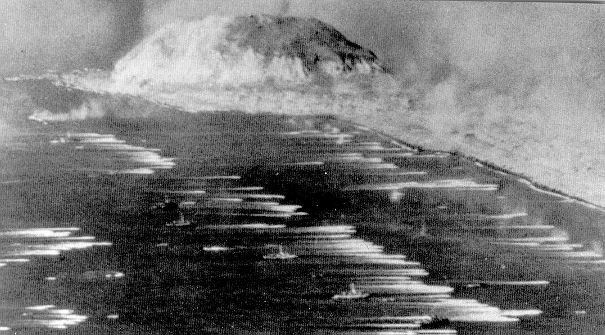
The men of the 2nd 155mm Howitzer Battalion were part of the largest body of Marines committed in combat in one operation during World War II. Many of the men were originally, 3/10 Howitzer Battalion, 2nd Marine Division, they had been reassigned to the new Howitzer Battalion and attached to the 5th Division, V Amphibious Corp, 28th Regiment for the invasion of Iwo Jima.
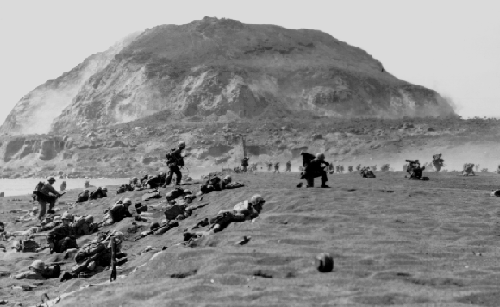
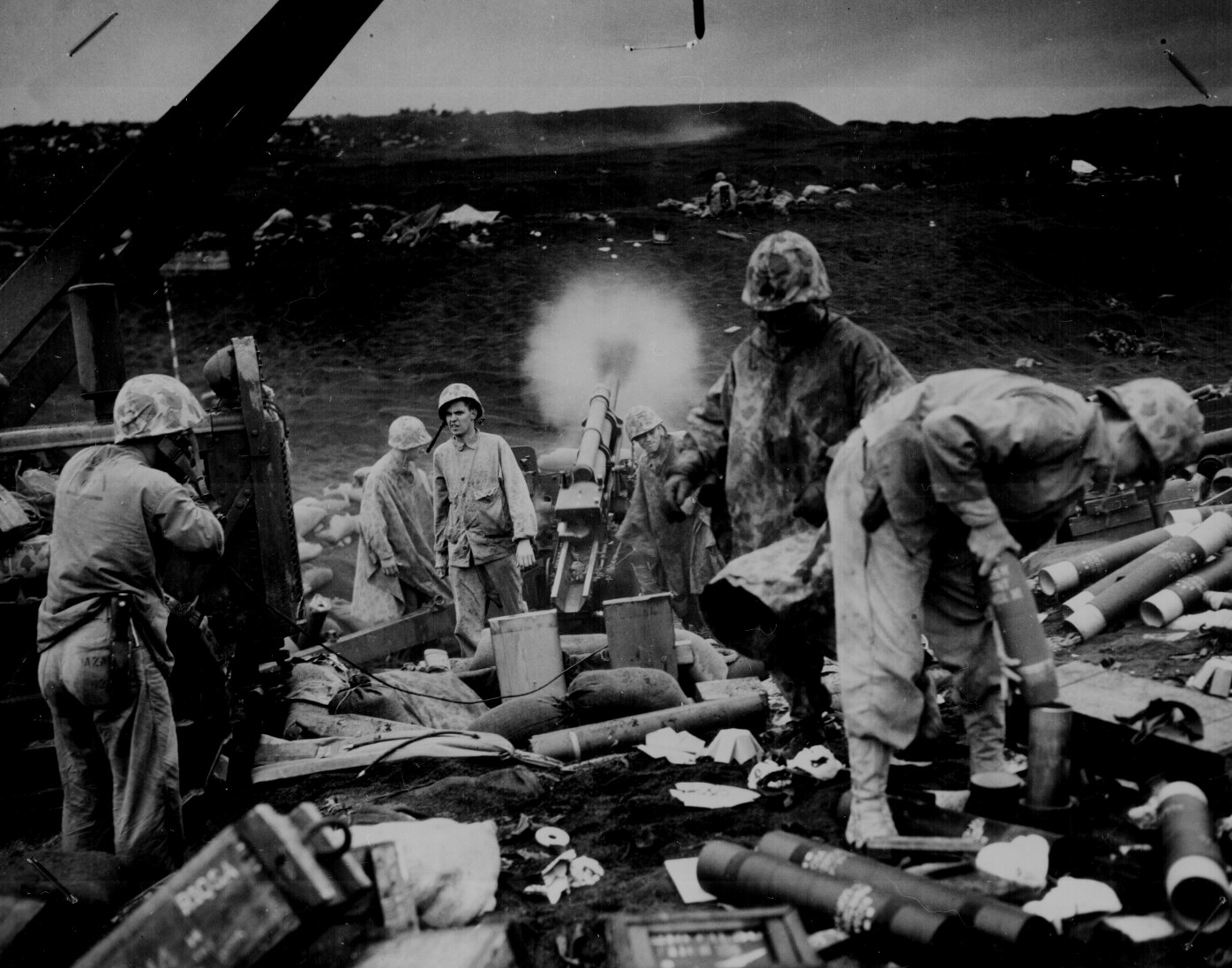
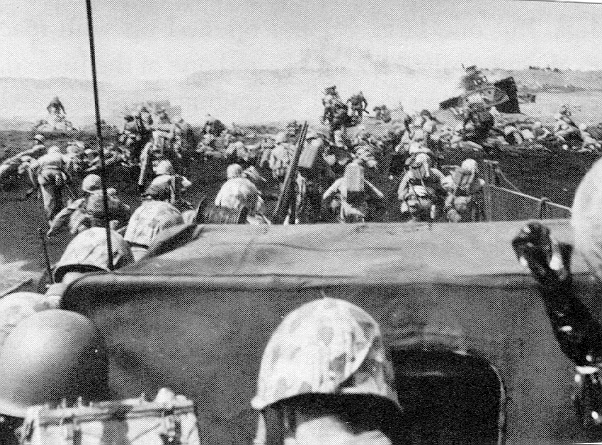
When the naval and air bombardment stopped the Japanese emerged from their fortified tunnels and caves, ready to begin a heavy barrage of fire against the landing force. Their strategy was to wait for the Marines to hit the beach, then annihilate them. General Kuribayashi’s battle plan was to wait for the invading marines to land, then draw them into an ambush. The Japs were only temporarily shell shocked by the pre-invasion bombardment. When the first Amtracs came ashore the Japanese defenders had already shaken off the effects of the bombardment and were ready to spring the trap on the unsuspecting marines. Unknown to the Marines only minutes from shore, the Japanese main defensive positions remained unscathed. At 0902 the first Amtracs touched down on the beach. The Amtracs of the first wave did not contain assault troops, each carried a three-man crew to fire the 75mm Howitzers and three machine-guns. Their mission was to engage and destroy all enemy positions on the beach then proceed fifty yards inland to set up a defensive perimeter. The timetable for the invasion had been set months before. Now as the Amtracs moved out of the water, the steel treads cut deep trenches in the fine black sand of the steep slope along the beach. They did not find any defensive positions on the beach and were only receiving light small arms fire. However, to stay on the beach meant that the landing forces not far behind would be exposed to certain disaster if they did not have room to charge from their craft and fight. Without the needed traction, many of the Amtracs could not get over the steep incline that faced them. The situation was becoming more serious by the minute. Some Amtracs backed off the beach and began to lay down covering fire from their 75mm Howitzers and machine guns. Bullets bounced off those that had made it to the top of the slope. At this time, a Navy Hellcat was hit by anti-aircraft fire over Suribachi. "Assault troops on the beach", screeched over the radios in the task force. Amtracs carrying the riflemen slammed onto the beaches and dropped their rear ramps before they even stopped moving. Marines charged from the craft spreading out in a line two miles wide. The first steps were easy, then slowed as their feet sank calf deep in the soft black volcanic sand. Due to their training order began to spread as combat skills took over. This was the first indication of what was to happen to John’s Battalion when it attempted to land equipment. Marines on shore were feeling optimistic since they were only receiving small arms fire and the landing was proceeding with amazing speed despite the soft sand. The 28th Regiment of the 5th Division was on Green Beach just below the towering Mount Suribachi. Hopes were high that the Japanese defenses were destroyed by the bombardment. Message from Green Beach at 0915, "Troops ashore and moving to isolate volcano. Resistance moderate, but terrain awful". General Kuribayashi’s plan was working as the Marines moved into the ambush. The cunning samurai was waiting for the right moment to unleash a torrent of fire. They were waiting for the beaches to pile up with men and equipment. At just the right moment they would rake the beaches with withering artillery and mortar fire and annihilate the Marines, preventing the flow of reinforcements to land on the beach. The trap was sprung just after 1000. Sandy hills that looked somewhat like anthills began to spit machine gun fire from small slits that were nearly invisible. Mortars fell like rain from hundreds of concealed positions. Artillery and anti-aircraft guns fired on the beaches, incoming landing craft, and support vessels. Coastal defense guns and larger mortars spewed death and destruction from Mount Suribachi.
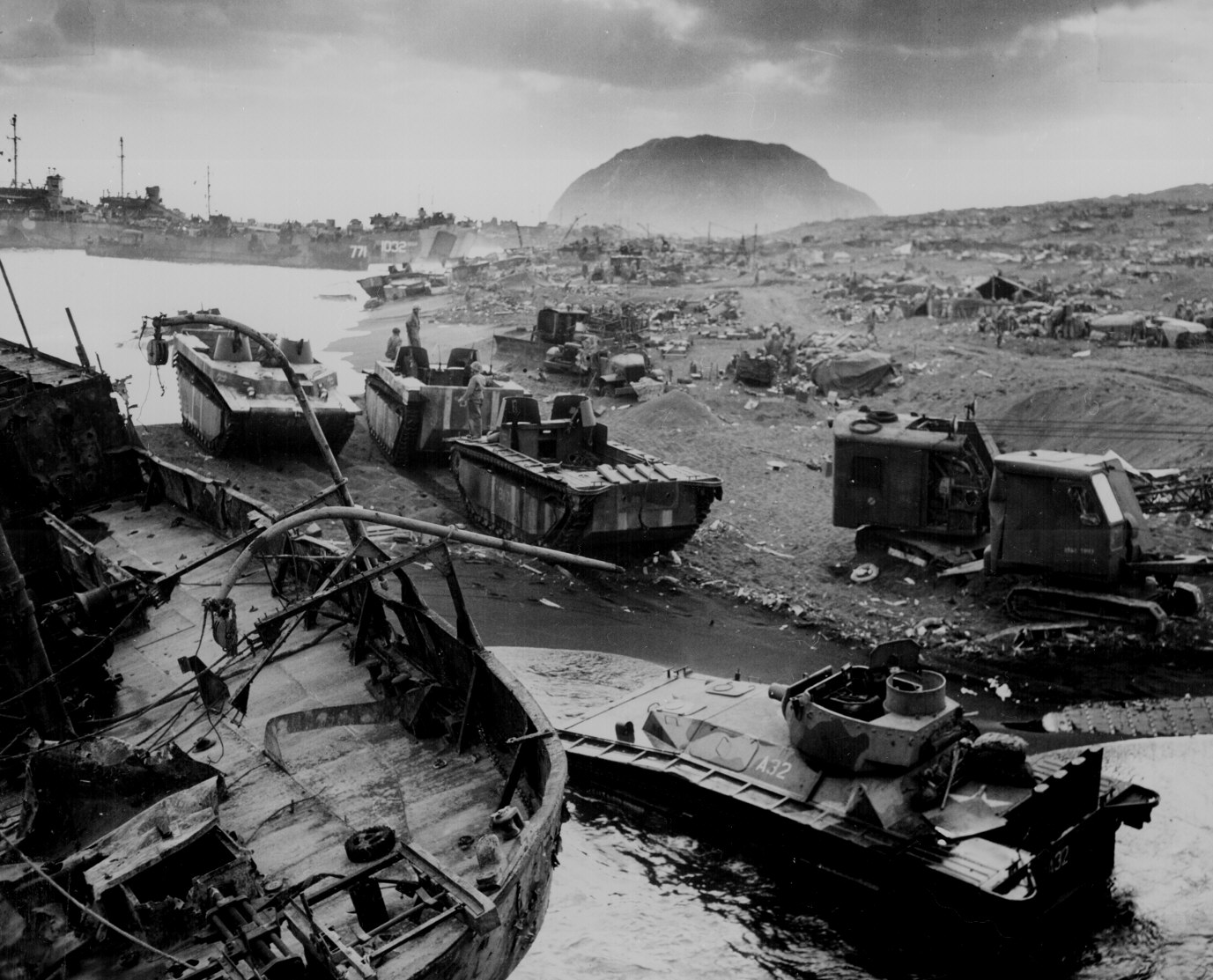
Every square yard of the beachhead was under intense fire. Over 6,000 men were already on the beach, there was no place to hide. There was no way to dig a foxhole in the black volcanic sand. As fast as a hole was dug out it filled again, a shell hole was the only source of cover. Landing craft backed off when they could, many were hit in the water. Several were destroyed and sank with tanks, ammunition, and trucks. When vehicles and artillery were finally landed they immediately sank in the sand. While John was in Hawaii, he met Gunnery Sergeant John Basilone who was from Raritan, New Jersey. This same Basilone was the first Marine to win the Medal of Honor in World War II. John said they talked about football and boxing, two interests they had in common. Undoubtedly, they talked of places back home, friends, and family. In 1942 in the humid jungles of Guadalcanal John "Manila John" Basilone single handedly wiped out a company of Japanese. An hour and a half into the Iwo Jima invasion Basilone encouraged his men, "C’mon you guys! Let’s get these guns off the beach"! He yelled as he lunged forward. The air screamed with the eerie sound of an incoming mortar, a violent explosion, dirt and debris thrown into the air, his arms flung outward, and in that instant "Manila John" and four other Marines died. 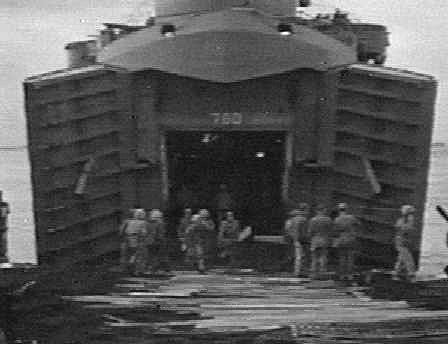 
The scene on the beach was chaotic, twisted craft and burning vehicles littered the beach. The wounded lay painfully, waiting for help. LST 760 came in on this scene of destruction attempting to move their howitzers onto the beach. The attempt failed and the LST backed off the beach and would not return until the next day when steel track laid across the sucking sand provided a roadway for the equipment to move on. The men must have felt frustration and even some relief when the LST moved back out to sea, where they would spend one more sleepless night. As the day came to an end and the sun set in the western horizon the first link up was made with a Battalion that had fought it’s way to the western shore. The Battalion commanded by Lieutenant Colonel Jackson B. Butterfield. By 1100 squads from the Battalion had fought their way off the beach seven hundred yards to the west and were cut off in no-mans-land. Working their way through the ravines at the base of the extinct volcano, they reached the western shore. To the left of Butterfield’s Battalion was the First Battalion commanded by Lieutenant Colonel Chandler W. Johnson. They had initially made good headway after landing at 0935. They had moved around the base of Suribachi, using ravines and boulders for cover, but by noon were in trouble. Pinned down by heavy artillery and mortar fire it would be several hours before they could move. It was sundown before they finally linked up with the other Battalion. At 1700, runners were sent out with the message to consolidate positions and dig in for the night. The commanders expected the worse, believing there would be a screaming bonzai charge sometime during the night. What they did not know was that the traditional bonzai charge was not part of Kuraybashi’s master plan. For the first time in it’s war with Japan the Marines would not hear the screaming mob of drunken Japanese soldiers coming at them in the middle of the night. However, the slaughter didn’t end when the sun went down. Intermittent and accurate artillery and mortar fire still rained down on the beach. Parachute flares half illuminated the night. The morning of D+1 revealed the violent devastation of the first day of the battle. Mangled, dead Marines lay everywhere. Evidence of the horrendous violence of the deaths was gruesome, bodies torn in half, arms and legs laid some twenty five to fifty feet from the torsos. Wounded, were still waiting to be evacuated to the hospital ships offshore. Walking wounded continued to fight. In less than twenty-four hours the Marines had lost 2,312 men. When President Roosevelt heard of the progress of the invasion and the casualties, he gasped in horror. At 0830 Johnson’s Battalion was on the move again at the base of Suribachi attacking from the east. Butterfield’s Battalion began their movement at the same time, only from the west. There were no air strikes or naval bombardment, because the Marines were too close to the Japanese positions. The expected supporting tanks were not there either, they were out of fuel and ammunition. By mid-morning the advance had moved only fifty to seventy five yards and was costly, finally at 1130 tanks began to move up to engage the enemy.
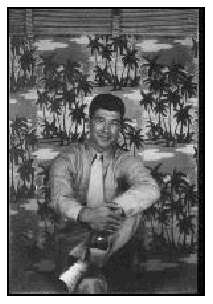
At 1530, LST 760 was unloading the critically needed howitzers and Forward Observers. Adie, with Carbajal, and Nichols would have debarked onto the left of Green Beach1. Forward Observers land with the infantry. The LST was hit by Japanese coastal defense guns. When the infantry is assigned an objective, a pillbox, machine gun emplacement, etc., the Forward Observer calls in artillery fire. The Observers are either with the troops on the front line or just to the rear. To direct accurate fire they must be able to see the target. ‘Horse’ Adie carried a 45 pistol. At six foot two inches, he would have found it almost impossible to walk in the black sand undoubtedly sinking deeper than the rest of the marines. ‘Cisco’ Carbajal and ‘Big Nick’ Nichols were carrying spools of communication wire for John’s radio. The radio was mounted on a jeep. John was directed to drive off the landing craft, but there was a dead Marine lying in the way. John insisted they move the dead Marine, refusing to move until they did. The Battalion moved the howitzers over the slope and going inland set up and began firing in support of the attack on Suribachi. Even with added fire power the advance on Suribachi slowed then sputtered to a stop by sundown. The men dug in for the night. If there is one thing we know, it is the friendship, that ‘Horse’, ‘Cisco’, and ‘Big Nick’ shared. Unless you have been in combat, it is impossible to imagine the bond that occurs between friends. They knew they could depend on one another. Each trusted the other with their life. They knew each other’s faces; their likes and dislikes. More than occasionally they shared stories about their families and loved ones. From their close relationship, they drew comfort. On their first night on Iwo Jima they dug in and waited for the dawn, secure in the fact that they were together. The temperature during the night dropped to a chilling forty degrees. Parachute flares floated in the night air, lighting up the sides of Suribachi. After two sleepless nights, they would have been exhausted. Watchful for a counterattack they undoubtedly took turns catching a few winks, if that was possible. They were well aware of the threat of a bonzai. On Saipan the Battalion had fought off 3000 Japanese in a final bonzai. They expected the same on Iwo Jima. The Japanese continued shelling the Marine positions. The bonzai charge never came.
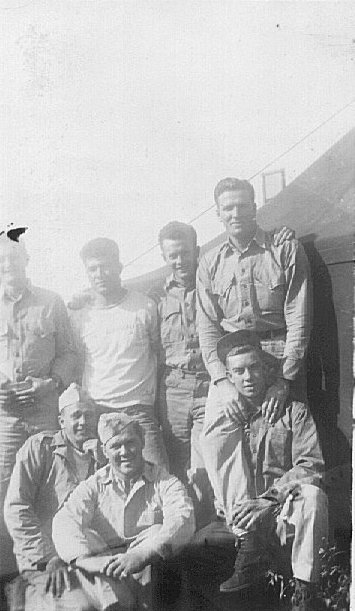
There were other men in the Battery that they depended on. There was Bill Coffin, Robert Glick, Jerome Lafferty, Robert Mitchell, Salvatore Carbone, Everett McFarland, Polie Ames, Roscoe Amick, "Red" Meier, Douge, Melton Plasner, and Kaiser. John’s hand written service record has a title, "Things I Want to Remember". The word "Things" is crossed out, and he wrote "People". By the end of the second day, the Marines controlled Motoyama Airfield Number One. On February 23, the famous flag raising took place on Mount Suribachi. John has said that he was already across the island on the other side of Suribachi, at the airfield. One evening, at sunset, John and his friends noticed a gun barrel protruding from a small rocky hill formation in front them. The Japs had elaborate tunnels from which they would emerge, fire on the marines, and then disappear. Innocent looking sandy hills had hidden machine guns that would fire on unsuspecting Marines. A point of frustration for the Marines was that the Japanese could not be seen. The Japs even dragged their dead back under the surface of the island. Suspecting that this was a hidden Jap position the three men decided to wait until daylight to charge the position of the gun barrel and kill the Japanese occupants. During the night, they were too apprehensive to sleep. Star shells and parachute flares illuminated the night, the metal barrel glistened in the dim light. Artillery and mortar shells continued to rain down on Marine positions. Rats ran over their feet as they waited for the morning sky to brighten. Machine gun fire clattered, grenades exploded, cries of the wounded could be heard. As the dawn light came, they readied themselves for the fight. As the moment of reckoning approached they realized that the barrel had not moved at all during the long night, either the Japs were asleep, or maybe dead. Moving on the position, they were relieved to find that the gun barrel that they had watched in anticipation all night was nothing more than one of the metal pipes used to reel out the radio wire. You can imagine their relief, and humiliation, which turned to laughter. The cursed whoever had thrown the pipe into the mound of dirt and rock. On D+1, February 20th the Marines of the Division had taken control of Motoyama Airfield Number One. In the morning the Marine front extended from the north end of Green beach inland to the east side of Motoyama Number One looping down around the southern tip to the western shoreline back across the southern end of the island at the base of Mount Suribachi to Green Beach. One tenth of the island was in Marine hands. At 1000 hours the night of D+1 the Japanese counterattacked the Marines on the western side of Motoyama One. Waiting until the enemy was on top of them the Marines opened up with a torrent of machine gun and rifle fire. The call for artillery fire went out and those Japanese that had not been killed by the Marine fire were killed in the hailstorm of howitzer fire. Again during sunrise another Japanese force attempted to infiltrate the Marine positions at the northern tip of the airfield. The attempt met disaster, one hundred dead Japanese were counted in the front of the Marine positions at dawn, victims of machine gun and artillery fire. During the first week of fighting the pattern of enemy mortar and artillery fire continued falling everywhere, the beachhead, along the Marine front lines at the base of Suribachi and on the Marines next to the airfield. By D+3 the big guns of the 2nd 155mm Howitzer Battalion was set up near Motoyama Airfield Number One. Forward observers in the front line positions called in adjustments to the artillery, firing back on the Japanese positions. The duel continued throughout the day and into the night. As the Howitzer fire intensified the Japanese counter fire began to slacken off. During the battle, Frank Nichols, "Big Nick" was wounded by fragments from an artillery shell or mortar. The wound did not seem serious to either John or Gil. John administered first aid, applying sulfur powder, cleaning and covering the wound. He went to sick bay, but never returned. They were told later that Big Nick was evacuated out to a hospital ship. "We got word later, that he died on the hospital ship. He must have gotten an infection or something. It didn't seem life threatening." John and Gil stated years later. Their fellow Marine who had been with them on Saipan and Guam was gone.
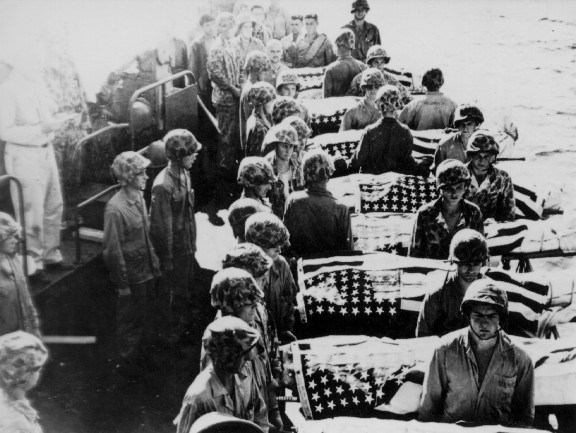
One day mortar and artillery fire came roaring down. John ‘Horse’ Adie was caught out in the open. Running in a crouching position he saw a hole that looked like a good place to take cover. Just as he neared the edge of the hole and was about to dive in he was thrown sideways and fell to the ground. For a split second he thought that he had been knocked down by the concussion of an exploding shell, then realized ‘Cisco’ had tackled him. He laid there staring at his buddy lying beside him, ‘Cisco’ was pointing into the hole. Peering over the edge John saw a Japanese hand grenade lying at the bottom. ‘Cisco’ eased to the edge, reached down and brought the grenade out, giving it a heave, the deadly explosive detonated when it hit the ground about fifteen yards away. The grenade had been booby trapped to explode if a Marine decided to use the foxhole for cover. The two crawled into the hole. John thanked Gil for saving his life. "Hell ‘Horse’, I saved myself, if that grenade had gone off I would have been hit too!", Gil dismissed John’s comment. Nevertheless, John knew what had just happened and he would never forget. We do not know if John and Gil knew that the second flag raised above Mount Suribachi came from LST 779, the other landing craft that the Battalion came in on. If they did, they never mentioned it. At the time, they heard someone shout, "there go the colors", the flag was flying over Suribachi. They were too busy to dwell on it at the time. There was a battle being fought, and they had a job to do. Forging ahead, they went on with their mission. The Battle for Iwo Jima raged on for twenty six days. The 2nd 155mm Howitzer Battalion fought for twenty two of those days. During that time, hundreds of Japanese bodies were left in the open. The flies and stench was overwhelming. John said that they were surrounded by rotting corpses. They would huddle under a poncho or something they could cover themselves with in order to eat. The Marine command knew the danger of the decaying bodies. Finally, planes flew over the island, crisscrossing back and forth spraying the battlefield with disinfectant. Doubtless, the Japanese must have panicked at the site, thinking the Americans were using poison gas. Marines need to have a drink now and then. Not water, a drink! One day John and his buddies came up with a brilliant idea. They mixed Aqua Velva after shave and raisins in a can. Covering the can with a tight fitting lid they buried the concoction so the mixture could ferment, swearing an oath not to dig it up for a week. The next day they broke their oath dug it up and drank the potion. "We almost died", Amick said years later. The can of moonshine is still there buried under the runway of Motoyama Number One. The raging battle continued, places on the island were given names, like, the Meat Grinder, Cushmans Pocket, Turkey Knob, and The Gorge. Kuribayashi’s men were squeezed into the northern end of the island, a virtual fortress. The Marines would have to fight for every inch of ground. One of the saddest duties John had during the war was burial detail on Iwo Jima, but one he would carry out with dedication and humility. The official dedication of the last cemetery took place on March 14, 1945. General Erskine spoke at the dedication;
"There is nothing I can say that is wholly adequate to this occasion. Only the accumulated praise of time will pay proper tribute to our valiant dead. Long after those who lament their immediate loss are themselves dead, these men will be mourned by the nation. For they are the nation’s loss. There is talk of great history, of the greatest fight in our history, of unheard of sacrifice and unheard of courage. These phrases are correct, but they are prematurely employed. The evidence has not been completely examined. Even the words and phrases used by historians to describe the fight for Iwo Jima, when the piecemeal story of our dead comes to light, will still be inadequate. Victory was never in doubt. Its cost was. What was in doubt , in all our minds, was whether there would be any of us left to dedicate our cemetery at the end, or whether the last Marine would die knocking out the last Japanese gun and gunner. Let the world count our crosses. Let them count them over and over. Let us do away with names, with ranks and rates and unit designations, here. Do away with terms, regular, reserve, veteran, boot, old timer, and replacement. They are empty, categorizing words which belong only to the adjutant’s dull vocabulary. Here lie only, (pause), only Marines."
On this day the island of Iwo Jima was also declared secure. As ceremonies and speeches on the southern end of the island commenced the sounds of artillery shells hitting Japanese positions on the northern end of the island could still be heard. Forward Observers were still out there on the front lines calling in artillery support for infantry units fighting suicidal Japanese. At the edge of the 5th Division cemetery bulldozers waited with engines running to dig new trenches for more graves. After three weeks of battle and heavy losses the Japanese fought on, the only reason for their continued resistance was to kill more Marines. There was no other point to the defense, Iwo Jima was lost. Motoyama Number One was heavy with air traffic, Japan was now within easy striking distance, and strike they did. D+25, a final artillery barrage smashed down on Cushmans pocket. Fighting was violent in the final six days. On March 22, 1945 John, Gilbert, and the rest of their fellow Marines that had survived the battle loaded on board an LST, which would take them to Guam. On Guam they relaxed and trained, the scuttlebutt was they were training for the invasion of Japan. John once told me that he did not think he would have survived another invasion. On August 6, 1945 a lone B-29 bomber dropped the first Atomic bomb on Hiroshima, Japan. Three days later another bomb was dropped on Nagasaki. On August 14, Emperor Hirohito announced to the Japanese people that they would fight no more. Officially the war ended on September 2, 1945 with the signing of the Official Surrender on board the USS Missouri. On signal, three hundred carrier planes and forty six superforts roared overhead in a V for victory sign. Sweeping the horizon beyond the Missouri were battleships, cruisers, aircraft carries, troop, and supply ships ready to occupy the country. October 25, 1945 John ‘Horse’ Adie, Gilbert ‘Cisco’ Carbajal, Roscoe ‘Mole’ Amick, the men of the 2nd 155mm Howitzer Battalion boarded the aircraft carrier USS Langley and headed home. For them the war was over.
To them I salute and say, "Semper Fi"! Prologue
In 1994, Joan sent for the casualty report for Frank Nichols. We realized that both John and Gil had to have an answer to the nagging question, "what happened to Big Nick"? About four weeks after she sent for the report, it arrived. She opened the envelope and read the report. She called her father with the news. "Dad, Frank Nichols was a corporal", she queried. "Yes, he was, how did you know that", he asked. "Well, I sent for the casualty report", she said. He was quiet. "Dad, Big Nick didn't die on the hospital ship. He died in a hospital back in the States not far from his home in Kentucky and is buried in his hometown", she gave him the news, he remained quiet. "He didn't die from his wounds, he was sick; he had leukemia. They must have discovered it when he was on the hospital ship and evacuated him back to the States", she finished. She could hear the relief when he replied. "Yes, he was sick all the time, he had a sore throat. Did you tell Gil, you have to call Gil and tell him", he wanted Gil to hear the news right away. Joan said she would call him and give him the information, she did, and Gil was relieved to hear that their friend had made it home. If you are not familiar with the famous photo of the flag raising on mount Suribachi here is a brief explanation. A patrol of about forty marines climbed to the summit of Suribachi. One of the men had a flag with him; finding a piece of pipe they fixed the flag to it and raised it for the island to see. Photos were taken of this flag raising. A high-ranking officer decided that the flag was not large enough and ordered another flag to the summit. A runner was sent to the beach and a much larger flag was given to him from LST 779. Meanwhile Joe Rosenthal was climbing to the summit. When the second flag arrived at the top of Suribachi, the first flag was taken down, the larger one was fixed to the pipe and raised, that is when the famous photograph was taken. There was a great controversy over the photo, many claiming that the photo was staged, it was not. You can find many sites on the Internet that contain details of this historic event. The following is an account of the second flag that was raised and photographed on Mount Suribachi. Private first-class Fred R. Huffman was in the bow of LST 779 waiting to hit the beach, it was February 20th. He was standing next to a friend, Sergeant Russ Mitchell who was holding a folded American flag. Mitchell told him that it was the ship's flag and it was going to be raised on Suribachi. He was to give it to the beach master after landing. Mitchell realized that he had forgotten his canteen and asked Huffman to hold the flag while he went to get the canteen. While Mitchell went to get the canteen, they hit the beach. Private Huffman waded ashore, found the beach master and gave him the flag. He never saw Sergeant Mitchell again. Three days later the flag was raised over Suribachi. Mitchell never saw it; he was killed two days before. Bill Paull a veteran of the "Forgotten Battalion" writes in his memoirs, "Russ Mitchell was killed in a particularly brutal manner and that memory is still too painful for me to write about". June 6, 1994 marked the 50th Anniversary of the invasion of Normandy, commonly referred to as D-Day. There were many D-Day’s in World War II, including Saipan, Guam, and Iwo Jima. The term actually stands for, "The unnamed day on which a particular operation commences or is to commence." However, the term became synonymous with the invasion of Normandy, likely, due to the use of the term in the newspaper headlines that announced the invasion. My father, Matthew L. Hession landed at H-Hour on Omaha beach. To commemorate his participation I wrote a poem for him. Unknown to me until recently Joan read the poem to her father. After 1994 John began to give Joan some information on his unit and places he went during the war. A few words here, a letter there, the newspaper clipping about Saipan. During a visit to New Jersey Poppy said to her, (about the information he had been giving her), "I thought you were going to write a poem, like Matt did for his father". Joan responded, "I didn’t think you would want me to do that." He smiled and nodded his head. I don’t know if he wanted one or not. If you didn’t John, I apologize, I wrote one. I couldn’t help myself. Researching this story has been very emotional and what is a poem, but, the sharing of a composition in verse of an experienced emotional stimulus, i.e.; beauty, love, or respect. For Poppy;
John’s Poem By Matthew Hession, July 28, 2001 I sometimes wonder when I die, Will what I did be forgotten. When my country called, I heard the voice, then made my choice. On one cold morning I stepped outside, I closed the door, I left my family and friends, I went to war. I became a Marine in World War II, I felt I had to fight for all of you. In the end back home I came, they called us heroes, I never felt the same, I only remembered men, screaming in pain. I fought with many of the best men I ever knew, I carried them in my heart and soul, Where you could not view. I never forgot, I did what I had to do. There were things I dared not share with you. Battlefield deeds best left behind, or kept locked up in my mind. When I die, Will you remember? I hope you will, for you see, I did it all for you.
Acknowledgements
Most of the historical information was gleaned from Internet sites on Saipan, Guam, and Iwo Jima. So many, that I did not keep track of them. If you are interested in the history of these three invasions use a search engine, you will find scores of sites. Two books also were very helpful in learning the details of the three invasions, "To the Marianas, by Edwin P. Hoyt and "Iwo Jima, Legacy of Valor", by Bill D. Ross. And of course, John J. Adie and Gilbert Carbajal who shared some their experiences with me. Thanks to my wife Joan and Mary Joyce Kemp because of the way they responded to my website on the subject, I felt I wanted to know more. My wish is not to make John out to be a hero, he never felt like one, and never expressed a desire to be recognized as one. Rather it is a feeble attempt to record what I have come to know for his family and friends. Hopefully, enough copies will circulate among those interested and some will survive into the future, so his descendants will have a written record of what he did.
|
 February 15, 1945, was the start of a living hell; the
invasion of Iwo Jima. It all started with a naval bombardment of the island by
the Navy, then came the bombers. The pre-invasion bombing was intended to soften
up the enemy. However, the Japanese had prepared for years. Underground tunnels
and defensive positions honeycombed the island, the bombardment did little to
destroy these defenses.
February 15, 1945, was the start of a living hell; the
invasion of Iwo Jima. It all started with a naval bombardment of the island by
the Navy, then came the bombers. The pre-invasion bombing was intended to soften
up the enemy. However, the Japanese had prepared for years. Underground tunnels
and defensive positions honeycombed the island, the bombardment did little to
destroy these defenses.



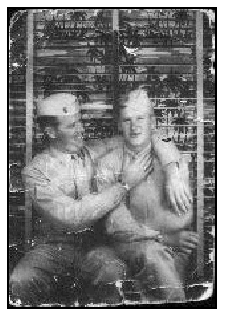 According to Roscoe ‘Mole’ Amick, one day they were
assigned to unload some cargo at a pier. Their day brightened when they learned
that the cargo was beer. About every five cases they would throw one under the
dock, returning later to recover them for their personal consumption.
According to Roscoe ‘Mole’ Amick, one day they were
assigned to unload some cargo at a pier. Their day brightened when they learned
that the cargo was beer. About every five cases they would throw one under the
dock, returning later to recover them for their personal consumption.