 |
on the Road to Santiago de Compostela (Sept.-Oct. 1999) |
 |
|
|
|
|
on the Road to Santiago de Compostela (Sept.-Oct. 1999) |
|
|
|
|
The Tour
| For this trip, I had a Montreal-Madrid round ticket (with a stop at Heathrow). My plan was to take the night train from Madrid to Hendaye (across the French border, on the Atlantic Coast) and from there, to reach Saint-Jean-Pied-de-Port, a favorite starting point for the French Way. I wanted to start there, some 23 km west of Roncesvalles, because crossing the Pyrenees looked like an interesting challenge, rewarded by spectacular panoramic views, according to trip reports I read on Trento Bike Pages.Saint-Jean-Pied-de-Port is some 800 km from Santiago, and I got there in 14 days. The whole bicycle trip lasted 18 days, in which time I covered 1100 km, including 880 km for the Camino itself. |
|
|
A cyclist's no man's land
| Thursday, September 23, 1999 -
As it happened, my plane landed at the Barajas International Airport, near
Madrid, at 11 p.m. I took a cab to the Chamartín station, which
I reached around midnight, too late to catch the night train to Hendaye.
I wanted to leave my bicycle in a locker, but everything was closed...
so sorry. I realized that I was stuck in front of an empty train station
with a bicycle in a box. I could have asked my cab driver to take me to
an hotel, but he didn't seem to know the neighborhood. Besides, I had already
paid 4100 pesetas (about $40 Canadian or $25 US) to get there, and I didn't
want to bust my travel budget on the first day. So, I spat in my hands
and proceeded to put together my trusty bicycle. Around 1 a.m., I was on
my way, with all my gear, in the deserted suburban streets, looking for
an hotel. But everywhere, I got the same answer: "Todo completo". Somebody
told me that this was a long weekend, and that all hotel rooms were booked
for 3 days until Monday night (actually, the only hotel with available
rooms I encountered was the Holiday Inn at 24,000 pesetas a night, breakfast
included...) I ended up sleeping on a bench in a quiet park, like a hobo.
At 5 a.m., awakened by the bitter cold, I went back to the station. Later, I made all the arrangements to catch the night train to Hendaye. (To get a free ride for your bicycle on a train, you have to reserve a low berth on a sleeper, under which you can slip your bicycle in a box). It was a cool, sunny day and I had some 12 hours to spare. I thought that I might as well use them to visit downtown Madrid (some 14 km from the Chamartín Station). I left my bags and my empty bicycle box (which was still where I had left it the night before) in a locker and moved on. Getting downtown was easy enough: I just followed the dense traffic. When I reached Plaza Colón, the hub of Madrid, I figured that I must have been doing something daring because I was the only cyclist on the street (later, I actually saw another cyclist; he was running on the sidewalk, wearing an anti-pollution mask). Anyway, I don't claim to have more cojones than Madrileno cyclists; I just didn't know what I was getting into. The next four hours, I crisscrossed downtown Madrid every which way, mostly because I was getting lost all the time. To navigate in the heavy traffic filling that hopeless maze whose streets change name every half kilometer, I ran to run on the sidewalks and to take one-way streets in the wrong direction, just like a complete idiot (a simple matter of urban survival). While Madrid, like many other European metropolises, is a diesel-smelling driver's nightmare, Madrileno drivers are surprisingly cool. Nevertheless, I enjoyed my quick tour of Madrid, an eye-catching city whose design (or lack thereof) and architecture are full of good surprises and offer splendid perspectives. I especially enjoyed riding in the vast and beautiful Retiro park, where I saw some other cyclists, at last. When I miraculously got back to the station, I had traveled some 50 km. Later, I was sitting in the station, waiting for the train with my cart. I was looking forward to a good night's sleep, my first one in three days. Outside, it was raining. But, due to a last minute change, my train docked at another platform, and I got there five minutes late. When I realized that I was stranded again in Madrid, I got very mad and went to the ticket office to ventilate my frustrations. I was tired and desperate. Despite my limited Spanish, I am sure that the clerk got my point loud and clear, but he didn't offer any helpful solution. Then, a taxi driver waiting there offered me to catch up with the train at its first stop in Avila, some 140 km from Madrid, for the modest sum of 22,000 pesetas... I was shocked and tried to cut the price down, but 20,000 ptas was his rock-bottom price. I finally accepted because I had no other choice and besides, it was cheaper than the alternative, the Holiday Inn... A few minutes later, that guy was driving his Audi at 120-150 km/h on the wet autopista. Soon, we were in Avila and I caught my night train - I suspect that he does that for a living, because he knew everybody in both stations. Was I ever glad to leave
Madrid! They made room for me and my bicycle in one of the sleepers, and
I tried vainly to slip into my berth without incommodating the people who
were already asleep. I hope that the people my noise awoke, my body odors
didn't suffocate (I hadn't had a shower in three days). At long last, I
got some sleep, from 2 to
|
Riding the French Basque Coast
Day by day
Day 0
| Saturday, September 25 - From Hendaye
to Bayonne (French Basque Coast)
(48 km, 4 h) - When I woke up at 8 a.m., people were leaving the train. I asked a man the name of the town we were in and he said "Irún". I don't understand Basque, so I thought he meant "Iruña", which is the Basque word for Pamplona. Fortunately, I asked two British girls who told me we were in Hendaye, France (Irún in Basque), and that I had better hurry and leave the train, which I did (Actually, I had to jump off the moving train after leaving the washroom in a hurry.) On the platform, I assembled my bicycle once again, on a chilly, gray morning. I got some francs from the automatic cash dispenser and left the station. At last, I was on the road, in a country I knew and appreciated. I followed the coast to enjoy the scenery from St-Jean-de-Luz to Bayonne. The road was going up and down, and because I was in poor shape, every climb was painful. To make it worse, a fine rain was pouring sporadically. In Biarritz, I saw some surfers in wetsuit hopping on the waves, near a deserted beach. I thought this was a good opportunity to wash myself (after 3 days!); a few minutes later, I was bobbing in the sea in front of the Grand Hotel in a state of pure bliss, under a faint sun. By the end of the afternoon, I was in Bayonne, where I found a cheap hotel room (120 F) in the old city. I downloaded my e-mail while sipping a cold beer at the local Internet café. After a hearty dinner, I fell in a coma-like sleep for the rest of the night. |
 |
 |
|
|
|
|
From Saint-Jean-Pied-de-Port to Santiago
in 15 days
Day 1
| Sunday, September 26 - From St-Jean-Pied-de-Port
to Roncesvalles (32 km, 3 h) - That morning, the sun was shining,
at last. Getting to St-Jean-Pied-de-Port (Kilometer 0), at the foot of
the Pyrenees, would have taken only one day, but the weather forecast was
not so good for the next day. For obvious reasons, I didn't want to cross
the Ibañeta Pass (a 1000-m climb) on a rainy or foggy day. So, to
put all the chances on my side, I took the railcar and at 11 a.m., I reached
the old walled city.
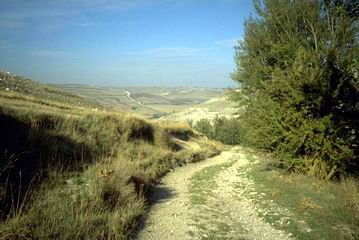
My first task was to get my pilgrim's credencial (or passport). I paid a visit to the Association des amis de St-Jacques. I was greeted by Mme Debril, a legendary hostess. (According to some sources, she is "Mme Savin" in Paulo Coelho's "Diary of a Pilgrim"). Because she was moving, she was quite busy packing up her things - while watching the mass on TV. She wouldn't give me a credencial because I didn't have a letter of recommendation from the archbishop's office and, as she explained, her organization was a religious one, not a travel agency. Nevertheless, she took almost one hour of her valuable time to give me vital information about the Road. Following her advice, I bought Millán Bravo Lozano's Guide pratique du pèlerin (also edited in English and other languages), a step-by-step account of just about everything there is to know or see, complete with maps, historic notes and special information and altitude profiles for cyclists. This guide (6th edition) is not always up to date, because various stretches of the Camino are renovated each year. However, most of the time, if the Guide says that a particular segment of the Camino is not suited for cycling, it is preferable to stay on the main road. You may have to breathe an occasional lungful of diesel fumes, but you will feel very safe and comfortable on the narrow shoulder that borders most of the paved roads, which are generally well-kept. French and Spanish drivers are used to deal with cyclists and they are very kind. Some Spanish drivers will honk just to make sure you know they are there. No offence intended; just don't give them the finger for that. Early in the cool and sunny afternoon, I was on the main road, heading for the hills. I was rested and feeling good. One hour later, I crossed back the Spanish border (a simple sign marking the frontier). The scenery was beautiful, the grade was gentle and I was pumping up the winding road without too much pain. On the summit of mount Ibañeta (1057 m), topped by a memorial chapel, a cold wind was blowing on pastures grazed by black-headed Basque sheep. There, I met a couple of elder New Zealander pilgrims. They were incredible people, pushing heavily loaded mountain bikes and smoking Gitanes while catching their breath. In Roncesvalles, some 2 km down, I had to pay 5200 ptas for a room at the inn, 10 times more that a bed in the pilgrim's shelter, because I still didn't have my credencial. The small museum near the abbey had a lot of interesting exhibits. For dinner, I ate the pilgrim's comida del dia (1300 ptas) with Hannes, a middle-aged Swiss artist who had been walking for several weeks. He showed me his beautiful sketches and watercolors. |
Day 2
| Monday, September 27 - From Roncesvalles
to Pamplona (54 km, 3½ h) - At 10 a.m. (nothing ever opens
earlier in Spain), I went to the Pilgrims' Office of the abbey to register
and get my pilgrim's credencial, required to stay in the pilgrims'
shelters. It was no big deal; the sleepy clerk gave me a form to fill and
asked for the 50 ptas fee, but not for the recommendation letter Mme Debril
gave me. Soon after, I was ready to kick some asphalt but, while I was
trying to pump in some more air, I tore a valve seat off a tire. No problem,
I had a spare chamber. Half an hour later, I was on my way on the main
road, going downhill. I switched to the Camino a few times, but the cyclable
stretches were rather short, and I had to fall back on the main road. The
sky was cloudy, but the cool temperature was ideal for cycling. It was
an easy stretch, except for a 3-km climb to get on the top of Alto de Herro,
where I met the New Zealanders again, and a group of three young Flemish
walkers who were soon joined by a minivan full of beer, chips, sausages
and goodies. Not the classic type of pilgrims. Personally, I think that
people who don't carry their own stuff are some kind of cheaters. But the
Camino is, and always has been, open to everybody, whatever their tricks,
devices or motivation.
While visiting the "Bridge of Rage", I had a second flat tire. This time, I had to patch the chamber. Two young Spanish cyclists came by for a chat. Near Pamplona, as a fine rain started to fall, I crossed the Camino again, cleanly marked out by golden arrows painted every 50 meters or so, which I duly followed until I reached the shelter, a large empty building on a hill called El Seminario, where priests were mass-produced until the 70s. For only 500 ptas, I got a comfortable bed in a large, almost empty dormitory. |
Day 3
| Tuesday, September 28 - From Pamplona
to Estella (53 km, 5 h) - That morning, the sun was up and shining;
for the next two weeks, the fair weather was there to stay. I had to stay
on the N-111 most of the time because the Camino was too rough. The road
passed trough endless harvested fields bounded by gray-blue mountains on
the horizon. On the edge of the hills, rows of wind turbines seemed to
challenge me to come up, like Don Quixote's windmills. In the afternoon,
I was feeling weak and a bit nauseous. Finally, I crossed a cyclable stretch
snaking in the middle of the fields, the farm buildings and the vineyards.
In Estella, I slept on the grass, under the hot afternoon sun, in front
of a badly weathered 11th century church.
At the shelter, I met some French pilgrims and went for a walk with them, through the tightly-knit medieval town, to see the cathedral and other spectacular views. I got rid of about 5 kg of extra weight by mailing a parcel to myself poste restante in Madrid. (Because I didn't have enough time to retrieve my parcel before I left Spain, I wrote to the postmaster to claim it and it was duly delivered to me in Montréal a few weeks later.) |
Day 4
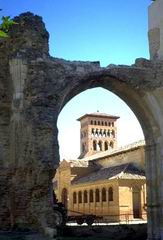
| Wednesday, September 29 - From Estella to Navarrete (69 km, 4½ h) - The next day, on Saint Michael's Day, my stomach was all right and I was feeling as if I had wings. I zipped through the vineyards of Rioja, staying on the Nacional 111 or 120. In Navarrete, I was impressed by the lavish gilded retable in the church, an extravaganza even by Spanish standards (if "standard" is the appropriate word when talking about Spanish baroque). At the pilgrims' shelter, I met a party of middle-aged French men and women who had been walking for one month, from Le Puy-en-Velay (one of the main points of gathering for French pilgrims), some 700 kilometers away. They were now seasoned walkers, doing 30 to 35 km a day, early to bed and early on the road. On the pilgrims' menu, we had a choice of chicken, pork and beef. Some took the beef, but that wasn't very clever, because the Spanish know only one way to cook meat: thin slices batter-fried in olive oil. Our "steaks" had the look and taste of old shoe soles. |
Day 5
| Thursday, September 30 - From Navarrete
to Belorado (69 km, 5½ h) - I left early in the cold,
damp morning. I was looking for a taller de bicicletas because a
bulgle was forming in my defective front tire. I switched to the N-120
because I didn't dare ride on the Camino with a bad tire. I finally had
it fixed in Santo Domingo de Caldeza, a nice medieval town with plenty
of churches to see. Later, I was back on the Camino, a wide, well-kept
and relatively flat path, paved in some places because it was used seasonally
by farm machines, snaking through dull, yellowish harvested fields. I was
slowed by a cold, front wind blowing from the sea, but I was feeling great
now, as I was getting used to the Camino and to the Spanish way of life.
(You have to remember that anything is probably closed between 1 and 5
p.m., and get used to eat later every day because the restaurants open
only at 9 p.m., and most Spaniards won't show up there before 10).
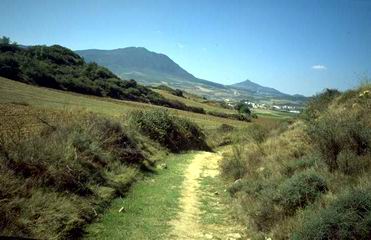
I reached the Belorado shelter, installed in an old hospital adjoining an impressive 12th century roman church. The main industries of Belorado are leather and peppers, some of which are fried outside with blow torches. Willy, the Swiss keeper, warmly greeted the pilgrims. He is an old, white-haired man with a gentle look in his clear blue eyes. Two walkers came with two small donkeys carrying their bags. The pilgrims were a mixed bunch of men and women of all ages coming from Spain, Germany, France, Canada (a Yukon girl), Australia and even the U.S.A. – I saw very few Americans on the Road). We cooked a common dinner in the community kitchen, switching every which way from English to French to Spanish. I also met two retired working-class blokes from Manchester who had been walking and drinking cheap wine all day. They thought that the pilgrim's life was more exciting than staying in England drinking beer while watching the telly. I was surprised to meet them again a couple of days later in a bar in Castrojeriz. Because it was early in the morning, they were still relatively sober (which may explain why they didn't remember me at all). They told me that whenever they got tired of walking, they simply hopped on the bus and skipped a few towns. |
 |
 |
 |
||
|
|
|
|
Day 6
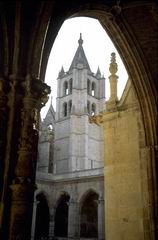
| Friday, October 1 - From Belorado to Burgos (57 km, 4½ h) - That morning, on the N-120, it was near the freezing point and my cyclist's gloves were of little help to keep my fingers warm. After a long climb, I switched to the Camino. Soon, I was going down a bush road through a dense forest of pines leading to San Juan de Ortega. There, I visited a beautiful 12th century sanctuary built over ancient roman tombs, looking very Spanish with its neat 3-belled wall. Then I moved on to the magnificent old city of Burgos. I had some trouble finding the shelter, because it had been moved from the Seminary. While I was in the old city, I visited the cathedral of Santa Maria la Réal, one of the most famous gothic churches of Europe (they are sandblasting it now; the stone lacework will look gorgeous when they take away the scaffolding). The shelter, located in a brand-new wooden cottage in a vast park near río Arlanzón, features clean showers (a rarity) and even an Internet workstation! That night, I dined with two middle-aged Breton ladies and a man from Figeac, who gave me interesting clues about Quercy (see Yet Another Tour of Southern France). |
Day 7
| Saturday, October 2 - From Burgos to Carríon de los Condes (103 km, 8 h) - That morning, I was back on the N-120 to avoid the Matamulos Hill (literally: the Mule-Killing Hill). Then, I cut trough the fields and pastures to get back to the path, to enjoy the beautiful scenic views of the hilly countryside. A shepherd walking with his flock had to call back his cyclophobic dog. I lunched near a windmill tower, or what was left of it, before passing through the impressive ruins of the convent of San Antón. After Castrojeriz, I got lost trying to bypass a daunting hill. Back on the road, I had to pedal some extra kilometers to make up for the lost time. I wanted to stop in Frómista, after 80 km, but the shelter keeper was reserving the place for "a group coming in a bus", a clear infringement of the "first come, first served" rule. I didn't want to argue and I moved on. It was getting late now. I stopped in every village on the map offering a shelter, but they were either closed or the few beds available were reserved for walkers (which is normal, considering that cyclists, unlike walkers, can always go on for a few more kilometers). I finally reached Carríon de los Condes around 6 p.m., after a record 100-km day. I didn't choose, but I stopped at the best place, a private shelter in the Santa Clara convent, where St. Francis stayed. This shelter, expensive by the Camino standards (1000 ptas), featured a fully equipped kitchen, clean showers with a towel, and beds with sheets and blankets, which were well worth the difference. There, I met a Catalan pilgrim who explained to me in French that he was a translator, too, and that he resented the tactless way the Spanish government was treating the Catalan people. This line sounded familiar to me because in many ways, Catalonia is Spain's Quebec. I also met Alex, a young athletic Scot striding ahead at an average speed of 40 km a day. |
Day 8
| Sunday, October 3 - From Carríon de los Condes to Sahagún (42 km, 3½ h) - On that cold sunny morning, the strong cold wind was blowing again from the ocean. I had a headache and felt miserable. After a while, bored by the flat, peeled fields on both sides of the path, I decided to take a break and rest in Sahagún, after only 42 km. There, I washed my clothes and indulged in a long siesta. I met Alex again, and we dined together at the pilgrims' restaurant. |
Day 9
| Monday, October 4 - From Sahagún to León (58 km, 4 h) - That morning, the temperature was near the freezing point. To make things worse, I had forgotten my cyclist's gloves in Carríon de los Condes. I had to hold the handlebar with one hand while I was warming the other in my vest pocket. The first thing I did in Mansilla de las Mulas was to buy new gloves and a tuque. Later, I met Emidio, a Portuguese cyclist speaking some French. As usual, we mixed languages to communicate. We zipped through the straight path splitting the dull plain and soon reached León. Almost everywhere on the Road, you will see ugly autonomist slogans painted on just about every available surface, in the language of the local ethnic minority (except maybe in prosperous Rioja). There is nothing unusual about the pro-ETA graffitis in Navarre, or the Galician slogans near Santiago, but you may be mildly surprised to see die-hard leonese autonomist slogans too, "LLEÓN SOLÚ", after 1000 years in the Spanish Union (the first name of Spain was "Kingdom of Castile and León"). The municipal shelter is located in a large building that used to be a school. I spent a couple of hours visiting the impressing San Isidoro cathedral, also surrounded with scaffolding, then I enjoyed a cold beer and the warm afternoon sun in an outdoor café. León is a very pleasant city, with kilometers of cyclable paths along río Bernesga. Later, I met Willy, the shelter keeper from Belorado, who was on his way to catch his plane to Switzerland. He wished me well and told me that he knew that I was going to make it to Santiago. That made my day. |
Day 10
| Tuesday, October 5 - From León
to Astorga (66 km, 4½ h) - The most interesting part of the
Camino starts in León (some walkers even skip entirely the Pamplona
to León section). After the never-ending plains, the scenery becomes
more diversified, heavy traffic is lighter on the N-120 and more stretches
of the path are cyclable. The day was cloudy, but warmer. I was five kilometers
past Astorga when I had my second flat tire in a row, again (by then, I
could fix a ponchada in 20 minutes flat). Because the leak was on
the top of the chamber, it had to be caused by the spokes of my warped
rear wheel. To make matters worse, my second defective tire was slowly
tearing itself apart. I had to ride back to the city and find a bicycle
shop. I reached the Astorga municipal shelter in great style, in a taxi.
I had to convince the keeper that I was a real cyclist. That overcrowded,
filthy, noisy and smoky shelter is the worst place I saw on the Camino.
No two shelters are alike; conditions vary considerably, depending on the
personality (or lack thereof) of the keeper and the resources that the
towns are willing to spend (or not) for the shelter and the maintenance
of the Camino.
Waiting for my vehicle, I took long strolls in beautiful Astorga, a walled city graced with a rich variety of interesting buildings, like the pseudo-gothic archbishop's palace designed by Antonio Gaudí, the famous Catalan architect. From a garden built on the wall, I could see mount Irago (or Rabanal) challenging me for the next day. |
 |
 |
|
|
|
|
Day 11
| Wednesday, October 6 - From Astorga
to Villafranca del Bierzo (80 km, 5½ h) - In the morning,
after a short period of rain, I left the bicycle shop on a machine that
felt like a new one. Soon after, I was attacking the Rabanal, a 300-m high
climb. The cool, cloudy day was good for climbing and I was in great shape.
When I passed the Iron Cross, I tossed a stone on the pile of rocks around
the base. (Because everybody has been doing that for centuries, it is very
hard to find a stone within a radius of one kilometer.) As I was reading
the messages on the mast, a bus stopped and out came a gaggle of chattering
Spanish tourists throwing their own precious stone in my direction (sigh!),
but they were aiming for the pile.
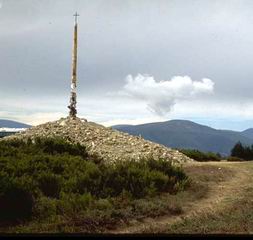
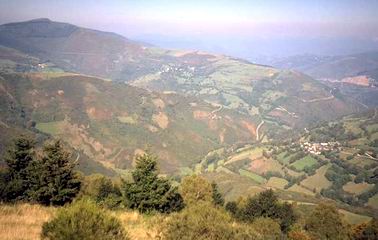
After lunch, I started an exciting 16-km long, 1000-m high downhill drop on the narrow, snaking road, going through villages of small dry stone houses. At the bottom of the valley, the sun was shining. Early in the afternoon, I reached Ponteferrada, a busy city with an incredibly well preserved Templar castle, with all the trimmings. I didn't stop because I wanted to get as close to the foothills as I could. In front of me, I could see the towering O Cebreiro, the gatekeeper of Galicia highlands, the last hurdle. As I was following the golden arrows marking the path like Tom Thumb, I was thinking of this pilgrimage as a paradigm of life, with its cortege of joys and sorrows, highs and downs, hopes and fears, successes and failures, and various concerns. Our minds are always anxiously chewing every thought and feeling, old and new, deep or shallow, over and over again - but such is the condition humaine. Wherever you go, travelling offers some great pluses, like meeting exceptional people – people that are bolder and/or bigger fools than yourself. A few kilometers from Villafranca del Bierzo, I passed Mio, a chubby, flat-faced, 24-year old Japanese girl from Tokyo, who was pushing uphill a heavy bicycle loaded like a Mexican bus, carrying a complete camping gear. She was pedaling her way back to Japan, half a world away. Starting from Paris, where she landed, she had already toured Belgium and France; after Spain, she planned to follow the Portuguese coast and cross over to Morocco, and then on through North Africa, Israel, Syria, Turkey, India, and so on. She wasn't going very fast, only 40-50 km a day, and she expected to be back in Japan in 2002. She wasn't crazy either, because she planned to take the plane to skip hostile countries like Algeria and maybe Pakistan. In Villafranca, a nice medieval town on a hill, the shelter "El Fenix" is located in an old dry stone house, next to the historic Santiago church. The keeper and the crowd there were very friendly. Except for some digestion problems, I was in great shape now, ready to take on O Cebreiro the next morning. |
 |
 |
|
|
|
|
Day 12
| Thursday, October 7 - From Villafranca
del Bierzo to Samos (69 km, 5½ h) - That morning, the hardest
part was right at the start: I felt very unsafe and miserable in the narrow,
smelly and slippery tunnel on the N-VI, which acts as a bottleneck for
all the Galicia-bound heavy traffic. Then, I began the formidable 700-m
climb of the O Cebreiro heights. Fortunately, the slope was gentle, the
temperature was cool and the sun was warming the damp valley. All along
the valley, workers were erecting colossal T-shaped concrete pillars for
a space-age skyway that will soon connect Galicia to the national network
of autopistas. For better or for worse, Spain is catching up with
the modern world at a reckless pace. Few people know that Spain, now one
of the most dynamic members of the European Union, passed a lot of countries
in terms of GNP, even Canada. Spain's economy has come a long way since
the autarkic regime of Francisco Franco.
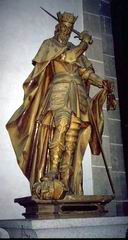
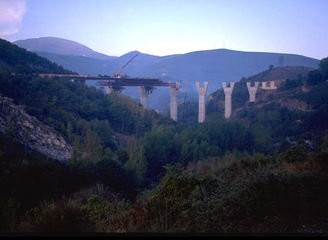
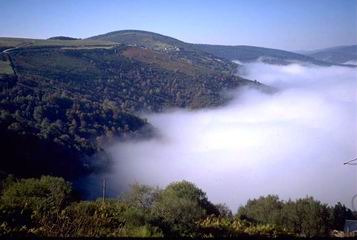
At 10:30, I stopped for coffee in Pedrafita. I was drenched with sweat and very pleased with myself. One hour later, I reached the tipico village of O Cebreiro. I lunched on the top (1300 meters), basking in the sunshine over a sea of fog drowning the valley all around, a view from heaven. I visited the sanctuary and headed for Tricastela, 700 meters downhill. It was a perfect day. The dive through the green hills and cattle-grazed pastures was absolute bliss. However, in Tricastela, the few beds left were reserved for walkers. So, I moved on to the Samos Benedictine monastery, some 20 kilometers away. I did the last stretch on the Camino, a narrow path between old stone walls crossing the beautiful hilly countryside of Galicia. I was the first pilgrim in Samos, an immense and impressive complex that used to accommodate some 700 monks, but now, there were only 10 of them left. The shelter was located in a vast hall, tended by the youngest of the monks, a fortyish, kind and well-educated man. The monastery is full of artistic and architectural treasures, like the cloister featuring interesting contemporary frescoes illustrating the life of St. Benedict. The only spoiler was a commemorating plaque honoring the 1942 visit of generalissimo Franco, "who rid Spain of atheist Communists". In the chapel, there were two weird statues of Santiago Matamoros (literally: St. James the killer of Moors), representing a sword-wielding character with his foot triumphantly resting on the severed head of some poor Moorish bastard. That didn't look kosher (or, for that matter, politically correct) for a church statue, but what do you know, for centuries, the Muslim Moors were fierce competitors, and every Christian got drafted to fight them, even the saints and their statues! Back at the dormitory, I consulted a visiting doctor about digestion problems. Her office was cleanly isolated from the hall by folding screens. The only problem was, while she was feeling my gut looking for an occlusion or something, I was lying right in front of a window close to the sidewalk, where everyone could watch... Anyway, she prescribed lemonade and a diet without dairy products for a few day, and that did it. |
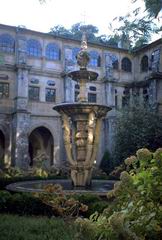
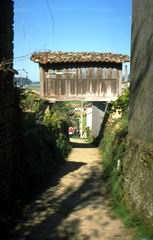
The Samos Cloister Santiago Matamoros A Galician Granary Day 13
| Friday, October 8 - From Samos to Melide (77 km, 6½ h) - That morning, I left in the chilly, heavy fog clinging to the low points. Until the sun could clear it up, late in the morning, crossing the bridges over the brooks felt like skinny-dipping in the Arctic Ocean. I enjoyed the last stretch before Portomarín, a long glide on a new asphalt road. In the valley, one can see the emerging ruins of a medieval town deliberately flooded to fill an artificial lake created to feed an hydro-electric power station. I stopped for a cup of coffee in the new town on the hill, right in front of the squarish church-fortress of San Nicolás, moved there stone by stone. There was no place for cyclists in Palas de Rei because, as I was getting closer to Santiago, accommodation was getting scarce. I finally ended up in Melide, where the Breton ladies I met in Burgos greeted me. They had skipped the flat central part of the Camino. Like in most shelters, there was a neat cleavage between the Spanish pilgrims, who were forming the largest group, and the other pilgrims, because the Spanish were mostly young and unilingual, while the rest of us were mostly middle-aged people, but not very fluent in Spanish. Because young people are gregarious, they would typically crowd the office of the shelter keeper (especially if she was a young, attractive girl) to chat and smoke, making us feel like intruders. Some other would go on chatting in bed after the lights are turned off, ignoring the curfew. I suppose that this is the price to pay as more and more people, young or old, hit the Camino. Seasoned pilgrims resent the present fad, which attracts all kinds of people who have more in common with tourists than pilgrims. But who am I to judge? The motivation of every pilgrim is an intricate nexus, even for himself. "What am I doing here?" This is one of the main questions pilgrims are meditating all along the road. |
Day 14
| Saturday, October 9 - From Melide to
Santiago de Compostela (53 km, 4½ h) - Now,
Santiago was only 50 km away, and I was travelling mostly on the path.
The last stretch through the eucalyptus-covered hills of the countryside
was pure joy. I was passing up more and more pilgrims now, even a group
of some 30 Germans. A Spanish girl congratulated me for using a bicycle
bell to warn the walkers ahead. She is right: it should be standard equipment,
because most walkers resent being startled by cyclists appearing suddenly
in their back. By 2:30 p.m., I reached Monte de Gozo, the last shelter
before Santiago. I made sure that I had a bed for the night and, relieved
of my panniers, I made a dash downhill to Santiago, just 5 km away. It
was a warm and sunny day, which is nice for a city having a bad reputation
for fog and rain, just like London. Naturally, I made a short visit to
the Cathedral, in the center of the old city reserved for pedestrians.
The Cathedral is a treasure of baroque architecture and its surroundings
are particularly impressive and inspiring. There were hundreds of pilgrims
waiting in line to cross the
Puerta Santa, which opens only the
year before Holy Years. The interior was another story; I was a bit disappointed
by the hubbub and the crackling of flashes. I decided I'd come back when
the place was more quiet.
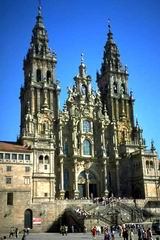
In the meantime, I started looking for a room, because I couldn't use the shelter for more than one night. As my usual luck would have it, Monday and Tuesday were holidays, which meant that there were no rooms available in town for the next four days – sounds familiar! So, I decided to bypass Santiago and move on to the sea the next morning. That night, I dined with a group of Portuguese pilgrims. With them, there was a couple of Brazilians of Japanese ancestry. The man, playing his guitar, was every bit as Latin as the Portuguese, despite his Asian peasant look. |
 |
 |
 |
||
|
|
|
|
The Galician Coast
Day 15
| Sunday, October 10 - From Santiago
de Compostela to Punta Louro (78 km, 5 h) - After
visiting Santiago, medieval pilgrims used to go to Cabo Fisterra (literally:
Cape End-of-the-Land), which is the westernmost part of Europe, for a second
baptism ritual. Some would seek purification by taking off all of their
clothes and jumping in the Atlantic Ocean, while others would pick scallop
shells as a proof of the successful completion of their pilgrimage. Eventually,
the shell (or conch) became the logo of the pilgrims, a.k.a. los concheros.
To reach the bay of Muros and Noia, I took the shortest route, the 543, a never-ending climb on a sinuous road. Appropriately, the last stretch is a long panoramic slope ending near the sea. Soon after crossing Río Tambre, I saw the open sea for the first time, a shiny mirror under the clear blue sky. Then, I started to follow the coast until I reached Muros, a seaside resort 30 km away, now almost empty because the tourist season was over. I decided to stop in Louro, a few kilometers farther, to enjoy the rest of that beautiful day. After renting a 2000 ptas room in an empty hotel, I went for a long walk around Point Carreiro. Past the lighthouse, I found a quiet place in the middle of the rocks and there, I enjoyed the sun and a dip in the ocean. From a path in the thorny bushes covering the hill, I could see the silhouette of Cape Fisterra, some 50 km away, but I didn't have the extra day I would have needed for a quick dash there, and, besides, rain clouds were building up. I decided to turn back the next day. That night, I had a plate of giant shrimp, a local specialty. In distant Galicia, food and accommodation are inexpensive, especially off-season. The only drawback is that everything is cooked a la plancha, that is, seasoned with salt and pepper and deep-fried in olive oil. This is a great with most fish, but it leaves a lot to be desired with seafood. For fine cuisine, you have to eat in Santiago, but then, forget about the cheap prices. |
Day 16
| Monday, October 11 - From Punta Louro to Padrón (70 km, 5 h) - I went all the way back to Noia but there, I cut through the hills on a narrow dirt road to visit Padrón, a Roman outpost built centuries before Santiago. I enjoyed passing through the small agricultural pueblos, where no cyclists ever go - in any case, this is what I concluded because of the way people were staring (or the dogs barking) at me. After an exhilarating descent in the valley, I was in Padrón, the alleged landing place of the boat returning the body of Saint James. There, I visited the Iglesia parroquial and the Roman remains covered with strange inscriptions under the main altar. For dinner, I ate a mound of octopus a la galegana, which is a fancy appellation for "spicy and deep-fried". At any rate, true seafood lovers will appreciate. |
Day 17
| Tuesday, October 12 - From Padrón to Santiago de Compostela (23 km, 2 h) - The last stretch was uneventful, except that it started to rain one hour before I was back in Santiago. I found a 2000 ptas room in an hospedaje just outside of the old city. Then, I went through the Puerta Sancta and, when my turn came, I hugged St. Jame's statue. I was so glad for the successful completion of my journey that I thought I owed him one. I took a few days to visit the cathedral and the city, then I was ready to go back to Madrid. Thanks to the Pilgrim's Certificate I got at the Pilgrims' Office, I had a 40 % discount on a Spanair ticket (9290 ptas), which is less than the combined price of the train and taxi I would have needed to get back to the Madrid International Airport. My bicycle was lost during one of the connections, but it was found and I got it back in Montreal a few days later. |
Conclusion
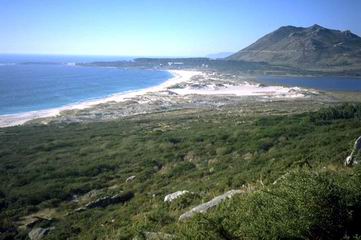
Cape Fisterra Another View of the Valley
| All in all, this was a wonderful journey. My only regret is the limited amount of time I had for this pilgrimage, because walking is certainly the best way to go, if you can spare 6 to 8 weeks. Another advantage of walking is that you stay on the path most of the time. I don't think I did more than 15 to 20 % of the travel on the path, because most of it is simply too rough or too steep for bicycles, though the situation is improving every year. I enjoyed meeting a lot of interesting people all along the Road and, wherever I was in Spain, I never felt unsafe. Most people were kind and willing to give helpful information, despite the language barrier. |
![[ French ]](francais.gif) |
![[ Bicycle Page ]](pgbike.jpg) |
![[ Home Page ]](enghome.jpg) |