This
article was written in collaboration with Scott Saunders ([email protected]).
The
P'tit train du Nord Bicycle Trail (July 1997)
 Since
our last bicycle trip in 1995 (see From Montréal
to New York in 4½ days on this site), Scott and I have been
planning several long rides but, for one reason or another, nothing happened.
However, last summer, a scaleddown alternative looked feasible. I
had already rented a cottage on Lake Nominingue, 200 km (120 miles) north
of Montréal. This lake happens to be about 50 km (30 miles) from
the end of the P'tit train du Nord bicycle trail (literally, the
"Li'll Northbound Train Trail"), a 200 kmlong trail on a decommissioned
railroad passing through forests, fields, small towns, and snaking around
beautiful lakes and mountains, from StJérôme to MontLaurier.
Scott liked the idea and arrived in Montréal on Thursday, July 24.
Since
our last bicycle trip in 1995 (see From Montréal
to New York in 4½ days on this site), Scott and I have been
planning several long rides but, for one reason or another, nothing happened.
However, last summer, a scaleddown alternative looked feasible. I
had already rented a cottage on Lake Nominingue, 200 km (120 miles) north
of Montréal. This lake happens to be about 50 km (30 miles) from
the end of the P'tit train du Nord bicycle trail (literally, the
"Li'll Northbound Train Trail"), a 200 kmlong trail on a decommissioned
railroad passing through forests, fields, small towns, and snaking around
beautiful lakes and mountains, from StJérôme to MontLaurier.
Scott liked the idea and arrived in Montréal on Thursday, July 24.
The
route
Most people who ride the P'tit train
du Nord bicycle trail prefer to start at the beginning of the trail in
StJérôme. Others go there for the special shuttle bus
that take cyclists and their gear right to the end of the trail in MontLaurier,
to take advantage of the gentle north to south slope (34 %). As for
us, our destination was Lake Nominingue, and to rough it up a little bit,
we decided to start form my place, right in the middle of the island of
Montréal, and from there, to take the shortest route to StJérôme,
50 km (30 miles) due north, which happens to be busy Route 117.
DAY
1 Friday, July 25 - From Montréal to ValDavid (100 km
60 miles)
We left Outremont at about 11 in the
morning. It was a cool and sunny day, just right for cycling. We quickly
reached Montréal's northsouth bicycle trail, going through
the small residential streets of the northern part of the island. We soon
crossed the Ahuntsic Bridge to reach Laval, a vast nondescript suburban
expanse crisscrossed by buzzing highways. The shortest way is Boulevard
des Laurentides (Route 335), and the only nice thing I can say about it
is that it is direct and relatively flat. We were lucky to cross Laval
in the morning because the day was already getting hot. In front of us,
there was a tall, thin girl heading north just like us. She didn't look
like an athlete, but she lead most of the time until she went her way,
on the north shore. We were impressed (to be fair, let's say that she was
not carrying heavy panniers like us). Scott boasted that he could pass
her, but then he wouldn't see her anymore.
To reach the north shore, we had to
pedal a few more kilometers eastward because the bridge connecting with
Route 117 was being rebuilt. From BoisdesFilion to the 117, we
followed pleasant Route 344 along Rivière des MilleÎles.
Riding on Route 117 is not my idea of fun; visually, it looks like an unending
anonymous suburban street with small businesses interspersed with patches
of countryside. However, it is rather flat and its large shoulder is very
convenient for cyclists. Later, Scott noticed a bad wobble on the back
wheel of his rental bicycle; it had a couple of loose spokes, and we had
nothing to fix it. It was about 1:00 p.m. and the asphalt was getting hot.
Fortunately, we were not very far from StJérôme, where
we easily found a bicycle repair shop. "It'll be ready in twenty minutes",
the lady said. This is how we got stranded in a dairy bar for two hours,
nibbling frozen yogurt and other delicacies, and chatting with friendly
locals who were so glad to explain to us with minute details how to reach
the start of the trail at the former station. From StJérôme
and up, most people are French and many of them don't speak English, but
they will gladly direct you to somebody who does. Finally, everything was
ready; Scott kept the bill to claim it later to the bicycle rental store,
and we bought the special tool to tighten spokes, which should be part
of any standard cyclist tool kit anyway.
That forced pit stop was good for Scott's
bicycle, but it proved to be disastrous for our nutritional balance. Needless
to say, we spoiled our appetite completely there and, not hungry anymore,
we decided to skip lunch and we hit the trail around 3 p.m. The trail is
a smooth, twolane, generally well tended graveled path. The hybrid
bicycles we were riding are just about perfect for the mixed road and trail
itinerary we were following. The fresh shaded trail on the bank of the
Rivière du Nord is quite a break for anybody just out of torrid
117. Some people were swimming or picnicking on the shallow beaches, but
we had to move on to make up for the time lost. We were hoping to find
a decent place for coffee in MontRolland, but there was none near
the station, and we had no time to look for one. A few kilometers up the
trail, we went by lake Raymond and its municipal beach, a nice place indeed.
Traffic was light now, but on that part of the trail, it can get quite
dense on weekends. You can get stuck behind toddlers, old folks or even
pedestrians with their dogs trotting along. Thank God, you won't see any
skaters there, because the designers of the trail had the good sense not
to pave the thing (more likely, they were denied the money).
Around 6 p.m., we were closing in on
ValDavid, our first stage, but we were feeling weak because we didn't
eat the right food in StJérôme. We could have stopped
for a bite in SteAdèle, a cute resort place we passed by, but
on the other end, we had to get to ValDavid as soon as we could in
order to reserve a camp site, a risky business on a hot Friday afternoon.
The grade was steeper now and we could certainly feel it after riding 100
kilometers on an empty stomach. I was thinking that they didn't call this
region "les Pays d'enhaut" ("the Country on the top") for nothing.
Worse, we were riding straight into the sun; blinded by the sunset, I almost
cut off a beautiful blonde who was going at breakneck speed on the opposite
side of the trail.
We finally made it to ValDavid
at 7 p.m., and the first thing we did was to visit the municipal tourist
office to get a camp site. We were lucky: there was one left in a camping
ground a few kilometers out. At last, the only thing left for us to do
was to choose a decent place to eat and rest. ValDavid, a small town
thriving on tourism, offers a wide variety of restaurants and entertainment
spots, but we went straight to the nearest goodlooking place, sporting
a terrace and a signer. However, the food was expensive and soso.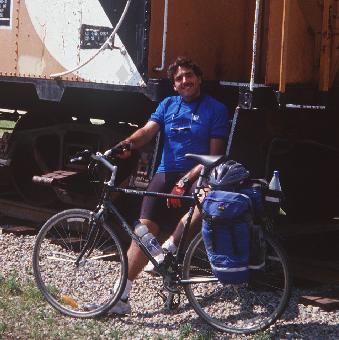 The
music wasn't much better and the signer had the nerve to complain because
the patrons weren't showing enough appreciation for his art. A little stiff,
we laboriously climbed back on our bicycles and headed for the camping
ground. It was getting dark now. As luck would have it, we got lost and
had to ask for our way. Folks up there are friendly and will gladly direct
you to any place, even if they don't have the slightest idea about where
you want to go (a good trick is to ask at least two different people and
hope for a consensus). We finally reached the camping ground, a family
outfit in a dip near noisy 117. The "last site" was exactly that: a small
lot in the middle of a trailer park that we had to share with other latecomers.
We took a dip in the muddy pond and went straight to sleep. I must have
slept very well; according to Scott, five minutes after I went in my pup
tent, I was snoring like a badly greased engine.
The
music wasn't much better and the signer had the nerve to complain because
the patrons weren't showing enough appreciation for his art. A little stiff,
we laboriously climbed back on our bicycles and headed for the camping
ground. It was getting dark now. As luck would have it, we got lost and
had to ask for our way. Folks up there are friendly and will gladly direct
you to any place, even if they don't have the slightest idea about where
you want to go (a good trick is to ask at least two different people and
hope for a consensus). We finally reached the camping ground, a family
outfit in a dip near noisy 117. The "last site" was exactly that: a small
lot in the middle of a trailer park that we had to share with other latecomers.
We took a dip in the muddy pond and went straight to sleep. I must have
slept very well; according to Scott, five minutes after I went in my pup
tent, I was snoring like a badly greased engine.
Scott in the Labelle
Train Museum
DAY
2 Saturday, July 26 - From ValDavid to LacNominingue (100 km
60 miles)
The second day was fair and fresh, just
like the first one. Around 9 a.m., we went back to town for breakfast but
only two restaurants were open at that ungodly hour in sleepy ValDavid.
The first one was full and the second one, empty, but it was advertising
expresso, cappuccino and all sorts of yummies that made my mouth water.
This joint was tended by a sturdy man in his sixties, Vladimir, manager,
cook, waiter and janitor of the premises. We ordered a classic bacon and
eggs with toast breakfast, with double espresso. Soon after, the coffee
is served; but there is a burnt coffeepot aftertaste to it and worst, it's
lukewarm; bad omen! Then the breakfast: the black Polish bread toast is
cold and dripping with melted butter, the overeasy eggs are overcooked
and scorched, and the bacon is badly burnt. At this time of day, I am not
in a mood for an argument, so, resigned, I start chewing. Then Vladimir,
probably bored, comes to our table for small talk. Scott tells him squarely
that the coffee is undrinkable, and as Vladimir picks up our cups, Scott
slips his toast on the tray and says: "You might as well replace these
too, they're inedible." Nonplussed, Vladimir leaves with his tray. Scott
tells me that he feels bad because he didn't return the eggs and bacon
too! A little later, Vladimir is back with the toasts and coffee (he didn't
bother to change our cups). He apologizes; he is alone and it is kind of
hard to do everything perfectly all at once, you know. Then he graces us
with the story of his life. Son of a poor Polish emigrant, he was raised
in the streets of Montréal, where he learned both French and English.
Later, he emigrated to the United States, joined the Marines and fought
in the Korean War as a captain. Taken prisoner in a North Korean camp,
he learned both Korean and Chinese. When he came back to the United
States, he worked for the CIA to prepare for the Bay of Pigs invasion (I
cannot help thinking that his participation must have something
to do with the monumental fiasco that followed), and now he is retired
and he goes fishing for Arctic char in a bush plane on some lake way up
north (but he never eats fish).
Then Vadimir, having recognized Scott's
American accent, asks him about his ethnic origins. To which Scott replies
that he is "100 % American". But this is not good enough for Vladimir.
Scott has to specify that his ancestors emigrated from Poland and Latvia
a century ago to flee the pogroms. Vladimir, detecting thin ice under his
wooden shoes, moves on and starts blasting Québec's economic and
political situation which is, according to him, "an unstable mess". Now
it's my turn to take offence: I can tolerate bad food or poor table service
from a waiter, but political science lectures given by same are more than
I can take. I correct him, pointing out that Québec is rather "a
stable
mess" which, at any rate, is not so much better and, should I say,
can be said of most other North American administrations. So much for Vladimir
the Terrible, the poor slob who stumbled upon the restaurant trade. Needless
to say, we left no tip.
Still dumbfounded, we climbed back on
our bicycles to do the thing we liked best, kicking up some more gravel
and dust. The kilometer gulping machines were back on. This time, we were
carrying digestible carbohydrates, like cookies and bran muffins we bought
in ValDavid. The trail was almost empty and very pleasant. We were
riding side by side, chatting and having fun. Sometimes, we were riding
near Route 117, crossing mixed forests, going up or down mild slopes. We
went by SteAgathe, a nice little town with a fine restored train station
just for cyclists. Later, we zipped by the StFaustin trout hatchery.
We didn't stopped there either because we wanted to have lunch in MontTremblant
Village, past StJovite. This is a small resort town in a valley near
MontTremblant Park, on the shore of beautiful lake Mercier. After
some rest and a bite in a setting of lakes, hills and mountains, we moved
on. Near the 100-km post which marks halfway to MontLaurier, in the
middle of nowhere, there is a vegetarian restaurant located on an ecological
camping ground, where you can nibble a blueberry muffin and sip some herbal
tea, if you are so inclined. We stopped at the former train station of
Labelle, which had been converted into a very pleasant stop, complete with
a small restaurant and a railway museum. Then we moved on to the town of
L'Annonciation, riding at a brisk pace.
From Labelle and up, there is a dramatic
change in the scenery. Obviously, with its lakes, mountains, parks, ski
and summer resorts, the Laurentian region is the natural playground of
Montréal, but Labelle is the limit. As you move further north, the
bicycle trail goes trough fields, pastures and logging areas; now, it follows
mighty Rivière Rouge, which was used to float wood down to the South
(now the wood is trucked on Route 117, which is only two lanes wide, not
a very pleasant ride). This is wild country; you don't see too many cyclists
either. In La Macaza (a former Bomarc missile base during the Cold War),
the trail crosses a small canyon on a former railroad bridge. A few people
were picnicking and swimming on a gorgeous sandy beach, and there was a
beautiful covered bridge upstream.
A few kilometers before L'Annonciation,
Scott broke a spoke, and we had no spare. This was bad news because on
a rough surface, a broken spoke can puncture a tire at any moment. We had
to slow down. In L'Annonciation, the last town before lake Nominingue,
we looked in vain for a bicycle shop. It was 3 p.m. and most places except
food stores were already closed for the weekend. To put all the chances
on our side, we left the bumpy trail and switched to the dreaded, but smoothsurfaced
117. After a few more kilometers, we turned left on Route 321 and soon
hit some real hills, the first since the beginning of the trip. We were
really close now; if Scott's wheel gave out at that point, what an anticlimactic
end it would be! So up we went, then down again to the lake. That was a
wonderful sight. It was about 4 p.m., and Huguette was waiting for us in
the cottage she had just finished cleaning: our timing was perfect. There
was even some cold beer in the refrigerator. But first, we went for a swim
in the lake to give some slack to our constricted muscles. The sun was
still shining and the water was warm. Oh! what a beautiful day!
According to the plan, Scott and I were
supposed to go to MontLaurier a couple of days later to see the end
of the trail, but we had to cancel that project because Scott's fingers
were still numb from the trip. This is one of the problem you can expect
with a rented bicycle, or any bicycle you're not used to. We decided to
take it easy and two days later, the three of us went up the trail to LacSaguay,
some 20 kilometers north. The trail is nice and easy, but there is not
much to see there, and the food at the local eatery was lousy (I couldn't
even get a decent poutine). So that was it for our ride on the P'tit
train du Nord trail. We certainly enjoyed canoeing, picnicking and swimming
on the pristine lakes of the PapineauLabelle Wildlife Refuge, but
this is another story. If you enjoy visiting vast and uninhabited expanses
of wildlife, the HautesLaurentides (Upper Laurentian Region) is for
you. And, except if you live in Yukon, it is probably a lot closer than
Alaska.
Conclusions
A word about the name of places in Québec.
Many visitors are surprised by the abundance of towns named after weirdnamed
saints who, obviously, never set foot in North America. The explanation
is simple. Most of these towns were founded by settlers one century or
two ago. In those days, the Catholic parish priest was often the only person
who could read or write and for that reason, his duties also included those
of representative of the government for civil matters like, for instance,
registering births, marriages and deaths. When a name had to be selected
for a new settlement, to avoid petty disputes between the settlers, the
good man would simply open his prayer book and pick up the name of the
saint of the day. That "saint du jour" approach gave Québec
a profusion of toponyms honoring mostly Greek and Latin saints from the
Ist
to the IVth
century because these early saints, virgins and martyrs simply monopolized
the Catholic church calendar (which, like most calendars, has only 365
days).
A word about eating well in Québec.
This trip report probably gives a negative impression as to the gastronomic
possibilities of the P'tit train du Nord bicycle trail. It is a
fact that we were not lucky on this trip but then, we took little time
to explore. I would advise cyclists who want something better than the
usual fast food not to stay on the trail but to go directly to the nearby
towns. There are plenty of good restaurants in places like SteAdèle,
SteAgate, StJovite and around MontTremblant Park, which
are ski resorts in winter time and attracts a lot of tourists all year
round. Good restaurants may be harder to find past the park, but the task
is probably not impossible. Read the excellent trail guide, which shows,
kilometer by kilometer, all the resources available for the travelers.
Ask fellow cyclists you will meet everywhere or get some advice from the
tourist office people. Bonne randonnée et bon appétit!
References
-
Laurentians Tourist Guide Association
touristique des Laurentides / Tourisme Québec,
Official Park Services Guide, "P'tit
train du Nord" Linear Park.
-
The Tourisme
Québec Web Site.
-
The Vélo du Nord shuttle bus (from
St-Jérôme to Mont-Laurier): (514) 436-3637 or 1-888-500-VELO.
-
The Association
touristique des Laurentides Web Site (under construction; French only
now, but see the neat clickable map under "Parc linéaire").
![[ French ]](francais.gif)
![[ Bicycle Page ]](pgbike.jpg)
![[ Home Page ]](enghome.jpg)