| |
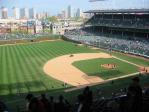
Wrigley Field is the home ballpark of the Chicago Cubs, which
was built in 1914. It was initially known as
Weeghman Park
and was built on the ground that was once a possession of a
seminary. The ballpark was basically built for the Federal
League Baseball club viz. the Chicago Whales. In 1915, it became
the ballpark of the Chicago Cubs when the Federal League
dissolved and Charlie Weeghman took the ownership of the team.
The chewing gum industrialist William K. Wrigley was also a part
of the group of shareholders who bought the club. In 1919, he
attained the complete proprietorship of the ballpark. In 1926,
the cub adopted the moniker of Wrigley Field after Wrigley.
|
Initially
the ballpark was built with only one deck of grandstands in
a V-shape with wooden bleachers in the outfield. The
nickname of the field is The Friendly Confines. It is the
second oldest major league ballpark and the only remaining
Federal League park. One of the finest features of this
ballpark is the ornamental ivy plant that was planted by
Bill Veeck against the outfield in 1937. He also sponsored
the installation of the manual scoreboard. In 1942 William
Wrigley donated the lights that were to be added Wrigley
Field in order to facilitate night games. |
 |
|
IThis highly disappointed the Cubs higher officials and they
threatened to move the franchise at the Busch Stadium. Even
the MLB declared that they won’t hold any playoff at the
Wrigley Stadium. As a result, the lights were eventually
installed in 1988. |
 |
|
The prevailing atmospheric conditions also affect the
play-offs in this major league ballpark. The cool puffs
of air of the spring season that arises from
Lake Michigan turn the potential home runs of the teams and convert
them into outs. In the summer the winds from the south
and the southwest turns the fly balls into home runs.
Since the winds do not blow as hard after the dawn, the
Cubs are scheduled to play as many as 30 of their 81
home games |
|
in 2005 during night. The other notable attraction of
this stadium is that the scoreboard operators raise to the top
of the scoreboard either a white flag with a blue "W" to signify
a Cubs victory, or a blue flag with a white "L" to signify a
loss to let the passengers on the train know the status of the
game. The nearness of the Red Line stop at
Addison is less
than one block from the Wrigley Field. It is one of baseball's
most time-honored parks where the scoreboard is still operated
manually.
Tenant:
Chicago Cubs
Capacity:
14,000 (original), 38,965 (current)
Surface:
Grass
Opened:
April 23, 1914-
Cost:
$250,000
Dimensions:
355-L, 368-LC, 400-C, 368-RC, 353-R
Architect:
Osborn Engineering
|
|