| TANGO |
 |
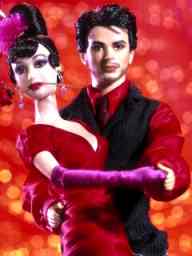 |
| Tango has become so poplular, Even Ken & Barbie have gotten into the act |
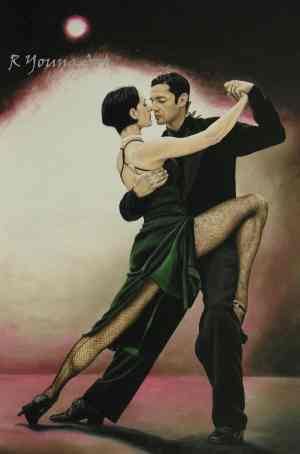
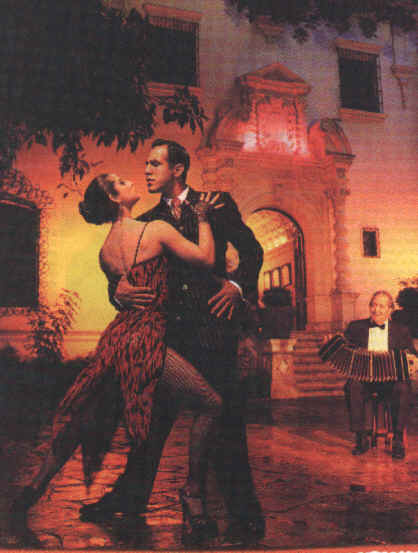
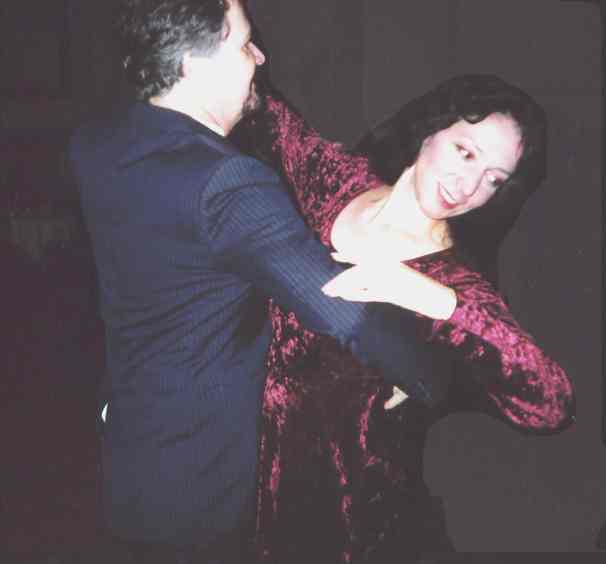
| [TANGO-L] The three TANGOS Contemporary Ballroom Tango comes in three styles; American, International and Argentine. American Tango was created by the major US studio chains Arthur Murray and Fred Astaire and by the independent US studios. American was derived from International to adapt it to social dancing. Many dancers start learning this style and continue with International International Tango style was created by the British, particularly by the Imperial Society of Teachers of Dancing and the International Teachers Association. While most of the world uses International exclusively, both styles are popular in NorthAmerica. International keeps a close body position, American allows separation of the bodies. International is used for competition although it can be used for social dancing as well International and American tango are elegant but somewhat artificial comparing to the more natural Argentinean style The music tempo was changed and many beautiful tangos were created in theUSA and the rest of the world (Japan, Germany, Turkey, Finland, Italy,France, etc.). It seems that International and American are borrowing more and more of the rich Argentinean choreography (this is also seen in rumba and bolero). The three tango styles are beautiful and very interesting when danced properly. |
| Arentine Tango The Tango began as two different dances. The first, with it's home in Spain, was "an exhibition dance performed by a solo dancer who directs the sharp accents of heel rhythms, snapping fingers, and flowing arm movements into a blend of both classical and Gypsy Iberian dance." The contrast to this is the well known ballroom style performed today. This style began in Argentina as "El Baile con Corte meaning 'the dance with a stop'" and later changed to "tango" or the "touch dance." It was performed as a taunting dance of the males upon the females. Though the Argentineans tried so hard to suppress this dance, a number of recognized dancers discovered it and in time toned it into and acceptable ballroom version. The first moderation came prior to World War I by Vernon and Irene Castle. Though they did not radically change the domination or style of it, they toned it down to hold what was known as "Tango tease." This is where it was made standard to the slow, slow, quick, quick, slow pattern that exuberated the motion of the quick stop and dramaticism. The most widely known was the new French version transformed by Valentino. Valentino returned emotion to the Tango"where the steps were more 'exotic'" and expressed the original emotion of the gauchos of Argentina. With this, Valentino returned the extreme closeness of the male to the female and the stubbornness to comply of the female to the Tango, which were what had been disapproved of from the beginning. |
 |
 |
 |
 |
|
|
|
|
|
 |
 |
 |
| Originally the Tango was danced as a courtship dance of the gauchos, sailors, and Italian immigrants, all competing for the 'favours' of the half-Indian women habituees of the waterfront cafes." It was a dominating dance of the working men who had been away for long periods of time; it "was now a sensuous, flamboyant and highly exotic dance, as yet known only in the lowest haunts of Buenos Aires and completely taboo in polite Argentine society." But, like most "unpopular dances" as it gained popularity among the dancers it would slowly "become slightly more respectable" though for the Tango, this popularity was mostly due to the new orchestra sound that was too good to remain in small bars. |
| The original Argentine tango was totally different from these ballroom dances in many ways. It suffered changes in Argentina, Europe and North America to become socially acceptable; and afterwards to conform to the other ballroom dances (this last only in Europe and North America). The beat became more prominent, the freedom of movement as expressed before was removed. It became necessary to step following a certain pattern of slow and quick steps combined in different forms and following musical phrases of eight or sixteen beats. The posture was changed from an 'A' frame to a 'V' frame. The upper bodies apart the lower closer. The faces that originally looked to each other or were check to check now are apart. There are jerky movements of the heads. It became more dramatic.Thereiscommunication with the partner at a physical level. The high concentration is not necessary. The faces remain serious.The student learns certain fixed patterns counting steps (usually 10 for each level).There is more exhibition of the upper bodies and less of the legs. |
 |
 |
 |
 |
 |