|
This is more on the discussion of univerals, introduced here, and an attempt to make my views more parsimonious. I still am not sure if I like the idea. |
|
Could stating facts be no more than making consistent demarcations in the world? In saying that two lines are parallel, we are splitting the world into three. We divide the world into one line, another line, and everything else in existence not included in the parameters of said lines (note: not just the mereological sums, but the groups exactly as they are). Expressing the relationship between the two lines is merely shorthand for what is not in the parameter of these lines and would be redundant if the entire state of the universe were known. This is different from saying that by knowing the entire state of the universe we would know the relationship between the two lines. My suggestion here is that the relationship is nothing independent of the groupings themselves.
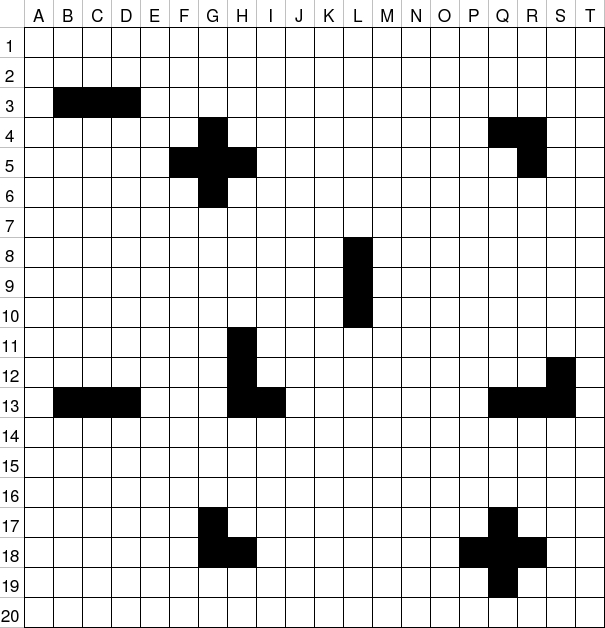
For an example that is easier to picture, we may state the simple fact above that the object B13-D13 is 4 units distance from the “L” object including H13, but no talk of relationships is necessary if we merely make three demarcations: B13-D13, the dark “L” including H13, and everything else composing the grid; in other words, the relationship can be reduced to divisions of the system. It is essential that we recognize that the system is all that exists. An interesting thing happens when we get divisions that can be interchanged; we find universals. For instance, if we divide the world into the objects B3-D3, B13-D13, and the remainder of the system, we see two divisions have been picked out that can both occupy the same position arbitrarily in respect to the remainder of the system. To extend this idea, if I were to make three demarcations in the actual world, two identical copies of the Tractatus and the remainder of the cosmos, the universiality of the Tractatus is reached not by anything taken between these two demarcations alone as wholes (although universals will be found within both copies for the same reason as I’m about the express), but by their arbitrariness with respect to the third group that is the remainder of the universe. Using something as compound as a book was probably confusing because it requires all of the elements of the compounds themselves to be identical. Electrons, let’s use: the universal “electron” exists in the ability to divide the world into every individual electron and the remainder of the world. The remainder of the world is the unique group, whereas all of the electrons in their specific relations with the rest of the world can be moved without altering the world. I might also represent the sentence “the ball is red,” for instance, not by relating the demarcation “ball” with the universal “redness,” but merely by dividing the world in three ways: the ball, all things red (including the ball), and the rest of the world. The most difficult thing to note here is that we are only dividing the world into groups, not making relationships between the groups that are over and above the groups themselves because we would then have something outside of the groups, which, as stipulated, encompass everything in existence. The groups are all that exist. The universal “redness,” again, exists in the arbitrariness with which this “aspect” of the demarcation “ball” (I wish I could avoid saying it in this way) could be swapped with the same part of other members of the group with respect to the remaining group demarcated that is the rest of the world. We can note that grouping the red ball with all blue things and the rest of the world would strike us as flawed because there is nothing common among the two former groups that can be interchanged without altering the latter. This is, of course, merely an experiment in thought, and I’m skeptical on the truth of the matter. Many will naturally object that the relations do exist and cannot be short hands for the remainder of the system as they are not identical with the remainder of the system, thus they themselves exist within the system and are as unique, if not more so, than the groups themselves. I’ll let these thoughts rattle for a while. |