
From Birth to Becoming an Artist
The Later Half of His Most Memorable Works
Main Page
From Birth to Becoming an Artist
The Later Half of His Most Memorable Works
Main Page
In 1492 Lorenzo the Magnificent passed away. That year Florence lost a significant proponent to the arts, they lost his encouragement to artists, poets and scholars. Lorenzo loved the arts so much that he used his power to convert the Garden of San Marco into a school for young aspiring artists. That year Michelangelo created the Battle of the Centaurs, a relief sculpture depicting the Greek characters in a complex war with intense action.
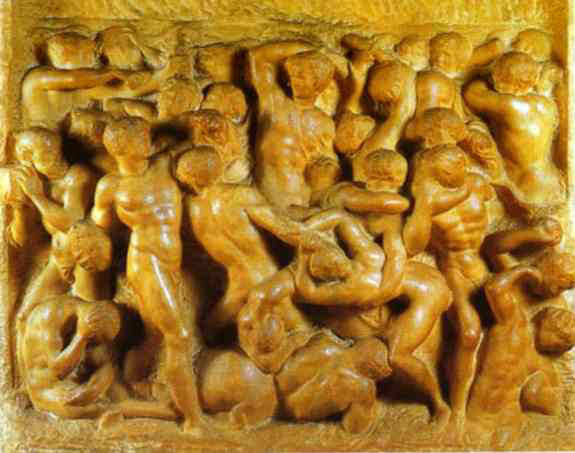 |
| Battle of the Centaurs. 1492 |
By 1494, events in politics lead to the eventual expulsion of the Medici family from Florence. During this time Michelangelo made his way to Rome. Here he created his first larger than life nude figure of the Roman god of wine, Bacchus. During this time he also did his first Pietà, (Pietà is a theme of art that shows Christ in his mother’s lap after his crucifixion). Pietàs have been created for many years, but Michelangelo succeeded where most others had failed. His wasn’t loud, painful and awkward as most had been. His was quiet and restrained but still remaining intense. The Pieta is the only work he was known to have sign, which he did only due to confusion on who created it. He snuck in late one night and carved his name on the work to clear up such confusions.
|
|
|
| Bacchus 1496-98 | Pietà 1498-1500 |
In 1501, after years of political confusion, Florence became a republic once again. On August 4, Michelangelo returned to Florence and for four years he had unconditionally supported the new order of things in Florence. Some of his work from this period expressed his view concerning his political orientation. Eventually the Arte della Lana or Wool Guild (a wealthy corporation, in charge of maintaining and ornamenting the Cathedral) commissioned Michelangelo to create his famous sculpture of David from the story of David and Goliath. The seventeen foot tall nude statue suggests impending movement and thought in motion. Michelangelo had gained an expert knowledge of anatomy, from studying human corpses for 5 years, which showed in this work. David was created to stand on top of the Florence Cathedral, which is probably why his hands and feet appear exaggerated (in order for the statue to appear proportional from the ground).. Instead it was placed in Florence’s center of government and the religious meaning changed to become a symbol of the strength against tyranny of the new government in Florence.
 |
| David 1501-1504 |
Between 1505 and 1512 he designed and created the fresco paintings for the decoration of the Sistine Chapel ceiling. This ceiling has nine scenes taken directly from the Book of Genesis, the most famous being the Creation of Adam, the Creation of Eve, the Temptation and Fall of Adam and Eve, and the Flood. These works are among Michelangelo's most famous creations. In 1989, this work was restored and the world's interest with Michelangelo was renewed with brighter, more brilliant colors.
 |
 |
| The Entire Ceiling of the Sistine Chapel 1505-1512 |
Creation of Eve, (top) Creation of Adam, (bottom) 1505-1512 |
Between 1505 and 1516, he was commissioned to create a tomb for Pope Julius II. He never finished the project, but he did complete an impressive statue depicting Moses. In the planning stage, the tomb would have been a massive three level structure with about 40 figures on it. In the end only three were completed, Moses, a rebellious slave and a dying slave. Part of the reason the tomb wasn’t completed was because of the ceiling of the Sistine chapel.
 |
| Moses 1505 |
The Early Half of his Most Memorable Works
The Later Half of His Most Memorable Works
Main Page

