|

Wolves
Biology and Ecology
|
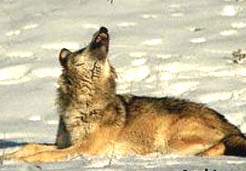
A wolf
is a large predator that depends for its survival upon
large ungulates (hoofed animals), such as deer, elk,
caribou, and in some parts of its range, moose and bison
that tip the scales at more than a thousand pounds.
It has powerful jaws capable of exerting about 1500
pounds per square inch -- or twice that of the domestic
dog. It is accustomed to a feast and famine existence,
often going many days without eating and then gorging
as much as 20 pounds in a single sitting. Wolves are
opportunistic hunters, meaning that they will take down
what they can get, which often happens to be the weak,
sick, old and very young. Wolves will chase and test
their prey looking for weakness. Hunting in this manner
helps to improve the overall health of their prey population
by removing the unhealthy individuals and by allowing
the healthiest animals to create future generations
(wolves will also take down healthy adults). Their method
of hunting also prompts the prey animals to become more
vigilant, agile and aware. The end result is a healthy
natural relationship between predator and prey which
has succeeded for hundreds of thousands of years
|
|
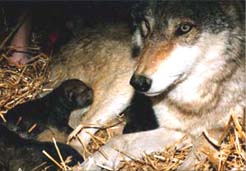
Their
Hunting Strategy
Wolves
are extraordinary predators that play an extremely important
part in a healthy, thriving ecosystem. Wolves are called
apex predators, which means that they are at the top
of the food chain. As predators, they serve to help
keep the ecosystem in balance by hunting primarily on
prey that is weak, sick or elderly, leaving stronger
and healthier animals to survive and produce viable
young. Other competing predators would be cougar, coyote,
bear and humans.
A predator's
life is not an easy one. Almost every time they are
hungry, wolves must find and bring down prey. Each predator
has its own tools and hunting strategies. Wolves use
their incredible sense of smell combined with excellent
hearing abilities to help them find prey. Wolves do
chase and test their prey, looking for the animals they
can kill while expending as little energy as possible
and decreasing chances of injury. Large ungulates like
deer, moose, elk and caribou are a wolf's primary food
source. Wolves will also eat smaller animals like beaver,
rabbit, mice and ground squirrel.
When
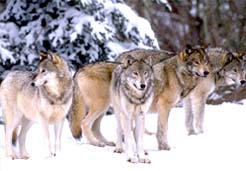
hunting large game, the wolf pack separates out and
surrounds its prey. Wolves usually bite the shoulders
and flanks. While some pack members approach the prey
from the rear, other wolves seize the prey by the nose.
Hunting
can be dangerous for a wolf. The antlers and the hooves
of a large animal like a moose or a caribou can injure
or kill an attacking wolf. As hunters, wolves have a
low success rate. One study shows that for every twelve
moose tracked, only one was caught.
Wolves
are built for a feast or famine diet and can "wolf"
down up to 20 pounds at one feeding. If wolves do not
finish what they have killed, the leftovers will feed
the scavengers - fox, coyote and raven.
Wolves must travel many miles in order to find suitable
prey. Scientists have estimated that one wolf needs
at least ten square miles for a "home" territory.
In the Arctic, wolves often follow their main prey,
caribou, as the caribou migrate, often thousands of
miles.
In nature there is a place for both predator and prey
and, although their relative numbers fluctuate, predator
and prey can maintain the equilibrium necessary for
the survival of both if given the opportunity to do
so naturally.
|
|
Physiology
& Anatomy
Scientific
name: Canis lupus
Kingdom: Animal
Phylum: Chordata
Subphylum: Vertebrata
Class: Mammalia
Order: Carnivora
Family: Canidae
Description:
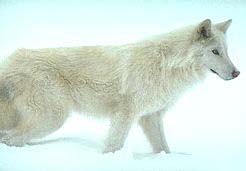
Length 4.5 to 6 feet, including tail; Height 26 to 34
inches at the shoulder; Weight 70 to 110 pounds - females
generally 5 to 10 pounds lighter than males; Coloration
ranges from white to black with combinations between
with gold, tan, brown and rust (a single litter can
contain a variation of colors)
Historic Ranges: Most of the northern hemisphere, throughout
the world to the southern borders of Chihuahua and Durango
in Central America
Present Range: Stable throughout Canada and Alaska.
Smaller populations exist in Minnesota, Wisconsin and
Montana. Reintroduction has been considered successful
in Idaho and Yellowstone National Park. Efforts are
currently underway to restore Mexican gray wolves to
public lands in Arizona and New Mexico. Red wolf reintroduction
efforts in The Great Smoky Mountains was called to a
halt in October of 1998 due to an insufficient prey
base. A number of red wolves have been successfully
reintroduced into the Alligator River National Refuge
in North Carolina and plans to find another site comparable
to the Rockies are underway.
Habitat: Nearly all habitats except tropical rain forests
and arid deserts.
Status: Protected under the Endangered Species Act
in the United States, except Alaska. The wolf is listed
as endangered in the lower 48. Minnesota may be the
first state to 'delist' the wolf.
Diet:
Consists primarily of members of the deer family: moose,
deer, elk and caribou. Wolves also eat beaver, rabbits
and mice.
|
|
Reproduction:
Wolves breed once a year. Their breeding season is usually
January through February. The mother gives birth 63
days later, roughly in April or May, to a litter of
4 to 8 pups, each weighing about 1 pound. The pups are
born in a den, where they will stay for the first 6
to 8 weeks of their life. When the pups are first born
they cannot see, hear or maintain warmth and they need
constant care from their mother. By to 8 weeks of age,
the pups will venture out of the den and begin their
life of learning how to be a predator.
Life
span: Roughly 6 - 10 years in the wild. They can live
up to 18 years in captivity.
Wolves
are superbly constructed and adapted for their particular
role in an ecosystem - predators that pursue a large
and small prey over different kinds of terrain: open
plains, dense forest, deep snow, steep slopes and into
the water if need be.
Wolves
have developed lean, muscular bodies set on long, powerful
legs to be able to pursue prey. Wolves are built for
endurance and running; they can average around 25 miles
per hour for several miles and 35 to 40 miles per hour
for short bursts.
The
wolf's expert hunting ability comes from a combination
of speed, stamina and strategy. Because wolves have
narrow chests and outward-splayed forelegs, their hind
legs can move in the same track as their front legs
- an advantage in covering ground efficiently. Wolves'
large, well-padded feet help to spread their weight
over snow and allows them to efficiently grip irregular
surfaces like rocks and logs.
|
|
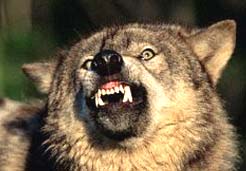
The
sagittal crest (the bone on the top of the skull) on
a wolf is where the jaw muscles are attached. This is
well defined on the wolf because of their very powerful
jaw. Wolves' jaws produce immense power - a crushing
pressure of about 1,500 pounds per square inch (psi),
compared with 750 pounds for average large dogs such
as German shepherds. Wolves have 42 teeth specialized
for stabbing, shearing and crushing bones. The first
four teeth, front and bottom are called incisors and
are used for nipping and gnawing meat from the bone.
Wolves use their canine teeth, which can grow to be
2 inches in length, for gripping and holding itself
to the prey animal. The premolars are used for slicing
and grinding. The specialized molars, called carnassials
are used for slicing and tearing. The last molars are
used for pulverizing and grinding food.
Even
more extraordinary is a wolf's sense of smell - up to
100,000 times greater than human beings'. Under the
right conditions a wolf can smell something up to 300
yards to 1 mile away. Their hearing is excellent also.
Under certain conditions, wolves can hear a howl as
far as six miles away in the forest and ten miles away
on the open tundra.
|
back to top
|